
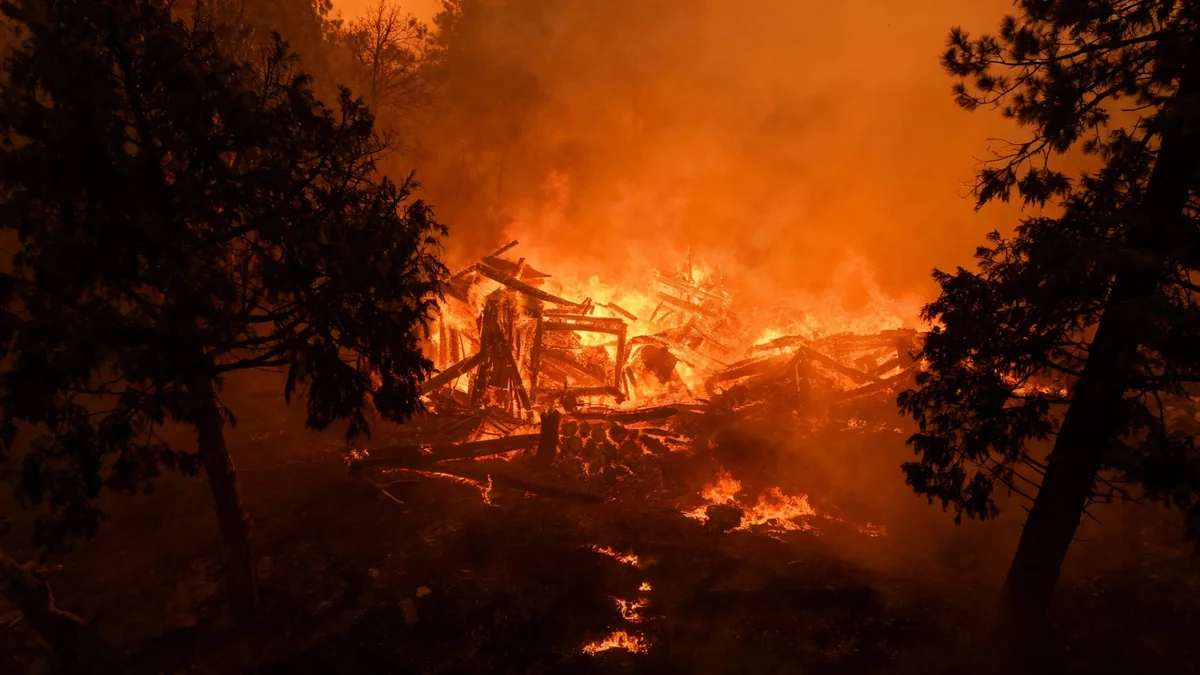



A landmark international study has concluded that human-driven climate change is dramatically increasing the intensity and scale of wildfires across the globe. The analysis found that in some of the hardest-hit regions, the conditions leading to severe fire seasons are now 25 to 35 times more likely than they would be in a world without human-induced global warming.
The State of Wildfires 2024–25 report combines satellite observations with advanced climate models to provide one of the clearest links yet between rising global temperatures and the devastating fires seen from Canada to the Amazon. The findings highlight a dangerous feedback loop where massive fires release record amounts of carbon, further accelerating climate change.
Key Takeaways
- Human-driven climate change has made extreme wildfire seasons up to 35 times more likely in certain regions.
- From March 2024 to February 2025, wildfires burned 3.7 million square kilometers, an area larger than India.
- Record carbon emissions were recorded in Bolivia and Brazil's Pantanal region, while Canada surpassed one billion tons for the second consecutive year.
- The report confirms a direct link between warmer, drier conditions and increased fire intensity, with satellite data playing a crucial role in the analysis.
A Planet on Fire The Scale of Recent Blazes
The past year has been one of the most extreme for wildfires on record. Researchers calculated that between March 2024 and February 2025, fires scorched approximately 1.4 million square miles (3.7 million square kilometers) of land worldwide. This vast area is larger than the entire country of India, illustrating the immense scale of the crisis.
Several regions experienced unprecedented fire activity, leading to staggering carbon emissions that contribute to the greenhouse effect. These emissions not only impact the atmosphere but also represent a significant loss of stored carbon from forests and wetlands.
Record-Breaking Emissions
- Bolivia: Saw its highest carbon dioxide emissions of the 21st century, totaling 771 million tons.
- Canada: For the second year in a row, emissions from its wildfires exceeded one billion tons of CO2.
- Brazil's Pantanal: The world's largest wetland experienced fires that produced six times the area's average carbon dioxide emissions.
These figures are not just statistics; they represent a significant acceleration of a cycle. As more carbon is released, global temperatures rise, creating even more favorable conditions for future fires. This positive feedback loop is a major concern for scientists studying climate stability.
The Unmistakable Link to Climate Change
For years, attributing a single fire event directly to climate change has been challenging due to the complex mix of factors involved, including weather, vegetation, and human land use. However, the new report utilized sophisticated methods to overcome this hurdle.
"Wildfires are shaped by a tangled mix of weather, vegetation, land use and chance," explained Douglas Kelley, a land surface modeler at the U.K. Center for Ecology & Hydrology and a co-lead of the report. "Yet across all those possibilities, the conclusion barely wavered: human-driven climate change increased the likelihood of these extreme fires and amplified how much land burned."
The research team ran thousands of simulations of past fire seasons, comparing scenarios with and without the effects of human-caused warming. The results consistently showed that the warmer, drier conditions created by climate change were a primary driver of the fires' intensity.
Kelley added that the scientific evidence is now overwhelming. "The science has now advanced to the point where the climate signal is unmistakable. But worryingly, climate change itself has advanced so far that this signal is visible in every extreme fire event we assessed," he said.
The Human and Economic Cost
The impact of these intensified wildfires extends far beyond charred landscapes and carbon emissions. The human and economic tolls in the past year have been devastating, affecting communities on nearly every continent.
Globally, more than 200 people lost their lives due to wildfires. This includes 100 fatalities in Nepal, 34 in South Africa, and 30 in Los Angeles. In Southern California, the blazes forced the evacuation of 150,000 people and resulted in an estimated $140 billion in damages.
Economic Devastation
The economic consequences are felt across various sectors. Fires in Canada's Jasper National Park alone caused over $1 billion in damages. In Brazil, the agribusiness sector in the Pantanal region suffered losses exceeding $200 million due to the destruction of grazing lands and infrastructure.
Air quality has also become a major public health crisis. Smoke from the fires in Brazil caused fine particulate pollution to spike to levels 60 times higher than the World Health Organization’s safety limits. Hundreds of millions of people were exposed to toxic smoke, leading to respiratory issues and other health complications.
The View from Orbit Satellites Track the Flames
Much of the critical data for this comprehensive analysis was gathered from space. Earth-observation satellites have become essential tools for monitoring the planet's health, and they play a vital role in understanding and responding to wildfires.
Satellites like NASA's Terra and Aqua are equipped with instruments that can:
- Detect active fires, even in remote areas.
- Map the extent of burn scars after a fire has passed.
- Monitor the movement and density of smoke plumes.
- Measure the dryness of vegetation, helping to predict fire risk.
This space-based information was used to validate the fire-weather models in the State of Wildfires report, confirming how climate change has altered conditions on the ground. According to the research team, future reports will incorporate data from even more advanced satellites.
Upcoming hyperspectral sensors and next-generation observation platforms will provide near-real-time data on fuel loads and vegetation dryness, potentially allowing for the detection of ignitions in their earliest stages. This technological advancement offers hope for better prediction and management, though the report's authors stress that the ultimate solution lies in addressing the root cause: climate change.