


A Washington-based startup, Portal Space Systems, is developing a new class of spacecraft designed for rapid orbital maneuvers, reviving a propulsion concept first explored by NASA decades ago. The company, led by a veteran of SpaceX and Stratolaunch, aims to provide the U.S. military with the ability to move satellites between orbits in hours instead of months, addressing a critical gap in national security capabilities.
Portal has secured significant financial backing, including over $20 million in venture capital and a $45 million public-private funding commitment from SpaceWERX, the innovation arm of the U.S. Space Force. The company is preparing for its first orbital technology demonstration scheduled for next year.
Key Takeaways
- Portal Space Systems is commercializing solar thermal propulsion, a technology studied by NASA and the U.S. Air Force in the past.
- The technology uses concentrated sunlight to heat a propellant, offering a combination of speed and efficiency not met by current systems.
- The company's CEO, Jeff Thornburg, has an extensive background in rocket propulsion, including leading engine development at SpaceX and Stratolaunch.
- Portal has raised over $65 million in combined venture capital and government commitments to fund its spacecraft development.
- An in-orbit demonstration of the core technology is planned for 2026, with the first operational spacecraft expected in 2027.
Harnessing the Sun for Propulsion
At its core, Portal's innovation is the modern application of solar thermal propulsion. The concept is straightforward: large, reflective mirrors concentrate sunlight onto a heat exchanger. A propellant, in this case ammonia, is passed through the superheated exchanger, causing it to expand rapidly and exit a nozzle, generating thrust.
This method occupies a unique middle ground between conventional propulsion systems. It is significantly more fuel-efficient than traditional chemical rockets but provides much higher thrust and faster transit times than solar-electric ion drives, which can take weeks or months to move a satellite to a new orbit.
According to CEO Jeff Thornburg, the technology was never abandoned for technical reasons. Instead, the economic and strategic incentives did not exist to pursue it further decades ago. "Lower launch costs, coupled with additive manufacturing, are the major unlocks to bring the tech to life, and make it affordable and in line with commercial development," Thornburg stated.
A Critical Need for Orbital Agility
The primary driver for Portal's technology is a recognized national security need. The ability to quickly reposition satellites is becoming crucial as space becomes an increasingly contested domain. Current electric propulsion systems lack the necessary speed for tactical maneuvers.
"There was no imperative for rapid movement on orbit in the 1990s," Thornburg explained. "Only recently have the threats from our adversaries highlighted the weaknesses in current electric propulsion systems, in that they have so little thrust and can’t enable rapid mobility."
The Propulsion Gap
Spacecraft propulsion has long involved a trade-off. Chemical rockets offer high thrust for quick burns but are inefficient for long-duration travel. Electric propulsion (ion drives) is extremely efficient, sipping propellant over months, but produces very low thrust, making orbital changes a slow process. Solar thermal propulsion aims to bridge this gap, offering rapid orbital transfers that are still more efficient than chemical options.
This capability gap has attracted strong interest from the U.S. Department of Defense. Portal emerged from stealth mode in April 2024, announcing it had already received more than $3 million in funding from the DoD and the Space Force. This was followed by the substantial $45 million commitment from SpaceWERX.
An Experienced Hand at the Helm
Jeff Thornburg's career path has uniquely prepared him to lead this venture. After earning an aerospace engineering degree and serving in the U.S. Air Force as an aircraft maintenance officer, he specialized in rocket propulsion. His work at the Air Force Research Lab contributed to advanced engine cycles.
In the private sector, his impact has been significant:
- SpaceX: Hired by Elon Musk in 2011, Thornburg was instrumental in the development of the methane-fueled Raptor engine, which now powers the Starship vehicle.
- Stratolaunch: Recruited by Microsoft co-founder Paul Allen, he led the creation of a liquid rocket engine named the "PGA" in Allen's honor. The project was discontinued after Allen's passing in 2018.
- Amazon: He also had a stint at Amazon, where he ran engineering and manufacturing for the Project Kuiper satellite internet initiative.
The idea for Portal originated in 2016 when Thornburg was researching nuclear thermal propulsion for a presentation. He considered whether concentrated solar energy could achieve a similar effect without the complexity of a space-rated nuclear reactor. He developed the concept in his spare time before dedicating himself fully as the company gained traction with investors and the Defense Department.
Roadmap to Orbit
Portal is developing a line of spacecraft at its facilities in Bothell, Washington, which include an 8,000-square-foot lab and a 50,000-square-foot manufacturing space.
Portal's Fleet
- Supernova: The company's flagship vehicle. Described as the size of a restaurant refrigerator, it will deploy reflective sheets spanning 55 feet to focus sunlight. It's designed to move payloads from low Earth orbit to geostationary orbit in under 24 hours.
- Starburst: A smaller, earlier-to-market spacecraft that uses an electrothermal heating system. While less powerful than Supernova, it will offer customers a rapid maneuverability option starting in 2027.
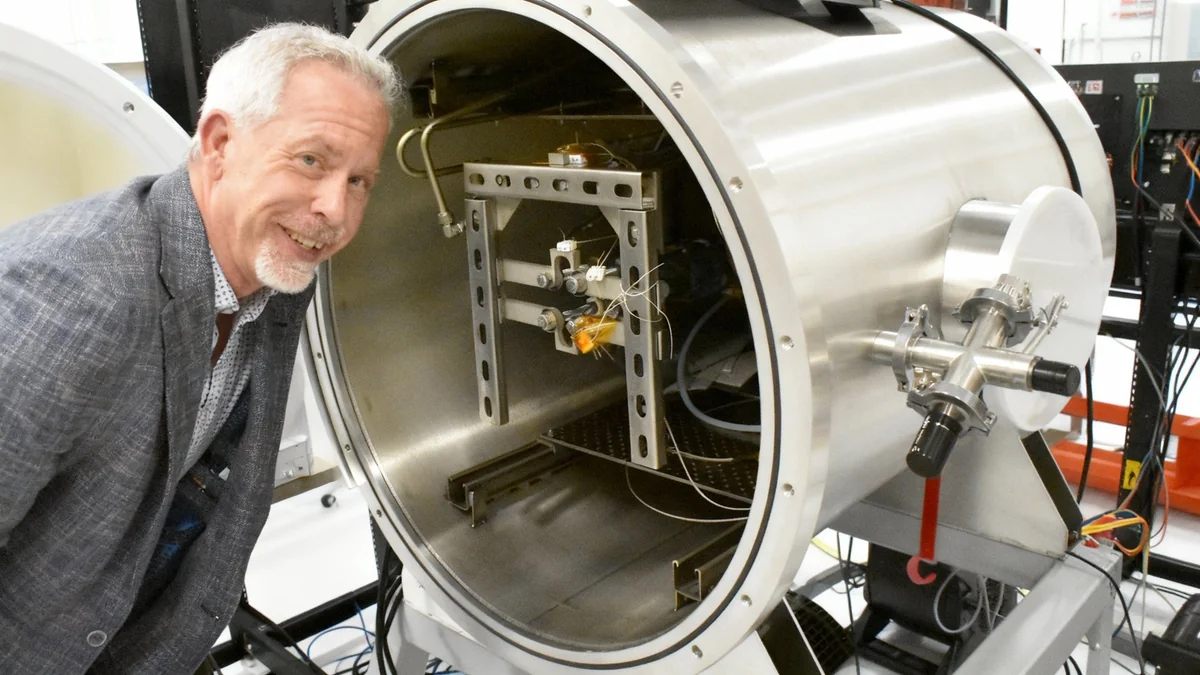
- Flare: The name for the 3D-printed heat exchanger thruster at the heart of the system, which was successfully tested earlier this year.
The company's immediate focus is on an orbital demonstration in 2026. A small, tissue box-sized package called Mini-Nova will be launched on a SpaceX rideshare mission to validate the core system design in space.
If the tests are successful, the Starburst vehicle is scheduled to begin customer missions in 2027, the same year the full-scale Supernova is planned for its debut. Co-founder and COO Ian Vorbach emphasized that the company's business model is tightly focused on meeting the military's demand for tactical responsiveness.
"What happens a lot in the space industry is that you have incredibly technical, talented people who have a technology that provides some very unique performance, and then they build it, and it turns out that performance isn’t needed," Vorbach said. "There’s got to be a reason to bring that innovation to market."
For Thornburg and his team, that reason is clear. Looking ahead, he sees this technology as a stepping stone. While he is intrigued by theoretical concepts like quantum propulsion, he believes the next practical leap is nuclear thermal propulsion. "Our Supernova spacecraft will have a version that will leverage a nuclear reactor at some point," he noted, viewing it as the key to making the inner solar system humanity's backyard.