
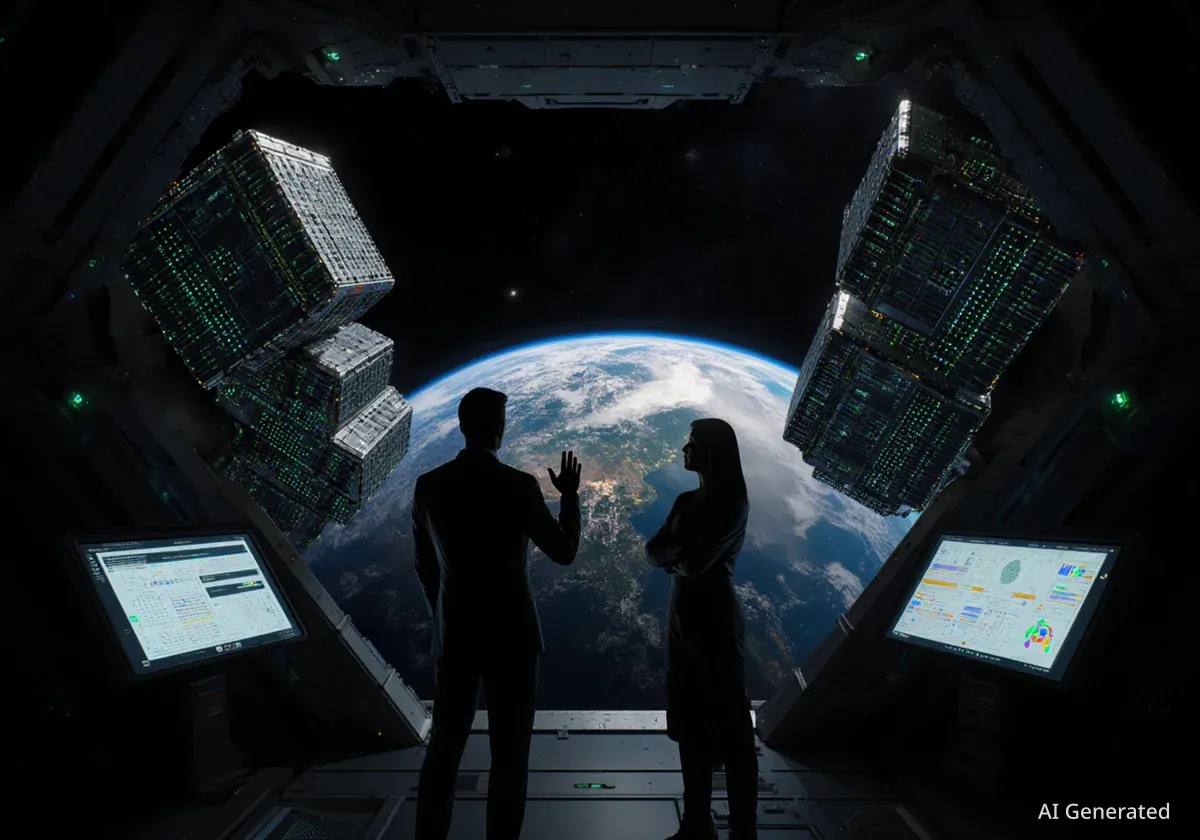


A debate is intensifying within the tech industry over the future of artificial intelligence infrastructure, with prominent leaders offering sharply contrasting views on the feasibility of placing data centers in orbit. OpenAI CEO Sam Altman has labeled the concept "ridiculous" for the near future, while SpaceX CEO Elon Musk sees it as an inevitable solution to AI's growing energy demands on Earth.
The discussion highlights a fundamental disagreement on the timeline and economics of scaling AI computation beyond the planet. While some, like Musk, are actively pursuing orbital deployments, others cite immense logistical and financial hurdles that they believe make such projects impractical for at least the next decade.
Key Takeaways
- OpenAI's Sam Altman believes space data centers are not viable this decade due to high launch costs and maintenance difficulties.
- SpaceX's Elon Musk argues that moving AI compute to space is the only long-term solution to its environmental strain and will be cost-effective within 2-3 years.
- SpaceX has filed with the FCC to launch up to 1 million satellites to function as orbital data centers.
- Other major tech companies, including Google and Amazon Web Services, are also exploring or weighing in on the concept, with varying levels of optimism.
A Fundamental Disagreement
The core of the debate centers on practicality versus ambition. Sam Altman, head of the company behind ChatGPT, has expressed strong skepticism about the immediate viability of orbital data centers. He pointed to the immense challenges that would need to be overcome before such a concept could be implemented at scale.
"I honestly think the idea with the current landscape of putting data centers in space is ridiculous," Altman stated in a recent interview. "It will make sense someday."
Altman's primary concerns are twofold: the prohibitive cost of launching heavy equipment into orbit and the near-impossibility of maintenance. He questioned how a company would manage to repair or replace a damaged component on a data center orbiting thousands of miles above Earth. "Orbital data centers are not something that's going to matter at scale this decade," he concluded.
Musk's Vision for an Orbital Future
In direct opposition to Altman's cautious stance, Elon Musk has positioned space-based data centers as a critical necessity. He argues that the exponential growth of AI will place an unsustainable strain on Earth's energy grids and environment.
"In the long term, space-based AI is obviously the only way to scale," Musk said at an event earlier this month. He offered an aggressive timeline, estimating that orbital computing could become the most economical option very soon. "My estimate is that within 2 to 3 years, the lowest cost way to generate AI compute will be in space."
Why Move Data Centers to Space?
The primary driver for this concept is energy. AI models require vast amounts of electricity for training and operation, which generates significant heat. In space, solar panels can provide a constant source of power, and the vacuum offers an efficient, natural cooling system, reducing the need for the massive water and energy resources consumed by terrestrial data centers.
An Ambitious Plan Takes Shape
Musk's vision is backed by concrete action. His company, SpaceX, recently filed a document with the Federal Communications Commission (FCC) requesting authorization to launch as many as 1 million satellites designed to function as a vast, interconnected data center in Earth's orbit.
The plan is part of a larger strategy following SpaceX's acquisition of xAI, Musk's artificial intelligence company. The combined entity aims to achieve a valuation of over $1 trillion to fund its ambitious infrastructure goals.
SpaceX's AI Compute Goals
- Launch Mass: 1 million tons of satellites into orbit annually.
- Compute Power: 100 kilowatts of compute power per ton.
- Annual Capacity Increase: 100 gigawatts of new AI computing capacity per year.
Industry Giants Weigh In
The debate is not limited to just Altman and Musk. Other leaders in cloud computing and technology have also shared their perspectives, largely aligning with Altman's more skeptical view on the current logistics.
Matt Garman, CEO of Amazon Web Services (AWS), highlighted the sheer scale of the challenge. "There are not enough rockets to launch a million satellites yet, so we're, like, pretty far from that," he said at a recent summit. Garman emphasized the current financial barriers, stating, "If you think about the cost of getting a payload in space today, it's massive. It is just not economical."
However, not all are dismissing the idea. Google CEO Sundar Pichai has indicated his company is actively exploring the concept. As part of an initiative known as Project Suncatcher, Google is looking into deploying solar-powered data centers in space, with Pichai suggesting a launch could happen as soon as next year.
The Path Forward
The discussion over space-based data centers reveals a critical turning point for the AI industry. As artificial intelligence becomes more powerful and integrated into society, the demand for computational resources will continue to soar.
While the immediate future may be constrained by launch costs and engineering challenges, the long-term potential remains a powerful motivator. Whether Musk's aggressive 2-3 year timeline is achievable or Altman's decade-long forecast proves more accurate, the race to build the next generation of AI infrastructure has officially left the planet.