
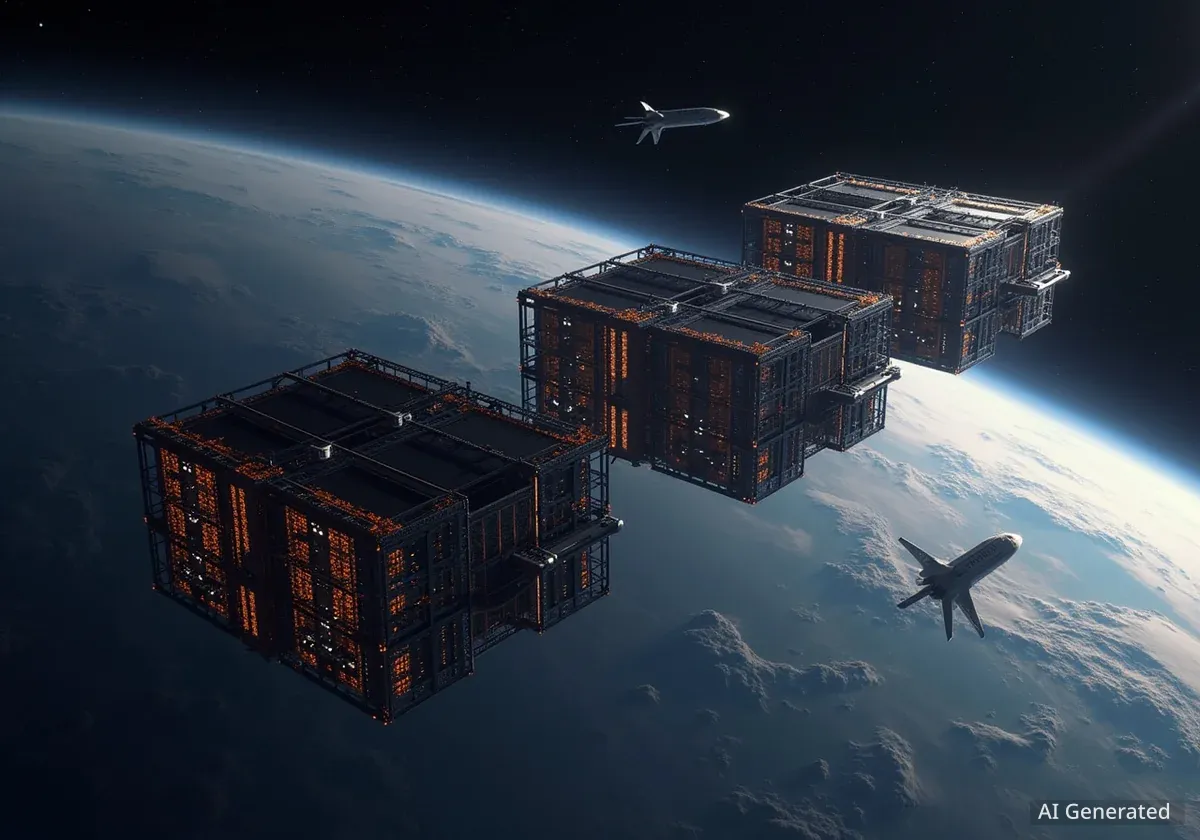


SpaceX is developing a plan to build data centers in orbit, a move designed to meet the massive energy and computing demands of artificial intelligence. The initiative, spearheaded by Elon Musk, aims to leverage the company's Starship rocket to create a satellite constellation dedicated to AI processing, funded in part by a future public offering.
This strategy reflects a growing belief among some tech leaders that terrestrial data centers face significant political and efficiency challenges. By moving infrastructure to space, companies could access constant solar power and operate outside of earthly constraints, potentially gaining a critical advantage in the race for AI dominance.
Key Takeaways
- SpaceX intends to use its Starship launch system to deploy a constellation of satellites that will function as orbiting data centers.
- The project aims to solve the energy problem for AI by placing satellites in a high orbit for continuous solar power collection.
- Major tech figures, including OpenAI's Sam Altman, reportedly agree with the underlying physics but are pursuing their own paths.
- Significant technical hurdles remain, particularly the challenge of cooling high-performance computer chips in the vacuum of space.
The Final Frontier for Artificial Intelligence
The insatiable demand for computing power from the artificial intelligence industry is pushing tech visionaries to look beyond Earth. Sources familiar with the company's strategy confirm that SpaceX is laying the groundwork for a network of space-based data centers. The concept involves using the powerful Starship rocket to establish a large satellite constellation, similar in structure to its Starlink internet service.
The primary driver behind this shift is energy. On Earth, data centers consume enormous amounts of electricity for processing and cooling, raising environmental and logistical concerns. The space-based model proposes a solution by placing these server satellites in a high orbit where they are perpetually exposed to sunlight.
This configuration would allow for 24/7 solar power generation, eliminating reliance on terrestrial power grids, avoiding weather-related disruptions like clouds, and erasing electricity bills from the operational cost equation.
Why Move Data Centers to Space?
Industry leaders are anticipating a future where building massive, energy-intensive data centers on the ground becomes increasingly difficult. Potential obstacles include political opposition, land use disputes, and strain on local power and water resources. Space offers a seemingly limitless frontier for expansion without these terrestrial limitations.
A New Space Race for Computing Power
Elon Musk is not alone in seeing the potential of off-planet computing. According to individuals briefed on industry discussions, OpenAI CEO Sam Altman also recognizes the long-term viability of the concept. While a legal dispute makes a collaboration between Musk and Altman unlikely, Altman is reportedly prepared to invest billions to secure his own foothold in space-based AI infrastructure.
This emerging competition highlights the strategic importance of computational power. The company that can provide the most efficient and scalable processing will hold a significant advantage in developing next-generation AI models.
Google's Strategic Position
Google is uniquely positioned in this developing arena. The company holds an approximate 7% stake in SpaceX, an investment valued at around $100 billion based on a rumored $1.5 trillion valuation for the space company. This means Google stands to benefit significantly from SpaceX's success, even as it develops a rival initiative known as Project Suncatcher.
The involvement of major players like Google and the interest from leaders at OpenAI signal a fundamental shift in how the tech industry views the future of its core infrastructure. The focus is moving from simply building bigger data centers on Earth to rethinking where they should be located altogether.
Overcoming Monumental Engineering Hurdles
Despite the ambitious vision, the path to creating functional data centers in orbit is filled with immense technical challenges. The most significant obstacle is heat dissipation. On Earth, data centers use air and liquid cooling systems to prevent processors from overheating. In the vacuum of space, there is no air to transfer heat away from the chips.
"Cooling computers in space is brutally hard. On Earth, air carries heat away from processors. In the vacuum of space, there's no air — so chips overheat and die."
Engineers will need to develop novel radiation-based cooling systems that can effectively manage the thermal output of thousands of high-performance processors operating continuously. Without a solution, the entire concept is unworkable.
The Problem of Maintenance and Upgrades
Another major point of friction is hardware maintenance. Upgrading a terrestrial data center is a routine process involving swapping out servers and components. Performing a similar task in orbit is exponentially more complex and expensive.
- Accessibility: Reaching satellites in high orbit requires costly and complex missions.
- Robotics: Any repairs or upgrades would likely need to be performed by sophisticated robotic systems.
- Hardware Longevity: Components must be designed for extreme durability and longevity, as replacements are not a simple option.
Skeptics point to these practical difficulties as major roadblocks. The inability to easily upgrade hardware could mean that space-based data centers quickly become obsolete as technology on Earth advances.
The Strategic Endgame for SpaceX
If SpaceX can overcome these challenges, the rewards would be transformative. The company would not only solidify its dominance in space transportation but also become a foundational pillar of the future digital economy. By controlling both the access to space and a significant portion of its AI computing infrastructure, SpaceX would gain an unparalleled strategic edge.
The plan to use an upcoming public offering to help finance this vision indicates the scale of the investment required. It's a high-risk, high-reward gamble that could redefine the boundaries of both the space and technology industries.
Ultimately, this initiative is about more than just building servers in space. It is a long-term play for control over the two most critical resources of the coming century: energy and computing power. The success or failure of this audacious plan could determine the leaders of the next technological revolution.