
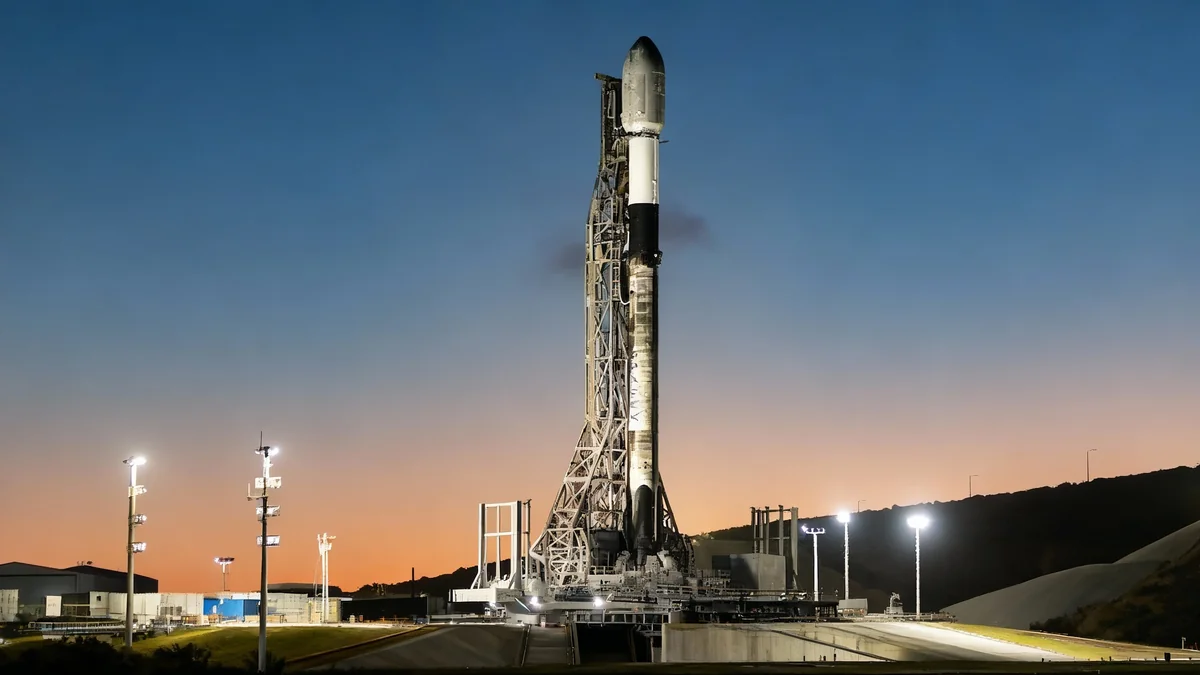


SpaceX successfully launched a Falcon 9 rocket from Vandenberg Space Force Base in California on Sunday morning, deploying another 28 satellites for its Starlink internet constellation. The mission, designated Starlink 11-15, lifted off at 9:58 a.m. PST, continuing the company's rapid expansion of its global broadband network.
Key Takeaways
- SpaceX launched 28 Starlink satellites from Vandenberg Space Force Base on December 7, 2025.
- The mission utilized a Falcon 9 first-stage booster, B1088, completing its 12th successful flight.
- The booster landed autonomously on the drone ship 'Of Course I Still Love You' in the Pacific Ocean.
- This mission marked the 115th Starlink launch of 2025, highlighting the company's accelerated deployment schedule.
Mission Details and Trajectory
The Falcon 9 rocket ascended from Space Launch Complex 4 East under clear morning skies. Following liftoff, the rocket initiated a south-easterly trajectory over the Pacific Ocean, a standard flight path for polar orbit missions launched from the West Coast.
The primary objective of the mission was to deliver the batch of 28 Starlink satellites into low Earth orbit. These satellites will join the thousands already providing high-speed, low-latency internet service to users across the globe.
A Busy Launch Cadence
The Starlink 11-15 mission is part of an exceptionally busy launch schedule for SpaceX. The company is on track to significantly surpass its previous records for annual launches, with another Falcon 9 mission scheduled for later the same day from Kennedy Space Center in Florida. That subsequent launch is expected to carry the 3,000th Starlink satellite deployed in 2025 alone.
Veteran Booster Completes 12th Flight
A key element of this mission was the reuse of the Falcon 9 first-stage booster, tail number B1088. This flight marked the 12th successful launch and landing for this particular vehicle, underscoring the reliability and cost-effectiveness of SpaceX's reusable rocket technology.
Prior to this Starlink mission, B1088 had a distinguished flight history, supporting a variety of government and commercial payloads. Its previous missions include:
- NASA’s SPHEREx mission
- Two missions for the National Reconnaissance Office (NROL-57 and NROL-126)
- The Transporter-12 rideshare mission
Precision Landing at Sea
Approximately 8.5 minutes after liftoff, the first-stage booster completed its entry burn and descended toward the autonomous drone ship, Of Course I Still Love You, stationed in the Pacific Ocean. The booster executed a precise landing, securing its recovery for future missions.
Landing Milestones
This successful recovery represents the 168th time a booster has landed on the 'Of Course I Still Love You' drone ship and marks the 545th overall booster landing for SpaceX to date. These figures highlight the maturity of the company's recovery and refurbishment operations.
Expanding a Global Network
The 28 satellites from this launch will soon raise their orbits and undergo system checkouts before joining the operational Starlink constellation. SpaceX continues to add to its mega-constellation at a rapid pace, aiming to provide comprehensive global internet coverage, including for remote and underserved areas.
The consistent launch rate, enabled by reusable boosters like B1088, is fundamental to this strategy. By launching batches of satellites multiple times per month from both its Florida and California launch sites, SpaceX can quickly build out network capacity and replace older satellites.
The ability to refly boosters not only reduces the cost of access to space but also allows for a launch frequency that would be impossible with traditional expendable rockets. Each successful landing is a testament to the operational efficiency the company has achieved.
With thousands of satellites already in orbit, the Starlink network has grown to become the largest satellite constellation in history. The company's ambitions extend beyond Earth, with plans for the massive Starship vehicle to eventually deploy next-generation Starlink satellites and support missions to the Moon and Mars.