
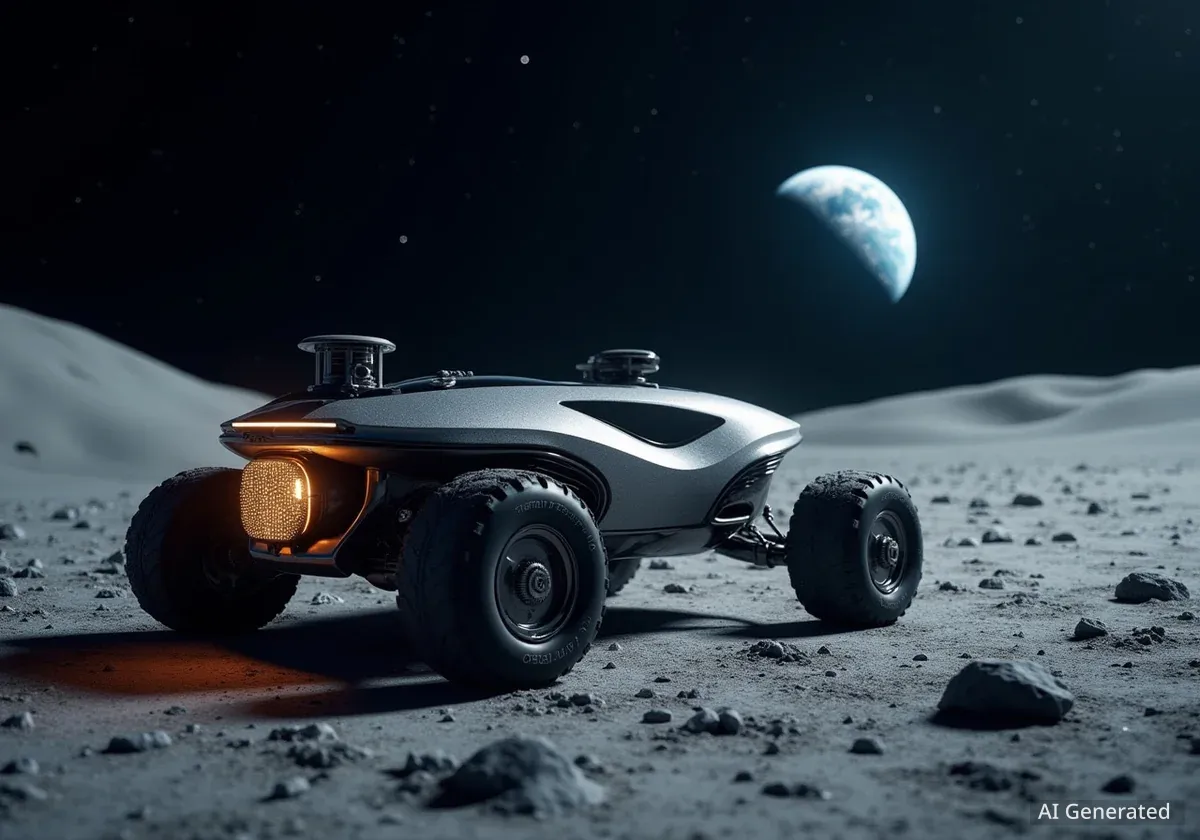



A Washington-based company, Zeno Power, has entered a strategic agreement with French nuclear fuel operator Orano to supply a novel power source for space exploration. The partnership will provide americium-241, an isotope derived from recycled nuclear fuel, to power long-duration batteries for NASA's upcoming lunar missions.
These advanced power systems are designed to help lunar rovers, landers, and other critical infrastructure survive the extreme conditions of the lunar night, a key challenge for the Artemis program and future exploration efforts.
Key Takeaways
- Zeno Power will use americium-241, a byproduct of recycled nuclear fuel, to create space batteries.
- A multi-million-dollar agreement with French company Orano secures a large-scale supply of the isotope.
- These new batteries, known as radioisotope power systems (RPS), will support NASA's Artemis program on the Moon.
- Americium-241 offers a sustainable alternative to plutonium-238, the traditional but scarce fuel for deep space missions.
A New Power Source for Lunar Exploration
Zeno Power is developing a new generation of radioisotope power systems (RPS) fueled by americium-241. To ensure a steady supply of this material, the company has signed a major agreement with Orano, a global leader in the nuclear fuel cycle. Under the terms of the deal, Zeno Power will make a multi-million-dollar investment to gain priority access to significant quantities of americium-241 each year.
Orano will extract the americium-241 from used nuclear fuel at its La Hague recycling facility located in Normandy, France. This process repurposes a material that was previously considered waste, creating a valuable resource for advanced applications in space.
The technology is critical for NASA's long-term goals. The power systems will enable robotic and stationary equipment to function during the two-week-long lunar night, when temperatures plummet and solar power is unavailable. They will also allow operations in permanently shadowed craters, areas of high scientific interest that may contain water ice.
What are Radioisotope Power Systems?
Radioisotope power systems are a type of nuclear battery that generates electricity from the heat released by the natural decay of radioactive materials. Unlike solar panels, they are not dependent on sunlight and can provide a continuous and reliable power supply for decades, making them ideal for deep space missions and harsh environments like the lunar surface.
Addressing a Critical Space Power Challenge
For decades, space missions venturing far from the sun have relied on RPSs fueled by plutonium-238 (Pu-238). This isotope has powered iconic missions like the Voyager probes, the Cassini mission to Saturn, and the Curiosity and Perseverance rovers on Mars. However, the global supply of Pu-238 is extremely limited, and production is slow and costly.
The increasing demand for long-duration power sources for both government and commercial space ventures has created an urgent need for alternatives. Americium-241 has emerged as a viable and sustainable supplement to plutonium-238, expanding the options available for mission planners.
"Working with Orano is a pivotal step in advancing Zeno’s multi-fuel approach," said Tyler Bernstein, Co-Founder and CEO of Zeno Power. "By pairing americium-241 for space missions with strontium-90 for maritime and terrestrial deployments, Zeno’s nuclear batteries will unlock operations in the frontier, from deep sea to deep space."
This multi-fuel strategy allows Zeno to tailor its power systems to specific environments. While americium-241 is suited for space, the company is also developing batteries using strontium-90 for use in remote terrestrial and marine applications.
The Advantages of Americium-241
Americium-241 presents several key benefits as a fuel for space nuclear batteries. Its most significant advantage is its long half-life, which is the time it takes for half of the radioactive material to decay.
Key Properties of Americium-241
- Long Half-Life: Over 430 years, compared to about 88 years for plutonium-238.
- Sustainable Source: It is naturally produced through the radioactive decay of other elements within used nuclear fuel.
- Proven Extraction: The technology to separate and purify americium from other materials is well-established.
The extended half-life means that a power system fueled by americium-241 can reliably produce electricity for many decades, far exceeding the operational lifespan of most space missions. This longevity is particularly useful for permanent infrastructure, such as a future lunar base or long-term scientific outposts.
Furthermore, its origin as a byproduct of nuclear fuel recycling makes it a more accessible resource. Orano's established industrial processes at the La Hague site can be leveraged to create a consistent and scalable supply chain for this critical material.
Implications for the Future of Space
The collaboration between Zeno Power and Orano represents a significant development in the infrastructure needed to support a sustained human and robotic presence beyond Earth. By diversifying the fuel supply for radioisotope power systems, the partnership helps mitigate a key bottleneck in long-duration space exploration.
According to Corinne Spilios, a senior executive at Orano’s Recycling Business Unit, the agreement highlights the benefits of a circular economy in the nuclear industry.
"Our work with Zeno demonstrates one of the significant values of recycling used nuclear fuel," Spilios stated. "By recovering americium-241, we can gain value from material once designated as waste by retrieving and using one of the isotopes for an advanced application such as space power systems. This agreement once again demonstrates the value of recycling recoverable nuclear materials, which allows for energy production while conserving natural resources."
As NASA and its international partners push forward with the Artemis program, the availability of reliable, long-lasting power will be fundamental to success. This new supply of americium-241 is poised to become an essential component in powering the next era of exploration on the Moon, Mars, and beyond.