
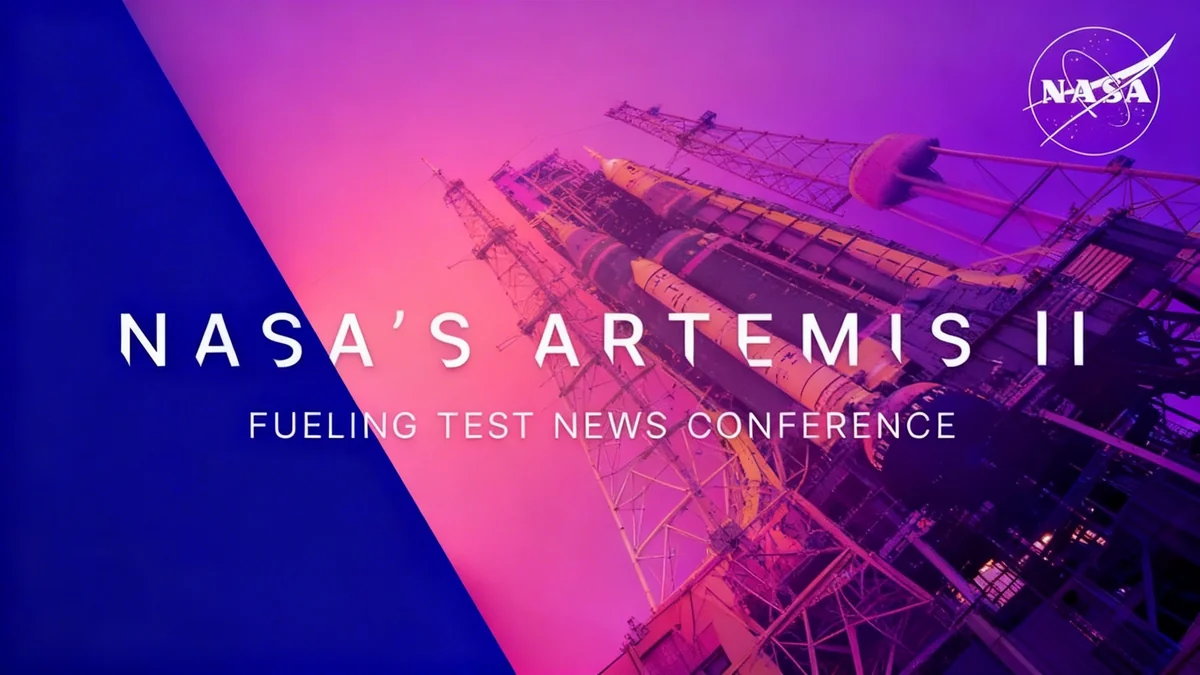


NASA has initiated a second critical fueling test for its Artemis 2 Space Launch System (SLS) rocket at Kennedy Space Center in Florida. The operation, known as a wet dress rehearsal, is a full-scale simulation of launch day procedures and a decisive step before the agency clears the massive rocket to carry four astronauts on a journey around the Moon.
The new test follows a previous attempt in early February that was cut short due to a persistent liquid hydrogen leak, an issue that has previously caused delays for the Artemis program. The success of this multi-day rehearsal will determine if the mission can proceed with a launch targeted for early March.
Key Takeaways
- NASA is conducting a second wet dress rehearsal for the Artemis 2 mission, which began on February 17.
- The first test was halted on February 3 after engineers detected a liquid hydrogen leak, a recurring issue for the SLS rocket.
- This rehearsal is the final major test before NASA commits to a launch date for the first crewed mission of the Artemis program.
- A successful test could keep Artemis 2 on track for a potential launch window in early March.
Countdown Redux: A Second Chance on the Launchpad
Mission controllers at Kennedy Space Center received the official "call to stations" on the evening of February 17, marking the start of a nearly 50-hour countdown sequence. This procedure meticulously replicates every step leading up to a real launch, from powering up vehicle systems to the final moments of the terminal count.
Overnight, teams focused on activating the Orion spacecraft, the core stage of the SLS rocket, and its Interim Cryogenic Propulsion Stage (ICPS). These initial steps are crucial for ensuring all components are communicating correctly and ready for the most demanding phase of the test: loading the propellant.
The primary objective of the rehearsal is scheduled for February 19, when engineers will attempt to load more than 730,000 gallons of super-cooled liquid oxygen and liquid hydrogen into the rocket's tanks. This is the same procedure that failed during the first attempt.
Echoes of Artemis 1: The Persistent Hydrogen Challenge
The technical difficulties facing Artemis 2 are not new. The first attempt at a wet dress rehearsal on February 2 was scrubbed after a leak was detected in a liquid hydrogen (LH2) line connected to the rocket's tail service mast umbilical. This is the large arm that feeds propellant and power to the base of the rocket before launch.
A History of Hydrogen Leaks
Liquid hydrogen is the smallest molecule in the universe, making it notoriously difficult to contain. Leaks were a significant source of delays for the uncrewed Artemis 1 mission in 2022. Engineers had to conduct multiple fueling tests and develop new loading procedures to manage the issue before that rocket could successfully launch.
During the first Artemis 2 test, engineers managed to fully fuel the rocket but had to pause the process twice to address the LH2 leak. Ultimately, the countdown was terminated with just over five minutes remaining on the clock when concentrations of hydrogen became too high to proceed safely.
Following the scrub, NASA announced the launch would be pushed from February to no earlier than March to allow time for a second rehearsal. This decision underscores the agency's commitment to safety, especially with a crew of four astronauts slated to be on board for the actual mission.
A Meticulous Process Toward Launch
The wet dress rehearsal is more than just a fueling test. It is a comprehensive exercise that validates the rocket, the ground systems, and the launch team's procedures. Throughout the countdown, teams will simulate various scenarios to ensure they are prepared for any eventuality on launch day.
Key Milestones of the Rehearsal:
- Power-Up: Activation of the Orion spacecraft and both stages of the SLS rocket.
- Propellant Loading: Pumping hundreds of thousands of gallons of cryogenic liquid oxygen (LOX) and liquid hydrogen (LH2).
- Terminal Count: Running through the final 10 minutes of the countdown, including built-in holds.
- Recycle Simulation: Practicing the procedure to stop the countdown and reset the clock, a common occurrence in real launches.
- Scrub and Detanking: Simulating a launch cancellation and safely draining the propellants from the rocket.
The test is expected to culminate in a simulated T-0, or launch time, on the evening of February 19. Even if the team encounters minor issues, the launch window for the simulation extends for several hours, giving engineers some flexibility to troubleshoot problems.
"These steps ensure the team is fully prepared for launch day," a NASA official stated in a briefing, emphasizing the rehearsal's importance for both hardware and personnel readiness.
The Path to the Moon
If this second wet dress rehearsal proceeds without significant issues, NASA will conduct a thorough review of all the data collected. A successful outcome would clear the final major hurdle for the Artemis 2 mission, allowing the agency to set a firm launch date.
The current launch windows are in March, specifically from March 6-9 and on March 11. Should the mission be delayed further, additional opportunities are available in April.
The world is watching as NASA works through these final technical checks. The Artemis 2 mission represents a monumental step in human space exploration, marking the first time astronauts will travel to the vicinity of the Moon in over 50 years. The success of this test on the ground is the critical precursor to that historic journey through the stars.