
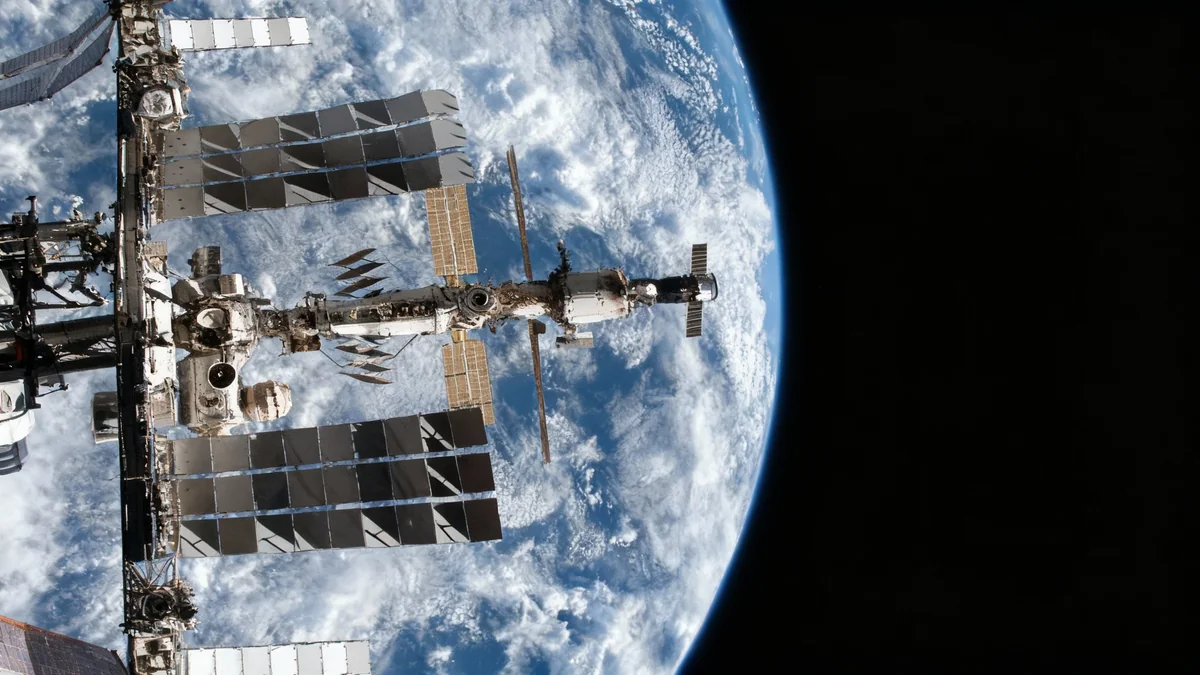


A persistent air leak that plagued the Russian segment of the International Space Station for nearly five years has finally been sealed, according to confirmations from both NASA and Roscosmos. The successful repair concludes a long and meticulous effort by cosmonauts to locate and patch microscopic cracks in the aging Zvezda Service Module.
The pressure within the affected area, a transfer tunnel known as the PrK module, is now stable. This development resolves a significant safety concern that had been classified as a high-consequence risk for the orbiting laboratory and its crew.
Key Takeaways
- A persistent air leak on the Russian segment of the ISS has been successfully sealed after a five-year effort.
- The leak originated from microscopic cracks in the PrK transfer module, connected to the 25-year-old Zvezda Service Module.
- Cosmonauts used a methodical process of isolating the module and using a special sealant to patch the cracks.
- Separately, repairs to a damaged Russian launch pad at the Baikonur Cosmodrome are progressing, with crewed and cargo launches scheduled to resume.
A Persistent Problem in Orbit
The issue first emerged in 2019, presenting a slow but steady loss of atmosphere from the station. For years, the precise location of the leak remained a mystery, prompting a prolonged and challenging investigation 400 kilometers above Earth.
The problem was traced to the PrK module, a small transfer chamber that connects the Zvezda module to a Progress spacecraft airlock. While initially small, the rate of air loss significantly increased, doubling in 2024. This escalation raised alarms among mission controllers, leading NASA officials to categorize the situation as a risk with both a “high likelihood” and “high consequence.”
The Aging Heart of the Station
The Zvezda Service Module is one of the foundational components of the ISS. Launched in July 2000, it provides living quarters, life support systems, and propulsion for the station. At over a quarter-century old, the hardware is showing signs of age, making structural integrity a constant focus for engineers and astronauts.
The successful repair is a significant achievement for the international partnership. In a statement, NASA confirmed the situation is now under control. “Following additional inspections and sealing activities, the pressure in the transfer tunnel attached to the Zvezda Service Module... is holding steady in a stable configuration,” a NASA spokesperson said.
“NASA and Roscosmos continue to monitor and investigate the previously observed cracks for any future changes that may occur.”
The Meticulous Hunt for Microscopic Cracks
Finding the source of the leak was a difficult and repetitive task for the Russian cosmonauts aboard the station. The cracks were too small to be seen with the naked eye, requiring a clever, low-tech approach to pinpoint their locations.
The process involved several steps:
- Isolation: Cosmonauts would seal the hatches to the PrK module, isolating it from the rest of the station.
- Observation: After a period, they would reopen the hatch and carefully observe where tiny particles of dust had accumulated. The escaping air would pull the dust towards the microscopic fissures, effectively marking the spot.
- Sealing: Once a potential crack was identified, they would apply a specialized sealant known as Germetall-1 to the area.
- Verification: The hatch would be closed again, and the pressure inside the module monitored to see if the leak rate decreased.
This painstaking cycle was repeated for years as multiple small cracks were discovered and sealed one by one. The persistence of the cosmonauts ultimately paid off, leading to the complete stabilization of the module's pressure.
Did You Know?
The Zvezda module, where the leak occurred, was launched on a Russian Proton rocket a quarter of a century ago, in July 2000. It serves as the structural and functional center of the Russian Orbital Segment of the ISS.
While this particular issue is resolved, the underlying cause of the structural cracking remains under investigation. The event highlights the ongoing challenges of maintaining an aging orbital outpost that has been continuously inhabited for over two decades.
Positive Developments on the Ground
In addition to the good news from orbit, Russia’s civil space program has seen positive developments on Earth. A key launch pad at the Baikonur Cosmodrome in Kazakhstan, Site 31, is expected to return to service soon following a significant accident.
In late November, the pad was damaged during a Soyuz launch. A large mobile service platform, which was not properly secured before liftoff, crashed into the flame trench below the rocket. The incident took the pad offline, disrupting the schedule for future missions.
Repairs have been underway, and mission planners now appear confident in a spring return to flight. NASA’s internal launch schedule reflects this optimism, with several key missions slated to launch from the repaired pad.
Upcoming Russian Launches
- March 22, 2026: A Progress cargo spacecraft is scheduled for launch.
- April 26, 2026: A second Progress resupply mission is planned.
- July 14, 2026: The next crewed mission, Soyuz MS-29, is scheduled to carry a crew including NASA astronaut Anil Menon to the ISS.
The timely repair of Site 31 is crucial for maintaining the steady flow of crew and cargo to the International Space Station. The successful resolution of both the orbital leak and the ground-based infrastructure problem marks a period of positive momentum for the international space partnership.