
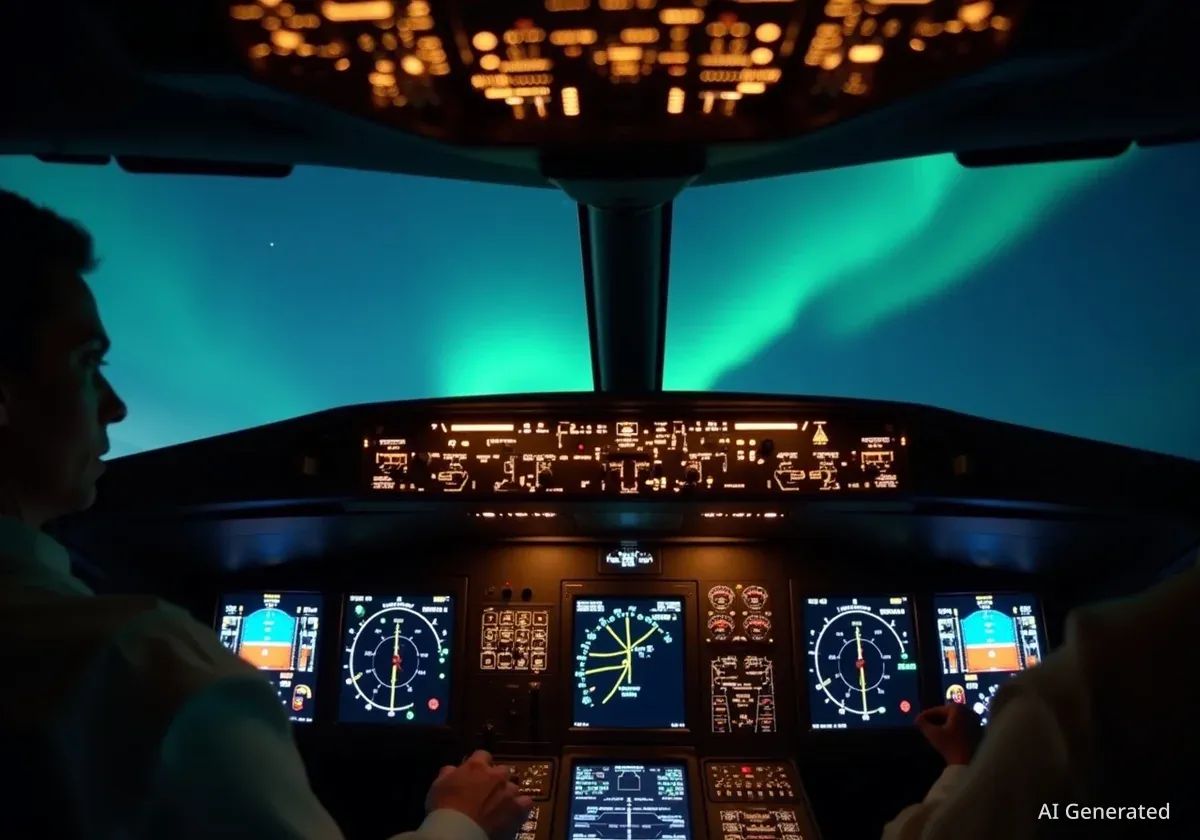

A recent incident involving an Airbus aircraft has highlighted a persistent but often overlooked vulnerability in modern aviation: space weather. Intense solar radiation was linked to disruptions on the flight, bringing attention to the risks that solar storms and energetic particles pose to aircraft flying at high altitudes.
While the most dramatic effects of space weather, like the aurora borealis, are admired from the ground, the same solar activity can interfere with critical flight systems. As our planet's technology becomes more sophisticated, so does its susceptibility to the sun's unpredictable nature.
Key Takeaways
- Intense solar activity can cause disruptions to aircraft electronics, communication, and navigation systems.
- A solar event in November 2025 was the most significant of its kind in nearly two decades, raising concerns within the aviation sector.
- While catastrophic failures are rare, even minor disruptions can lead to flight delays, cancellations, and significant economic losses.
- The European Space Agency (ESA) is enhancing its forecasting capabilities with tools like AVIDOS and the upcoming Vigil mission to mitigate these risks.
The Invisible Danger at 30,000 Feet
When most people think of flight risks, they imagine turbulence or mechanical issues. However, a threat originating 93 million miles away is gaining increased attention from safety experts. This threat is space weather, a term for the changing environmental conditions in space driven by the sun's activity.
Aircraft are most vulnerable at cruising altitude, where they are beyond the full protection of Earth's atmosphere. During a solar storm, the sun can eject clouds of energetic charged particles, known as Solar Energetic Particles (SEP), at nearly the speed of light.
When these particles reach Earth, they can create cascades of secondary particles in the atmosphere. It is these particles that can interfere with sensitive aircraft electronics. Another source of this radiation comes from outside our solar system, known as Galactic Cosmic Rays (GCR), which are remnants of distant supernova explosions.
What Are Solar Energetic Particles (SEPs)?
SEPs are high-energy particles, primarily protons and electrons, accelerated by solar flares or coronal mass ejections from the Sun. They travel at relativistic speeds and can reach Earth in a matter of minutes to hours, posing a radiation hazard to astronauts, satellites, and high-altitude aircraft.
From Minor Glitches to Major Disruptions
The impact of these energetic particles on an aircraft's electronic components can vary widely. In many cases, the effect is minor, such as a 'bit flip' in an onboard computer. This is when a single binary digit in a computer's memory switches from a 0 to a 1, or vice versa, potentially causing a temporary malfunction that a simple software reset can fix.
However, the potential for more severe consequences exists. While no cases of complete electronic failure have been reported in aviation due to space weather, the possibility remains a concern. The most significant recent event occurred in November 2025.
“Such energetic particle events with the energies needed to reach aircraft altitude are quite rare in recent solar cycles. The event we had in November 2025 was the most significant in almost 20 years according to some experts and, so far, no major impacts on the aviation sector have been reported,” said Alexi Glover, ESA Space Weather Service Coordinator.
The primary concern during a major solar storm is not the safety of a single aircraft but the cascading effect on the entire aviation system. Modern air travel relies on a complex, interconnected network of communication and navigation that is highly susceptible to space weather.
The Impact of an Extreme Solar Storm
A once-in-a-century solar storm could have a profound impact on aviation. While multiple backup systems would likely prevent safety compromises, the operational efficiency of the industry would suffer immensely. Widespread communication blackouts and navigation failures would lead to substantial economic losses from delayed and cancelled flights, affecting millions of passengers.
Communication and Navigation at Risk
Two of the most critical systems for modern flight are radio communication and satellite navigation, both of which can be severely degraded by solar storms.
Radio Blackouts
Radio bursts from the sun can disturb the ionosphere, an upper layer of Earth's atmosphere. This disturbance can block or absorb high-frequency radio signals, leading to large-scale radio blackouts. This would make it difficult, if not impossible, for air traffic control to communicate with aircraft. The problem is especially acute for flights over oceans or polar regions, where alternative communication options are limited.
GNSS Failures
The same ionospheric disturbances that cause radio blackouts also disrupt Global Navigation Satellite System (GNSS) signals, including GPS. Aircraft would experience intermittent signal loss and significant positioning errors. In such a scenario, pilots would be forced to rely on older, backup navigation methods:
- Inertial Reference Systems: Gyroscopes and accelerometers that track the plane's position without external signals.
- Ground-Based Beacons: Radio signals transmitted from ground stations.
- Paper Charts: The traditional method of navigation, requiring manual calculation and observation.
Forecasting the Storms: ESA's Proactive Approach
While space weather cannot be stopped, its effects can be managed with advanced warning. The European Space Agency (ESA) is at the forefront of developing tools and missions to monitor the sun and forecast potentially hazardous events.
Through its Space Weather Service Portal, ESA provides tailored information to various sectors, including aviation. A key tool is AVIDOS (Aviation Dosimetry), which calculates the expected radiation dose for any given flight path. It also provides real-time alerts on energetic particle events using data from ground-based neutron monitors.
This information allows airlines and air traffic controllers to adjust flight plans, reroute aircraft away from the most affected regions like the poles, or lower cruising altitudes to gain more atmospheric protection.
The Vigil Mission: An Eye on the Sun
To further enhance these capabilities, ESA is developing the Vigil mission, scheduled for launch in 2031. Vigil will be a dedicated space weather satellite positioned at Lagrange Point 5, a unique gravitational balance point that allows it to view the 'side' of the sun that is rotating towards Earth.
This vantage point is critical. Vigil will be able to detect potentially hazardous solar flares and coronal mass ejections before they are even visible from Earth. This will provide valuable extra time—several days of advance warning—for authorities to prepare and protect critical infrastructure on the ground and in the air. By providing earlier and more accurate warnings, Vigil aims to transform space weather forecasting from a reactive to a proactive science, ensuring the skies remain safe for travel.