


A dispute over the final home of the space shuttle Discovery has intensified, with three Texas lawmakers formally requesting the Department of Justice to investigate the Smithsonian Institution. They allege the museum illegally used federal funds to lobby against legislation that would move the historic orbiter to Houston.
The request, sent on October 22, marks a significant escalation in the ongoing political and legal battle for control of one of America's most iconic space artifacts.
Key Takeaways
- Texas Senators John Cornyn and Ted Cruz, along with Representative Randy Weber, have asked the DOJ to investigate the Smithsonian for potential violations of the Anti-Lobbying Act.
- The core of the dispute is the "One Big Beautiful Bill Act," which mandates the transfer of a space vehicle, presumed to be Discovery, to Houston.
- The Smithsonian claims legal ownership of the shuttle and estimates relocation costs at $120 million to $150 million, far exceeding the $85 million allocated in the act.
- Lawmakers counter that the actual cost is much lower and argue the Smithsonian, as a federally funded entity, is subject to the law.
Justice Department Asked to Intervene
The conflict over space shuttle Discovery has moved from the halls of Congress to the Department of Justice. In a formal letter, Senators John Cornyn and Ted Cruz, joined by Representative Randy Weber, urged Attorney General Pam Bondi to examine the Smithsonian Institution's recent activities.
The lawmakers accuse the museum of using federally appropriated funds to influence Congress and public opinion. Their letter alleges that the Smithsonian actively worked to undermine the "One Big Beautiful Bill Act," a law signed on July 4 that directs NASA to transfer a human-flown spacecraft to Houston's Johnson Space Center.
Specific allegations include lobbying congressional staff, coordinating with journalists to generate favorable media coverage, and circulating what the lawmakers describe as inflated cost estimates for moving the shuttle.
A Legislative Tug-of-War
The current confrontation stems from legislation that passed this summer. The act sets an 18-month deadline for the relocation of a "space vehicle" to a NASA facility involved in the Commercial Crew Program.
Houston's Johnson Space Center fits this description, and the lawmakers' letter states the city is "honored" to welcome Discovery. This legislative success followed an earlier, unsuccessful attempt in April called the "Bring the Space Shuttle Home Act."
Discovery's Current Home
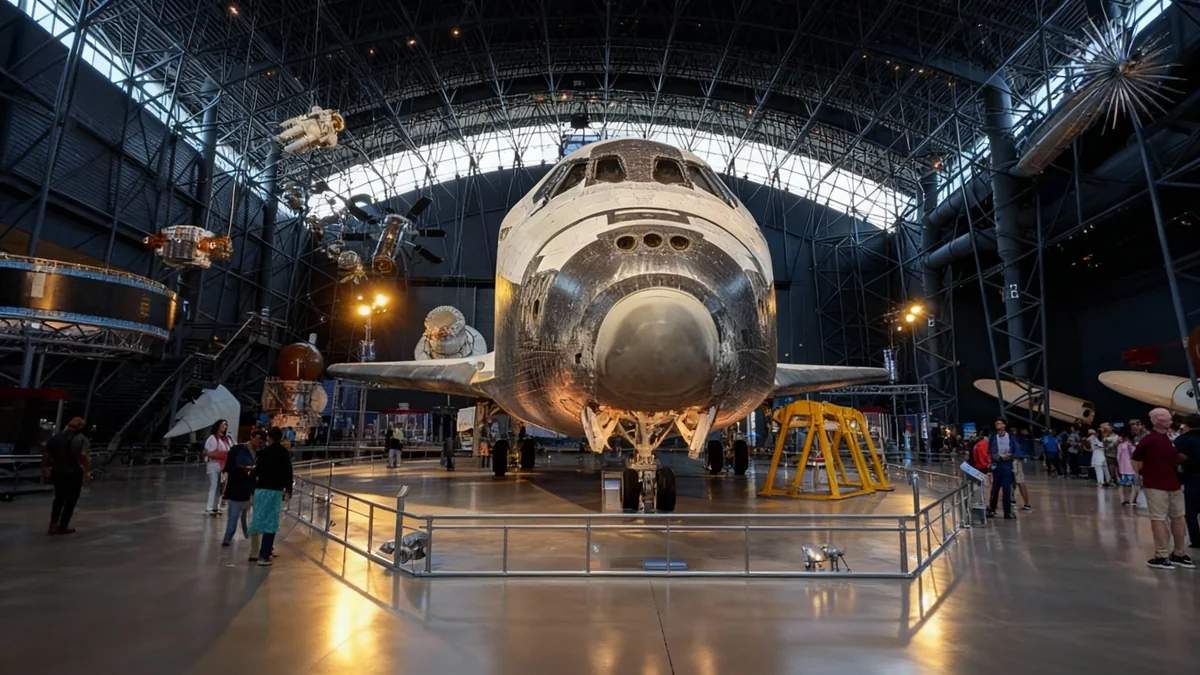
The space shuttle Discovery has been on public display at the Smithsonian National Air and Space Museum's Udvar-Hazy Center in Chantilly, Virginia, since 2012. It was awarded to the museum after a nationwide competition following the retirement of the shuttle fleet in 2011. At that time, NASA transferred "all rights, title, interest and ownership" of the orbiter to the Institution.
The Smithsonian maintains that it is the legal owner of Discovery and has a permanent responsibility for its conservation. Museum officials have raised serious concerns about the logistics and legality of forcibly removing a major artifact from the national collection.
Dispute Over Cost and Ownership
A central point of contention is the cost of moving the 122-foot-long orbiter. The Smithsonian, in consultation with NASA, provided Congress with an estimate of $120 million to $150 million. This figure accounts for the partial disassembly required for transport.
This estimate is significantly higher than the $85 million allocated in the legislation. Furthermore, it does not include the cost of constructing a new, climate-controlled facility in Houston to house the shuttle.
"This is a silly attempt to silence the Smithsonian from publicly defending their full and permanent 'right, title and interest' of Discovery," said Joe Stief, founder of KeeptheShuttle.org, an independent group opposing the relocation.
The Texas lawmakers have rejected the Smithsonian's figures. Their letter to the DOJ cites unnamed "industry experts" who allegedly estimate the true cost to be more than ten times lower than the museum's projection.
They also challenge the Smithsonian's legal standing, arguing that because it receives two-thirds of its funding from the government, it should be considered a federal entity subject to federal law. The letter cites court decisions that describe the Smithsonian as “a government institution through and through.”
The Anti-Lobbying Act
The Anti-Lobbying Act generally prohibits the use of federal funds for communications intended to pressure the public to contact Congress about legislation. However, guidance from the DOJ and the Government Accountability Office often treats direct communication between federal agencies and Congress as standard intragovernmental business, not lobbying.
A Complex Legal Question
The Smithsonian's unique status as a "trust instrumentality" complicates the legal arguments. It was created by Congress to serve a public purpose but operates with a degree of independence from the traditional federal agency structure.
This hybrid status could be a key factor in any DOJ review. Whether the Smithsonian's communications with Congress are considered prohibited lobbying or permissible coordination is an open question. The lawmakers' letter also broadens its criticism, accusing the museum's leadership of pursuing a "politicized agenda" in exhibits related to American history.
The Smithsonian Institution, which is governed by a Board of Regents that includes the Chief Justice of the Supreme Court and the Vice President, has not issued a public comment on the letter. A formal DOJ review could set a new precedent for how the Anti-Lobbying Act applies to federally chartered institutions that also rely on private funding.