
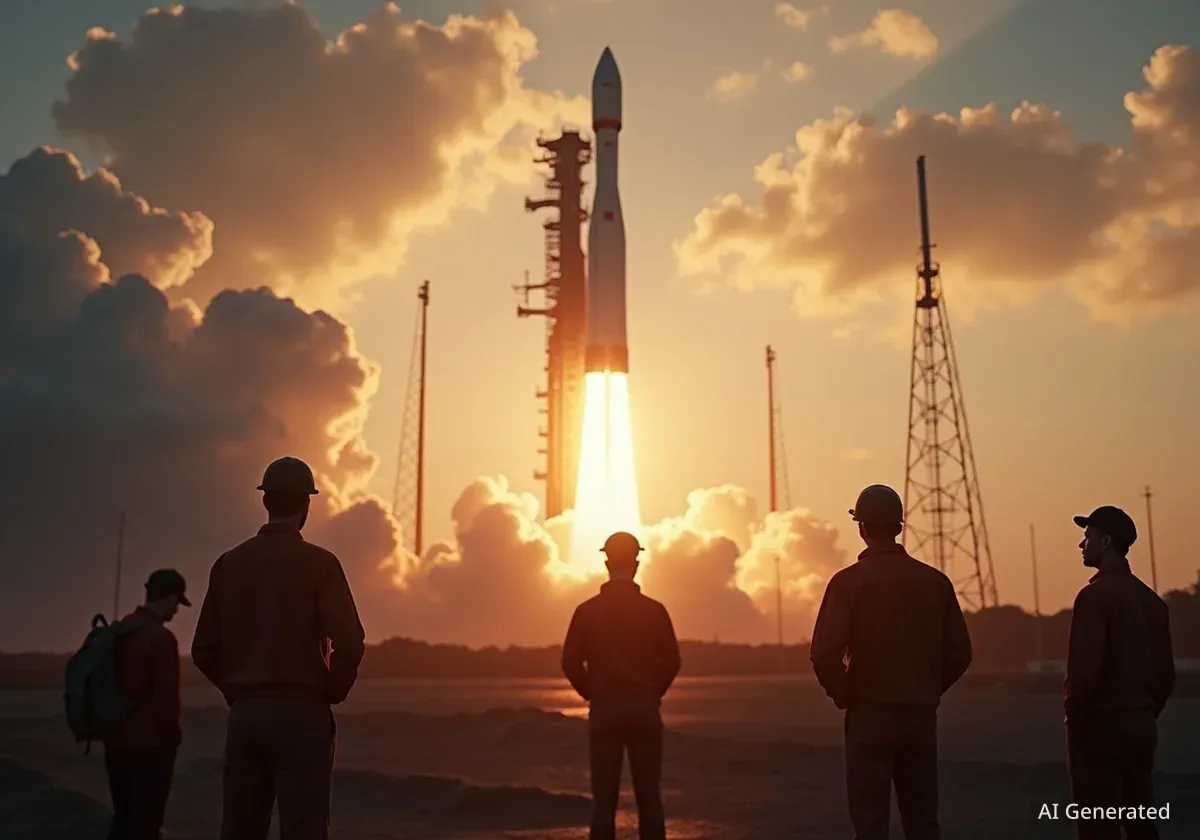

On October 11, 1968, NASA launched Apollo 7, the first crewed mission of the Apollo program. The 11-day flight was a critical test of the redesigned Apollo spacecraft, following the tragic fire that killed the Apollo 1 crew 20 months earlier. Piloted by astronauts Wally Schirra, Donn Eisele, and Walter Cunningham, the mission's success was essential to restoring confidence and keeping the goal of a lunar landing on schedule.
Key Takeaways
- Apollo 7 launched on October 11, 1968, and was the first crewed flight of the Apollo program.
- The mission's primary goal was to test the redesigned Apollo Command and Service Module (CSM) in Earth orbit.
- It followed the Apollo 1 fire, which had halted the program for nearly two years.
- Despite technical success, the mission was marked by significant tension between the crew and Mission Control.
- The flight's success paved the way for Apollo 8's historic journey to the Moon just two months later.
A Program Reborn from Tragedy
The Apollo program was in jeopardy before Apollo 7 ever left the ground. On January 27, 1967, a fire during a launch rehearsal claimed the lives of astronauts Gus Grissom, Ed White, and Roger Chaffee. The incident, known as the Apollo 1 fire, exposed serious design flaws in the Command Module, particularly concerning the pure oxygen environment and flammable materials.
NASA spent the next 20 months conducting a thorough investigation and completely overhauling the spacecraft. The redesigned Command Module featured a new hatch that could open in seconds, fire-resistant materials, and numerous other safety improvements. The future of the entire lunar program rested on this new hardware performing flawlessly.
The Weight of Expectation
The mission carried immense pressure. It was not just a test flight; it was a demonstration to the American public and the world that NASA had recovered from its darkest moment. A successful Apollo 7 would prove the spacecraft was safe for the complex lunar missions to come.
Mission Objectives and Technical Successes
Apollo 7 was an Earth-orbital mission designed to be a comprehensive shakedown of the Apollo Command and Service Module (CSM). The crew's task was to test nearly every system on board, from propulsion to navigation and life support. The flight was scheduled for 11 days to push the spacecraft to the limits of a lunar mission's duration.
Over the course of 163 orbits, the astronauts successfully tested the powerful Service Propulsion System (SPS) engine, which was crucial for entering and leaving lunar orbit. They fired it eight times, and it performed perfectly. The crew also conducted rendezvous and docking simulations with the Saturn IVB upper stage, mimicking maneuvers required to link up with the Lunar Module on future flights.
Apollo 7 By The Numbers
- Mission Duration: 10 days, 20 hours, 9 minutes
- Orbits Completed: 163
- Distance Traveled: 4.5 million miles (7.2 million km)
- Crew: Wally Schirra (Commander), Donn Eisele (Command Module Pilot), Walter Cunningham (Lunar Module Pilot)
The 'Wally, Walt, and Donn Show'
A significant aspect of the Apollo 7 mission was its use of live television broadcasts from orbit. These transmissions, nicknamed the "Wally, Walt, and Donn Show," provided the public with their first-ever live views from inside an American spacecraft. The astronauts used handheld signs and offered tours of their cabin, bringing the experience of spaceflight into homes across the country.
These broadcasts were a public relations success, helping to rebuild public enthusiasm for the space program. For their efforts, the crew later received a special Emmy Award.
Tensions with Mission Control
While the spacecraft performed well, the human element of the mission proved challenging. The flight was marked by friction between the crew, particularly Commander Wally Schirra, and ground controllers in Houston. The issues began early when the astronauts experienced symptoms of space adaptation sickness.
Shortly after, Schirra developed a severe head cold in the zero-gravity environment. With no way for his sinuses to drain, the condition was intensely uncomfortable. This led to a series of disagreements with Mission Control over the flight plan and procedures.
"You've added two burns to this flight schedule, and you've added a urine water dump; and we have a new vehicle up here, and I can tell you at this point TV will be delayed without any further discussion," Schirra famously told Mission Control during one exchange.
The Helmet Controversy
The most significant conflict arose over the procedure for reentry. NASA procedure required the astronauts to wear their helmets during the fiery return to Earth. However, Schirra, concerned that the pressure changes during reentry would be excruciatingly painful with his congested sinuses, refused the order for the crew to wear their helmets.
He argued that if his eardrums were to rupture from the pressure, he needed to be able to pinch his nose to equalize it, which was impossible with the helmet on. After a tense standoff, the crew's decision stood, and they landed without helmets. While medically justified from Schirra's perspective, the act of defying a direct protocol from Mission Control had lasting consequences.
Legacy of Apollo 7
Apollo 7 was an unqualified technical success. The mission proved that the redesigned Apollo spacecraft was a capable and reliable vehicle, ready for the challenges ahead. Its flawless performance gave NASA leadership the confidence to make a bold decision: send the next mission, Apollo 8, on a journey to orbit the Moon.
However, the difficult relationship between the crew and the ground team ended the spaceflight careers of all three astronauts. Wally Schirra had already planned to retire, but Donn Eisele and Walter Cunningham, who were rookie astronauts, were never assigned to another space mission. According to flight director Chris Kraft's autobiography, the crew's conduct ensured they would not fly again.
Paving the Way for the Moon
Without the engineering validation provided by Apollo 7, the historic Apollo 8 lunar orbit mission and the subsequent Apollo 11 moon landing would not have been possible. Despite the interpersonal conflicts, the mission accomplished every one of its test objectives, effectively putting the Apollo program back on track and securing its place in history.
The mission remains a pivotal moment in space exploration—a story of recovery, technical excellence, and the complex human dynamics that accompany high-stakes endeavors. It successfully bridged the gap from tragedy to triumph, ensuring that the goal of landing a man on the Moon before the end of the decade remained within reach.