



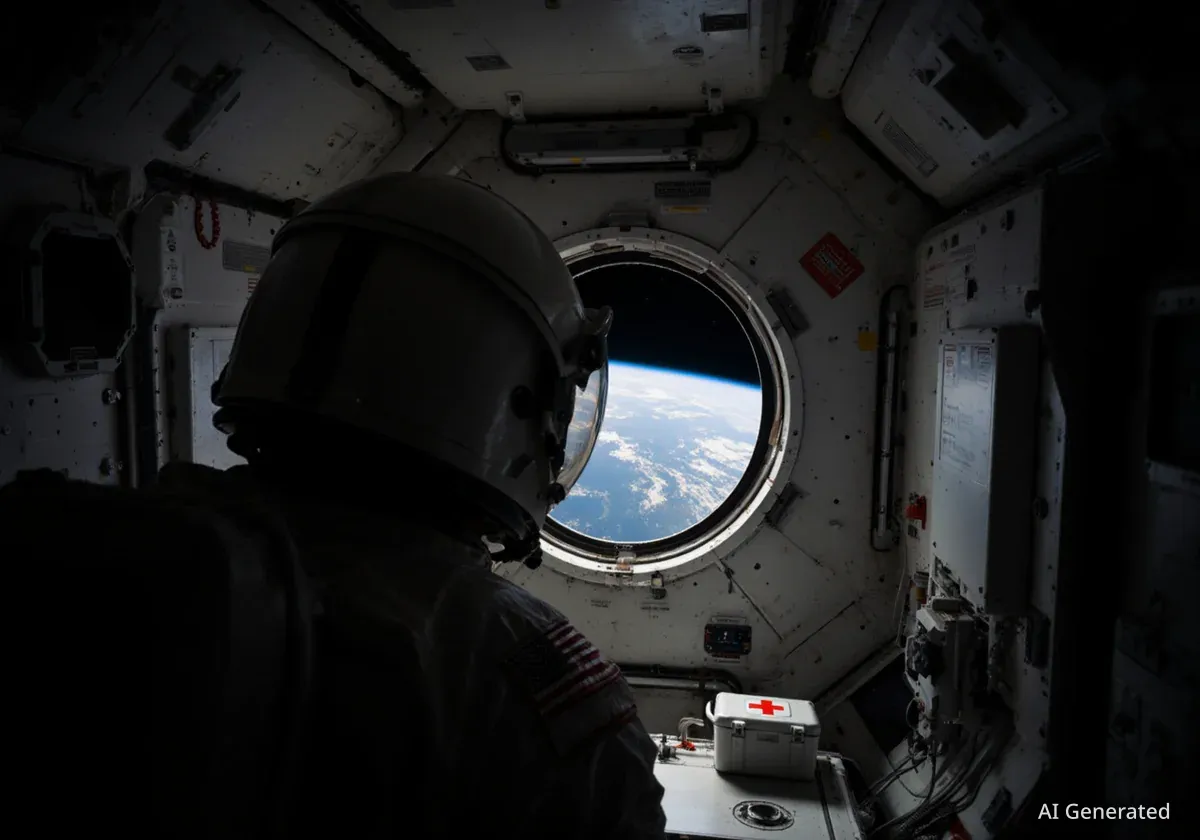

NASA is evaluating the possibility of ending a mission on the International Space Station (ISS) ahead of schedule following a medical emergency involving an astronaut. The situation prompted the postponement of a planned spacewalk and has initiated a review of the Crew-11 mission's duration.
The US space agency confirmed on Wednesday that the health concern is significant enough to consider the rare step of curtailing the mission. Crew-11 is an international collaboration, with astronauts from the United States, Japan, and Russia currently on board the orbiting laboratory.
Key Takeaways
- NASA is considering an early return for the Crew-11 mission due to an astronaut's medical issue.
- A spacewalk scheduled for January 8 was postponed as a direct result of the health concern.
- The Crew-11 mission involves an international team of astronauts from the US, Japan, and Russia.
- Early termination of a space mission is a rare event, reserved for serious contingencies.
Developing Situation Aboard the Space Station
The first public indication of an issue arose when NASA announced the postponement of a spacewalk, or Extravehicular Activity (EVA), that was set for January 8. In a subsequent statement, the agency linked the delay to an emerging health concern with one of the crew members.
While NASA has not disclosed the identity of the astronaut or the specific nature of the medical condition, the consideration of an early mission termination highlights the potential seriousness of the situation. Mission managers are now in the process of assessing all options.
The Crew-11 mission is part of the regular rotation of astronauts that maintain and operate the ISS. These missions typically last for approximately six months, during which the crew conducts scientific experiments, performs station maintenance, and carries out technology demonstrations.
What is an Extravehicular Activity (EVA)?
An EVA, commonly known as a spacewalk, is any activity done by an astronaut outside a spacecraft beyond the Earth's appreciable atmosphere. Spacewalks are complex and physically demanding tasks, essential for station assembly, maintenance, and upgrades. Postponing an EVA is not taken lightly and typically only occurs due to technical issues with suits, hardware, or crew health.
Protocols for Medical Emergencies in Orbit
The International Space Station is equipped with medical supplies and equipment to handle a range of health issues, from minor ailments to more significant emergencies. Crew members receive extensive medical training to serve as Crew Medical Officers, capable of performing procedures under the guidance of flight surgeons on the ground.
However, the resources in orbit are limited compared to a terrestrial hospital. For any condition that cannot be managed on the station, NASA and its international partners have established clear protocols for medical evacuation. The primary goal is always the safety and well-being of the crew.
An early return would involve one of the docked spacecraft, such as a SpaceX Crew Dragon or a Russian Soyuz capsule, functioning as a lifeboat to bring the crew members back to Earth. Such a decision involves complex logistical planning and coordination between all international partners.
The ISS: A Laboratory in the Sky
- Altitude: Orbits at an average of 400 kilometers (250 miles) above Earth.
- Speed: Travels at approximately 28,000 kilometers per hour (17,500 mph).
- Occupancy: Has been continuously occupied by humans since November 2000.
- Size: The largest single structure humans have ever put into space, spanning the area of an American football field.
The Rarity of a Mission Curtailment
Shortening a crewed mission is an exceptionally rare event in the history of the ISS. The program is built on extensive planning and redundancy to mitigate risks and ensure missions can be completed as scheduled. A decision to bring a crew home early would underscore the agency's commitment to its 'crew safety first' principle.
The health of astronauts is monitored meticulously before, during, and after spaceflight. The microgravity environment, combined with increased radiation exposure, can have significant effects on the human body. These effects include bone density loss, muscle atrophy, and changes to the cardiovascular system, all of which are subjects of ongoing research on the station.
"The health and safety of our astronauts is our top priority. We are constantly monitoring the situation and consulting with our flight surgeons and international partners to determine the best course of action," a NASA official might state in such a situation, reflecting standard agency policy.
International Cooperation in Crisis
The Crew-11 mission is a testament to the ongoing international cooperation that defines the ISS program. With astronauts from NASA, the Japan Aerospace Exploration Agency (JAXA), and Roscosmos working together, any decision regarding the mission's future must be made in full concert with all partners.
This collaborative framework is crucial during emergencies. Communication channels between control centers in Houston, Moscow, and Tsukuba, Japan, are well-established to handle precisely these types of contingencies. The immediate focus will be on stabilizing the situation and ensuring the affected astronaut receives the best possible care.
In the coming days, NASA is expected to provide further updates as mission managers complete their assessment. The space community and the public will be watching closely for more information on the health of the astronaut and the ultimate decision regarding the fate of the Crew-11 mission.