
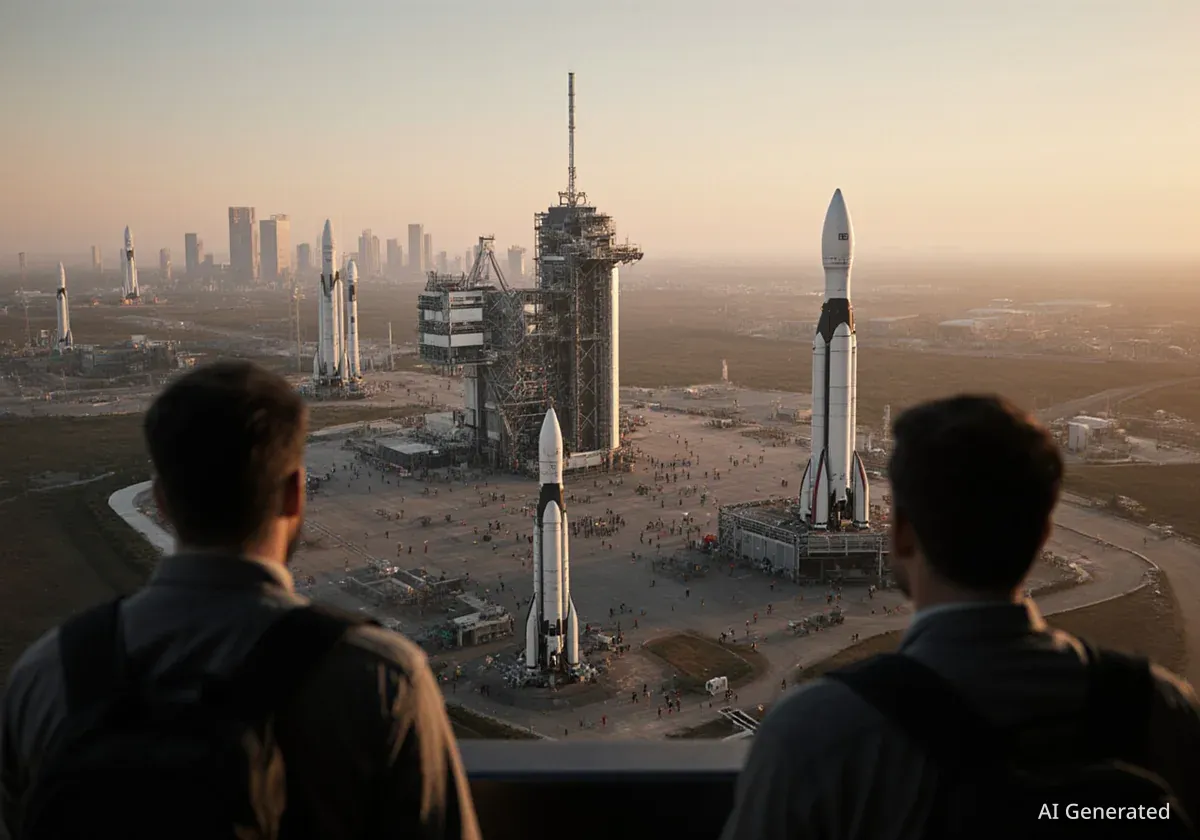


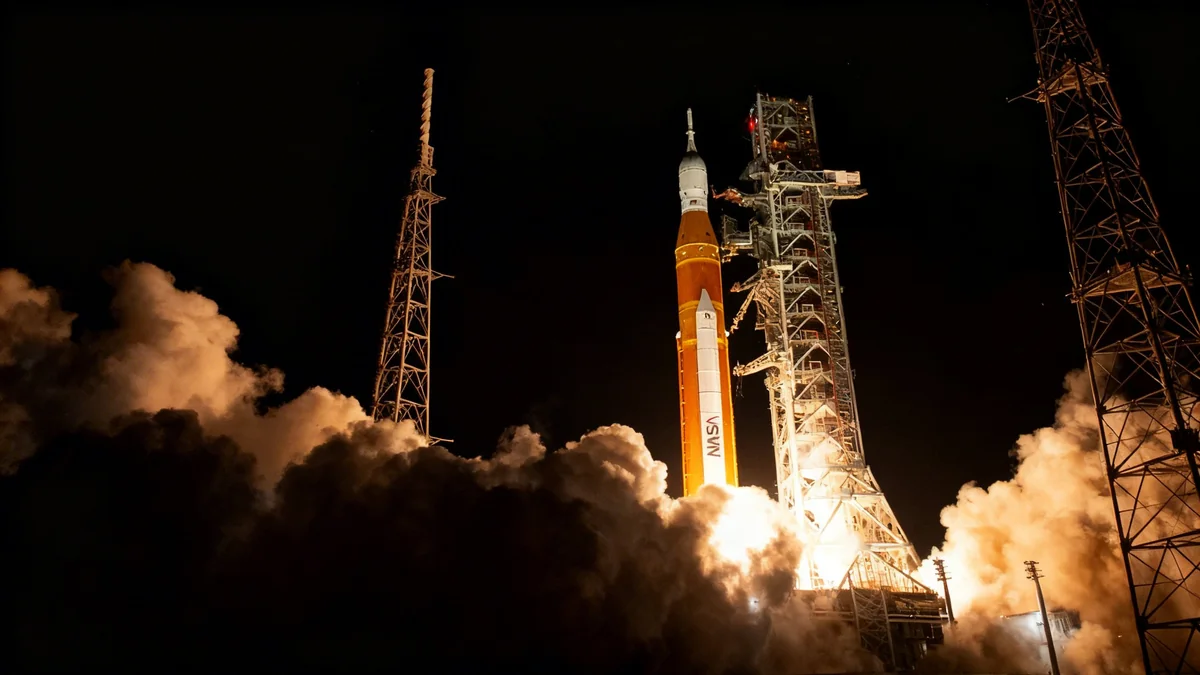

A dramatic shift is underway in low-Earth orbit and beyond. Private companies have firmly taken the lead in space exploration, conducting 70% of all global spacecraft launches in 2024. This commercial surge is not just changing who goes to space, but is also rapidly expanding the economic frontier, with projections showing the space economy will surpass $1 trillion by 2032.
This new era is defined by falling costs, increased access, and a transition from government-led missions to a bustling marketplace of innovation. As the International Space Station (ISS) approaches retirement, a new generation of commercial space stations is set to redefine humanity's presence in orbit.
Key Takeaways
- Commercial firms were responsible for 7 out of every 10 spacecraft launches globally in 2024, signaling a major power shift in the space industry.
- The cost to launch payloads into space has plummeted, now 40 times cheaper than in the 1980s, with a further 95% cost reduction anticipated.
- The global space economy is on a trajectory to exceed $1 trillion within the next decade, driven primarily by commercial activities.
- At least five commercial space stations are planned to launch before 2030, replacing the aging International Space Station and creating new orbital habitats.
The New Leaders in Space
The landscape of space exploration, once the exclusive domain of national governments, has been fundamentally reshaped. While nations like the United States, Russia, and China remain the only countries capable of independent human spaceflight, the operational tempo is now dictated by the private sector.
Companies are not just launching satellites; they are building the entire infrastructure for a new orbital economy. This commercial dominance is most evident in launch statistics, where private enterprise now accounts for the vast majority of missions.
A Market in the Stars
In 2024, the global space economy reached an estimated value of $613 billion. The breakdown reveals a clear trend:
- Commercial Space Products and Services: $343 billion
- Commercial Infrastructure and Support: $137 billion
- U.S. Government Budgets: $77 billion
- Non-U.S. Government Budgets: $55 billion
Commercial activities now represent over 78% of the total space economy.
This shift has been fueled by a staggering reduction in launch costs. Technological advancements, particularly in reusable rocket technology, have made accessing space more affordable than ever. Costs are already 40 times lower than they were in the 1980s, and industry analysis suggests they could fall by another 95%. This accessibility is the primary driver behind the explosive growth of the commercial space sector.
A Changing of the Guard in Orbit
For over two decades, the International Space Station (ISS) has been the sole permanently inhabited outpost in space. A symbol of international cooperation, its operational life is nearing its end. However, its retirement will not leave a void. Instead, a fleet of new, commercially operated space stations is preparing to take its place.
This transition marks a move from a single, government-funded facility to a diverse ecosystem of orbital platforms, each potentially serving different markets, from scientific research and manufacturing to tourism.
The Next Generation of Space Stations
Several companies are racing to deploy the first commercial successors to the ISS. These upcoming stations represent the next logical step in the commercialization of low-Earth orbit.
- Haven-1: Developed by Vast, this station is scheduled for launch as early as 2026.
- Axiom Station: Axiom Space plans to launch its first module in 2027, which will initially attach to the ISS before becoming a free-flying station.
- Orbital Reef: A joint venture by Blue Origin and Sierra Space, this platform is also targeting a 2027 launch and is envisioned as a "mixed-use business park" in space.
- Starlab: A collaboration involving NanoRacks, Voyager Space, and Airbus, Starlab is planned for a 2029 launch.
These commercial outposts will operate alongside new government-led projects. Russia has announced its Russian Orbital Service Station for 2027, and India plans to launch its Bharatiya Antariksh Station in 2028. This mix of private and public infrastructure points to a more complex and dynamic future in orbit.
Expanding National Ambitions
While commercial entities lead in launch services, more nations are developing their own space capabilities. As of 2024, the number of countries with the ability to send probes to other planets has grown to eight. This group includes established players and newer entrants like the United Arab Emirates, whose Mars Hope Probe successfully entered Martian orbit in 2020. This growing international participation is expanding the frontiers of scientific discovery.
The Trillion-Dollar Frontier
The economic implications of this new space race are immense. Financial analysts project the space economy will grow from its current $613 billion valuation to over $1 trillion by 2032. This growth is not limited to launch services but encompasses a wide range of sectors.
Key areas driving this economic expansion include:
- Satellite Services: Communication, Earth observation, and navigation systems remain a cornerstone of the space economy.
- In-Space Manufacturing: The unique microgravity environment offers opportunities for producing advanced materials, pharmaceuticals, and fiber optics.
- Space Tourism: Suborbital and orbital flights for private citizens are becoming a reality, opening a new high-end tourism market.
- Resource Extraction: Long-term plans include the potential for mining asteroids and other celestial bodies for valuable resources.
This burgeoning economy signifies that space is no longer just a destination for exploration but a platform for industrial and commercial development. The infrastructure being built today is laying the groundwork for industries that could define the 21st century.
Looking Ahead: An Integrated Future
The future of space is being shaped by innovation extending beyond rocketry and orbital mechanics. Advances in fields like biohacking for long-duration spaceflight, research into dark energy, and the development of advanced, integrated communication networks will be crucial.
As humanity extends its reach, the convergence of government ambition and commercial innovation is creating a powerful synergy. This partnership is accelerating our journey to becoming a multi-planetary species and unlocking economic opportunities that were once the stuff of science fiction. The next decade promises to be one of the most transformative periods in the history of space exploration.