


A coalition of government, academic, and commercial organizations is developing a unified digital platform to manage the growing economic activity in cislunar space. The project, named LUNAverse, aims to create a shared digital environment for engineering, commerce, and innovation related to future lunar missions.
Key Takeaways
- LUNAverse is a new coalition building a digital "commons" for the cislunar economy.
- The platform will feature a digital engineering environment, an innovation accelerator, and a business-to-business marketplace.
- The initiative is a continuation of work from DARPA's 10-Year Lunar Architecture (LunA-10) study.
- Key participants include The Aerospace Corporation, NASA, and various commercial space companies.
- The primary goal is to improve efficiency, guide investment, and promote collaboration in the expanding space sector.
A Digital Foundation for Space Commerce
As interest in the economic potential of space accelerates, the number of companies and government agencies involved is rapidly increasing. This growth introduces significant complexities in coordinating missions, managing resources, and ensuring systems can work together.
To address these challenges, The Aerospace Corporation and its partners are pioneering a concept for a shared digital trade space. This platform is intended to serve as a foundational tool for the entire space industry, simplifying operations and making it easier for new companies to participate in the cislunar ecosystem.
What is Cislunar Space?
Cislunar space refers to the region of space between the Earth and the Moon. It includes Earth's orbit, the Moon's orbit, and the gravitational field that influences both celestial bodies. This area is considered the next frontier for commercial and scientific development beyond low-Earth orbit.
A coordinated digital approach is expected to create efficiencies for both U.S. space agencies and the commercial sector. By establishing a common environment, the project aims to speed up investment, development, and deployment of new space systems.
The LUNAverse Initiative
The effort to build this digital commons is being led by a coalition named LUNAverse. This group brings together organizations from government, the commercial sector, academia, and research institutions. The name was coined by Studio 52, one of the coalition's digital development partners.
The LUNAverse initiative has its roots in the DARPA 10-Year Lunar Architecture (LunA-10) Capability Study. LunA-10 was designed to promote commercial collaboration for an era of interoperable lunar infrastructure. It successfully created a digital cislunar environment with detailed models for physics, gravity, lighting, and astrodynamics.
The LunA-10 study integrated digital models of rockets, lunar landers, rovers, power systems, and even proposed railroads to simulate the first decade of a functional lunar economy.
The successes and collaborations from LunA-10 are now driving the formation of LUNAverse. The goal is to expand on that foundation and build a practical, industry-wide platform.
"The goal is to bring together this community into a digital commons and establish a foundation for a total set of digital environments for the cislunar ecosystem that is greater than the sum of all of the parts," said Dennis Paul, a senior project leader at The Aerospace Corporation.
Paul, who also co-chairs a task force at the American Institute of Aeronautics and Astronautics, added that the platform will "help the user community plan more effectively, allow the investment community to understand the return-on-investment... and enable the commercial sector to close the business case.”
Components of the Digital Ecosystem
The proposed digital commons for cislunar commerce will be built on three core pillars designed to support the entire lifecycle of space-based projects.
1. A Digital Engineering Environment
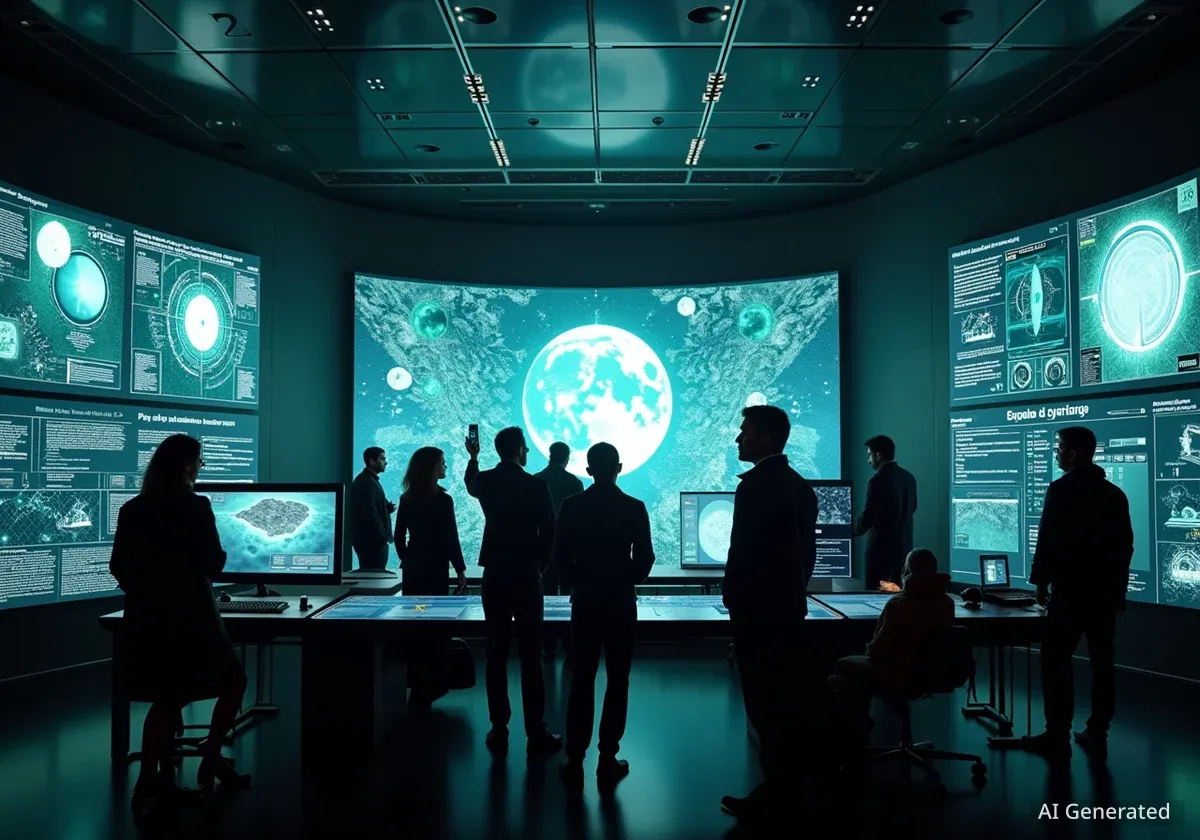
This component will serve as a comprehensive digital twin of the entire physical cislunar ecosystem. It will allow engineers and planners to simulate missions, test hardware compatibility, and aggregate market demand for specific services and capabilities. Tools like the Aerospace Cislunar Modeling Environment (ACME) will enable collaborative work on this shared digital model.
2. An Innovation Accelerator
The platform will include a dedicated space to help innovators and startups bring new capabilities and services to market more quickly. This accelerator will provide resources and a collaborative environment to foster new technologies needed for a sustainable lunar presence.
3. A Digital Marketplace
At its core, the LUNAverse project aims to create a marketplace where participants can conduct direct business-to-business transactions. This would allow companies to buy and sell services like transportation, data communications, power, and resource utilization directly within the platform.
A major challenge for this endeavor is data governance. "We're really focused on data management, governance and sharing,” Paul noted. He explained that while innovators need to protect their intellectual property, sharing as much data as possible is critical to building an open and neutral digital enterprise that benefits everyone.
Collaboration and Next Steps
The LUNAverse coalition has already begun its work through a series of workshops. The first was held in July 2024 at NASA's Jet Propulsion Laboratory, with subsequent events at NASA Ames Research Center, Space Symposium 40, and ASCEND.
These workshops have brought together early partners to discuss the requirements and applications for an effective digital environment. The goal is to ensure that the platform is built with interoperability in mind from the ground up, allowing companies to develop technologies that can seamlessly connect and work together once deployed in space.
Ron Birk, principal director of space enterprise evolution at Aerospace, described LUNAverse as a crucial testing ground.
"Just as the Moon is a physical proving ground for other regions of space, the LUNAverse is a proving ground for the concept of digital engineering ecosystems," Birk stated. "The U.S. government is in. Academia is in. International partners are in. The linchpin is the commercial sector."
The next LUNAverse workshop is scheduled for late October 2025 at NASA’s Kennedy Space Center. The continued involvement of a critical mass of innovative companies is seen as the key driver for the project's success and the future evolution of space ecosystems, potentially extending to Mars and beyond.