


The U.S. Defense Advanced Research Projects Agency (DARPA) is examining the potential for significant economic activity on the moon. A new guide, developed through the agency's LunA-10 initiative, details a framework for building a self-sustaining lunar marketplace over the next decade. The document addresses key technological and financial hurdles that must be overcome to make commercial operations on the moon a reality.
The guide, titled "The Commercial Lunar Economy Field Guide," brings together insights from over 130 authors to explore foundational concepts for off-Earth economic development. It focuses on creating monetizable services that could support future lunar industries, with a strong emphasis on resource extraction as a central driver for profitability.
Key Takeaways
- DARPA's LunA-10 initiative aims to establish a scalable lunar infrastructure within 10 years.
- A new "Field Guide" details the steps needed to create a self-sufficient commercial economy on the moon.
- Mining lunar resources is identified as the most likely driver of a profitable moon-based economy.
- Major challenges include managing extreme temperature swings and the high cost of space insurance.
- More data on the concentration of valuable materials like rare-earth elements is needed to prove economic viability.
A Blueprint for Lunar Commerce
DARPA is actively promoting a vision where the moon becomes a center for commercial activity. The agency's LunA-10 initiative serves as a 10-year plan designed to foster the development of infrastructure that can support a vibrant lunar economy. This effort aims to transition the moon from a place of scientific exploration to one of economic opportunity.
To support this goal, Air University Press has published "The Commercial Lunar Economy Field Guide." This comprehensive document outlines a vision for lunar industry over the next decade. It compiles 23 chapters from a diverse group of experts, all focused on creating a self-sufficient and monetizable ecosystem for future buyers and sellers on the moon.
What is DARPA?
The Defense Advanced Research Projects Agency (DARPA) is an agency of the U.S. Department of Defense responsible for the development of emerging technologies for use by the military. While its focus is defense, its research often leads to innovations with broad civilian applications, such as the internet and GPS.
The guide explores the foundational technologies required to establish a permanent industrial presence. It moves beyond theoretical discussions to provide a practical look at what is needed to orchestrate off-Earth economic development. The core idea is to create services that can sustain themselves financially, reducing reliance on government funding over time.
Identifying Key Obstacles
The process of creating the Field Guide revealed several significant, and sometimes surprising, challenges. Michael Nayak, a DARPA program manager and the guide's editor, highlighted some of these hurdles in a recent interview. He noted that the project was an "expansive exercise" that underscored the immense work required to realize this vision.
The High Cost of Risk
One of the unexpected findings was the critical role of space insurance in commercial space activities. According to Nayak, insurance is a major cost driver and a significant barrier to entry for many companies.
"One big surprise was the surprising role of space insurance in commercial activities, a huge cost-driver and a significant cost barrier," Nayak stated. "If you want to create a commercial ecosystem, you have to create a better way to make the risk understandable to space insurance companies."
Without more affordable or accessible insurance options, the financial risks associated with lunar ventures could be too high for many private investors and companies to bear. This makes addressing the insurance problem a priority for enabling a commercial lunar economy.
Managing an Extreme Environment
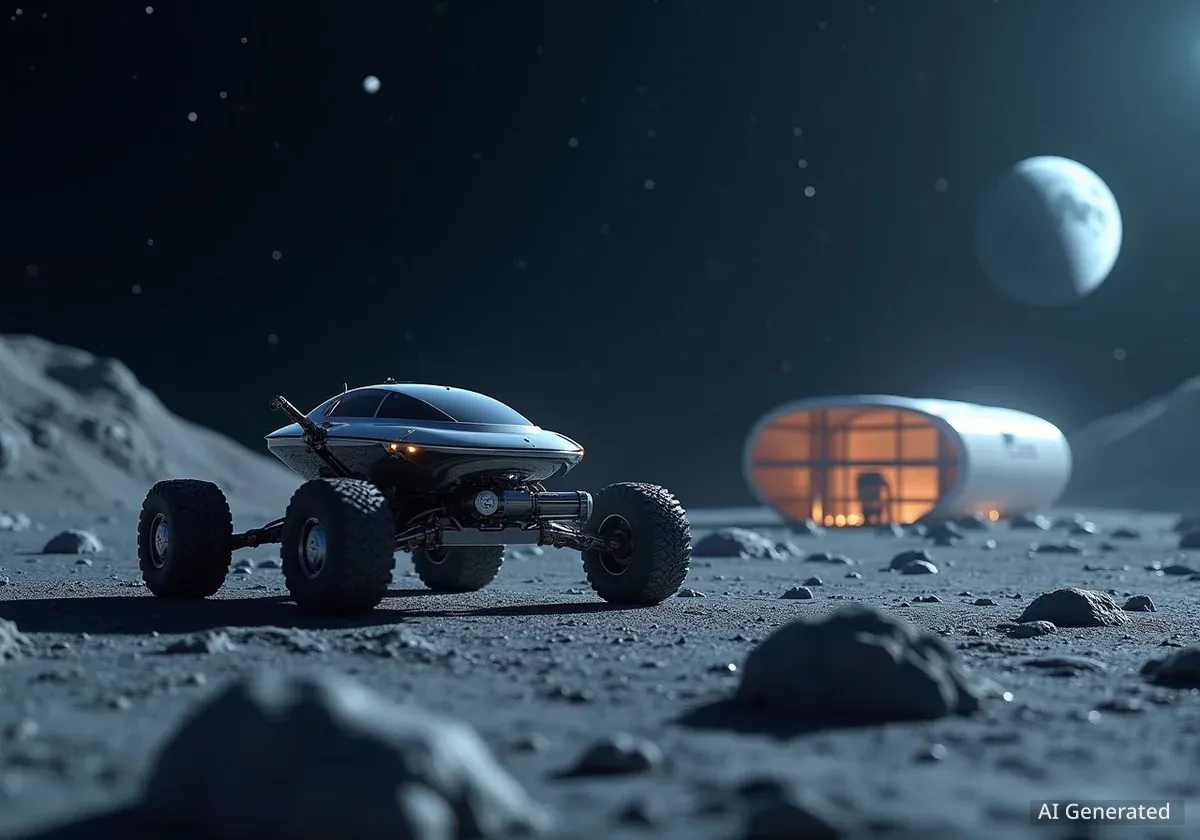
Another fundamental problem is the moon's harsh environment, particularly its extreme temperature fluctuations. The lunar surface can swing from scorching heat in direct sunlight to extreme cold in the dark. This presents a major engineering challenge for any machinery or infrastructure operating there.
Nayak explained that managing the heat generated by equipment like drills and heavy machinery is a "huge, fundamental problem." Operations would require complex systems to both cool equipment during the lunar day and keep it warm during the frigid lunar night. As the Field Guide points out, a commercial economy cannot be viable if it can only operate during sunlit hours.
Lunar Temperature Swings
Temperatures on the moon's surface near the equator can reach as high as 127°C (260°F) during the day and plummet to as low as -173°C (-280°F) at night. This massive temperature difference of over 300°C poses a significant challenge for equipment design and operation.
The Search for Profitability
While DARPA's role is to incentivize commercial industry, a central question remains unanswered: What, exactly, is monetizable on the moon? Nayak admits that this is still an open question, as no lunar activity has yet been proven to be directly profitable.
"We talked to a lot of investors that are super-interested in space," he said. "But in terms of answering a key question — What is monetizable on the moon? — I think that's still an open question."
The Field Guide is structured around essential services that would be needed, including:
- Power generation and distribution
- Communications networks
- Data processing and storage
- Positioning, navigation, and timing (PNT) services
However, these services are only valuable if there is a primary industry to support. The consensus, for now, points toward resource extraction.
Mining at the Center
"What really came out are the potential resources on the moon," Nayak noted. "Mining is at the center, and that's the best guess at the moment. The question is, What are we mining, what is its concentration, and is it actually economically viable?"
To answer this, DARPA has initiated another program called the Lunar Assay via Small Satellite Orbiter (LASSO). This program aims to use low-altitude, high-resolution sensors to map resources across the entire lunar surface. The data gathered by LASSO could provide the crucial information needed to identify the most compelling commercial applications.
"If there is commercial value, at least based on what we now know, I would argue it's the moon's subsurface," Nayak concluded.
Targeting Valuable Resources
The economic viability of lunar mining hinges on finding valuable materials in high enough concentrations to justify the immense cost of extraction. Based on our understanding of geology, there are two primary candidates for what could provide an economic windfall.
Potential Lunar Resources
- Rare-Earth Elements: These are crucial for many modern technologies, from smartphones to electric vehicles. If found in significant quantities, they could be highly valuable. However, more data is needed to confirm their presence and concentration.
- Platinum Group Metals: This group includes highly valuable metals like platinum, palladium, and rhodium. Nayak suggested that if these exist on the moon, they would likely be deep underground and require energy-intensive methods to extract.
These possibilities are currently best guesses based on assumptions from Earth's geology. "We don't know if that's a good assumption for the moon," Nayak cautioned, emphasizing the need for more direct observation and data.
The overwhelming takeaway is the need for more information. The path to a profitable moon is paved with unanswered questions and immense challenges. "There's so much learning we need to do," Nayak said. In his closing remarks for the Field Guide, he wrote, "Envisioning the future is easy. Dragging it into the present and making it real is not... I hope this work inspires you to help us push this rock uphill to the finish line."