
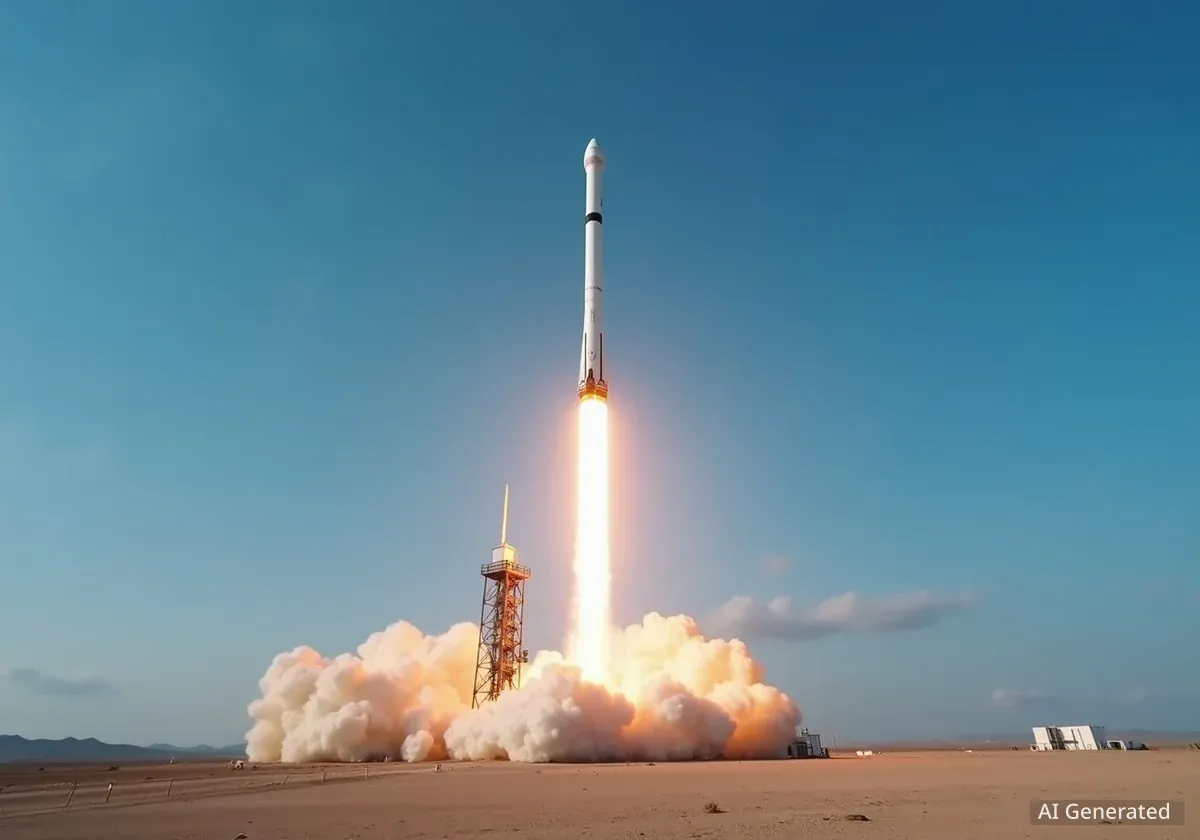
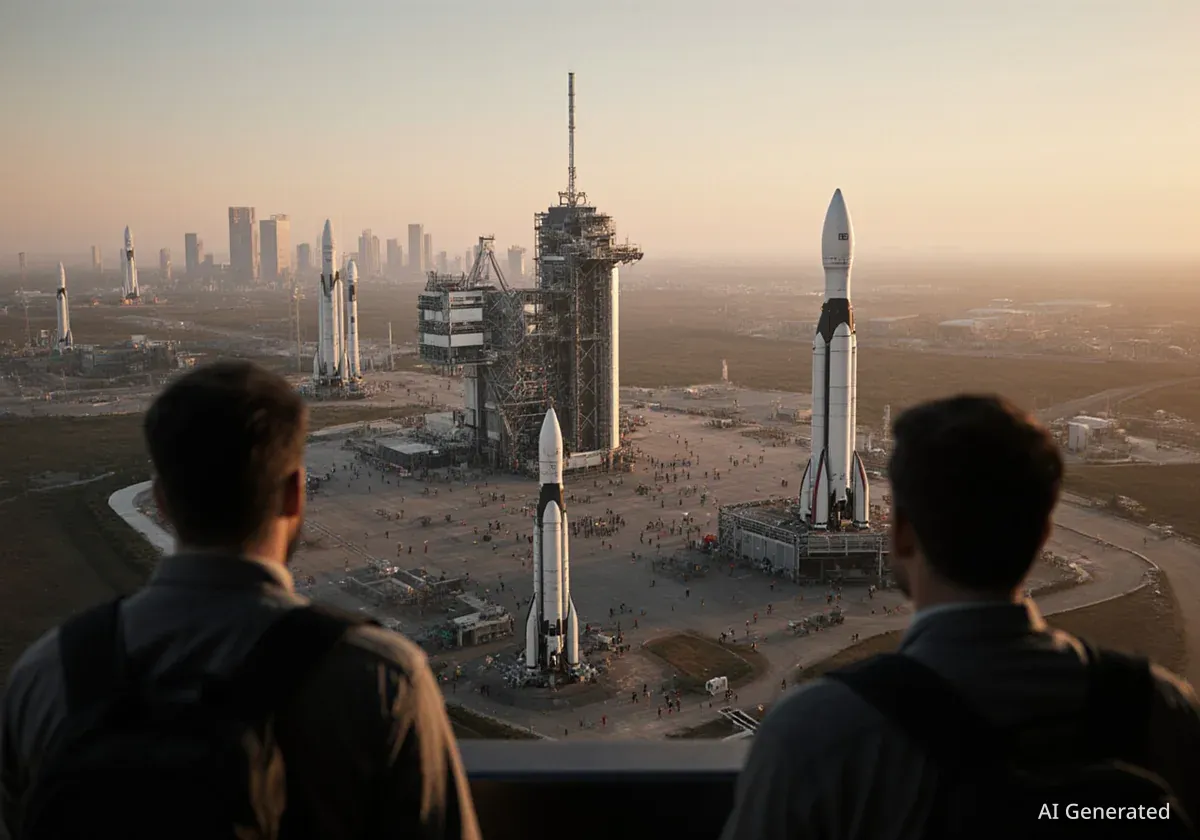

Blue Origin, the aerospace firm founded by Jeff Bezos, is preparing a major expansion of its space tourism operations. The company plans to build three new New Shepard vehicles to increase its flight frequency to as often as once per week, responding to growing demand for suborbital travel.
In addition to expanding its rocket fleet, Blue Origin is actively searching for a second launch site to supplement its current facility in West Texas. This strategic move aims to increase operational capacity and flexibility for its commercial spaceflights.
Key Takeaways
- Blue Origin is constructing three additional New Shepard rockets to expand its fleet.
- The company's goal is to achieve a launch cadence of up to one flight per week.
- A search is underway for a second launch site to support the increased operational tempo.
- The expansion is driven by strong market demand for suborbital space tourism and research flights.
Scaling Up for a New Era of Space Tourism
Blue Origin's decision to significantly increase its launch rate marks a pivotal moment for the suborbital spaceflight industry. The primary goal is to make space tourism more accessible by reducing wait times and increasing flight availability. By adding three new reusable vehicles to its fleet, the company intends to create a robust system capable of supporting weekly missions.
This accelerated schedule is designed to meet the rising interest from tourists, researchers, and commercial clients who want to experience a brief journey to the edge of space. According to industry reports, the demand for such flights has consistently outpaced the available supply.
"The goal is not just more flights but fostering a sustainable space economy," an executive familiar with the company's plans told GeekWire, highlighting the long-term vision behind the expansion.
The New Shepard program has already established a track record with over 30 flights. This history of operations provides the foundation for the planned increase in frequency. The company is leveraging its experience to streamline processes from manufacturing to launch turnaround.
The New Shepard System
The New Shepard is a fully reusable, vertical-takeoff, vertical-landing (VTVL) space vehicle. It consists of a pressurized capsule that carries passengers and a rocket booster. The system is designed to fly past the Kármán line, the internationally recognized boundary of space at 100 kilometers (62 miles) altitude, providing several minutes of weightlessness.
Expanding Infrastructure Beyond West Texas
A key component of Blue Origin's growth strategy is the establishment of a second launch site. The company's current base, Launch Site One in West Texas, has served as the hub for all New Shepard missions to date. However, a weekly launch cadence could create logistical bottlenecks at a single facility.
Sources familiar with the company's internal planning have indicated that a new location is being evaluated to add capacity and provide operational redundancy. While specific locations have not been disclosed, a second spaceport would enable more flexible scheduling and could better serve a global customer base.
This infrastructure growth is accompanied by an evolution in hardware. Blue Origin has been methodically upgrading its fleet, retiring older components to make way for newer, more advanced models. For example, the RSS H.G. Wells capsule was retired after completing its 12th flight, demonstrating the company's commitment to continuous improvement and reusable technology.
Proven Flight Record
As of September 2025, the New Shepard program had successfully completed missions like NS-35, which carried over 40 scientific payloads to space. This mission demonstrated the platform's utility for both tourism and research.
Financial Strategy and Market Position
The New Shepard program has already proven to be a significant revenue generator. By mid-2022, the operation had surpassed $100 million in revenue from ticket sales. The company has attracted high-profile customers, including crypto entrepreneur Justin Sun, who flew on the NS-34 mission in August 2025.
To broaden its customer base, Blue Origin has embraced modern payment methods. Through a partnership with the payment processing company Shift4, Blue Origin accepts cryptocurrencies such as Ethereum and Bitcoin for flight bookings. This move opens new financial channels and appeals to a tech-savvy demographic.
In the competitive landscape of commercial spaceflight, Blue Origin's strategy focuses on reliability and scale. While competitors like Virgin Galactic have faced their own operational challenges, Blue Origin aims to position itself as the market leader in suborbital tourism through a consistent and frequent flight schedule.
Technical Advancement and Future Challenges
Underpinning the planned expansion is Blue Origin's investment in its propulsion technology. By 2024, the company had already constructed five propulsion modules, the powerful engines that lift the New Shepard rocket. More are planned to support the new vehicles and ensure a steady supply for the weekly launch target.
However, achieving this ambitious goal is not without challenges. The company has faced delays in the past, such as a four-week postponement of the NS-35 mission due to an avionics issue. Scaling up production and operations will require a robust supply chain and a skilled workforce to avoid similar setbacks.
Furthermore, securing regulatory approvals for a new launch site and streamlining manufacturing processes will be critical hurdles. Success in these areas will be essential to realizing the company's vision for accessible commercial space travel in the next decade.
This expansion is a crucial step in Jeff Bezos's broader vision of creating a future where millions of people live and work in space. The New Shepard program serves as a practical and economic foundation for more ambitious projects, including the orbital-class New Glenn rocket and lunar exploration initiatives.