


New analysis of NASA's Double Asteroid Redirection Test (DART) mission reveals the 2022 impact had a more significant effect than first reported. Scientists have now confirmed the spacecraft not only altered the orbit of the small asteroid Dimorphos around its larger companion, Didymos, but it also changed the path of the entire two-asteroid system around the sun.
This finding provides stronger evidence that humanity possesses the technology to deflect a potentially hazardous asteroid, a key milestone in planetary defense strategies. The mission, which intentionally crashed a spacecraft into an asteroid, has now demonstrated an ability to influence celestial bodies on a larger scale.
Key Takeaways
- New data confirms NASA's DART mission altered the solar orbit of the Didymos-Dimorphos asteroid system.
- The 2022 impact was initially celebrated for shortening Dimorphos's orbit around Didymos by 32 minutes.
- This secondary, larger-scale orbital shift demonstrates that kinetic impactor technology is more effective for planetary defense than previously proven.
- The mission provides crucial data for developing future strategies to protect Earth from potential asteroid threats.
A Landmark Mission in Planetary Defense
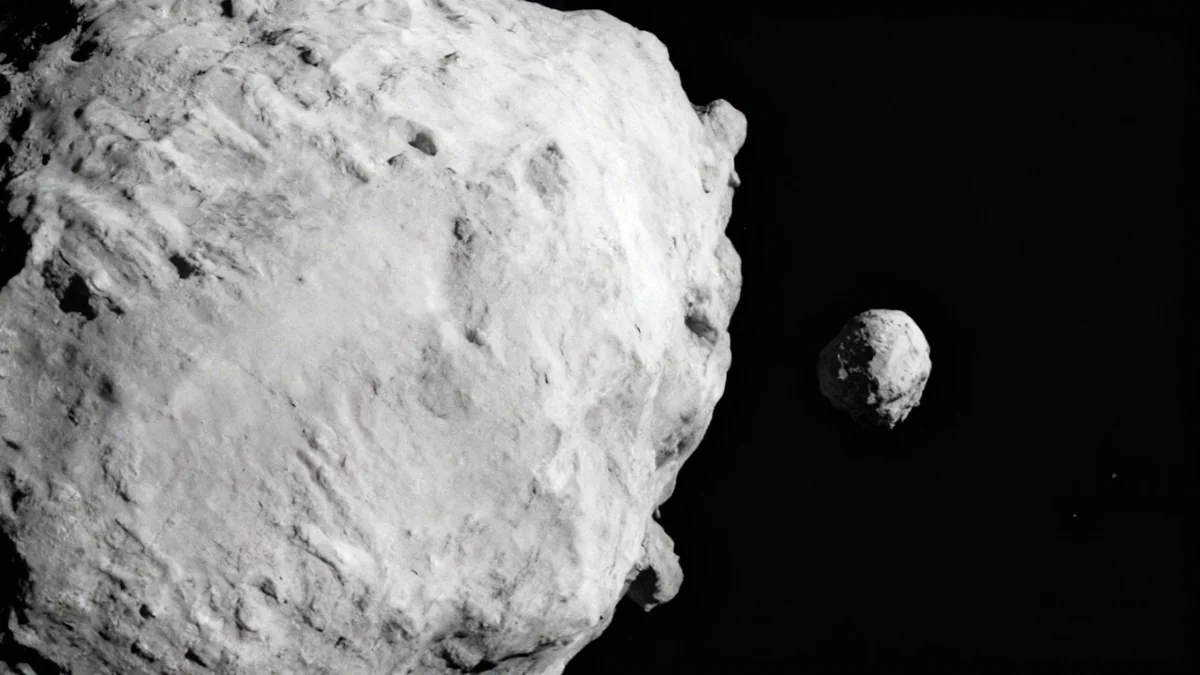
In September 2022, the world watched as NASA's DART spacecraft completed its one-way journey. Its target was Dimorphos, a small moonlet asteroid orbiting a larger parent asteroid named Didymos. The mission had a single, clear objective: to crash into Dimorphos and see if the kinetic force could change its trajectory.
This was not an academic exercise. It was the first-ever practical test of a method for planetary defense. The goal was to prove that if a dangerous asteroid were ever discovered on a collision course with Earth, humanity could potentially send a spacecraft to give it a nudge, altering its path enough to miss our planet.
Understanding the Target
The Didymos system was an ideal candidate for this test. It is a binary asteroid system, meaning two asteroids orbit each other. Didymos is about 780 meters in diameter, while its smaller moonlet, Dimorphos, is roughly 160 meters. Crucially, their path posed no threat to Earth, making them a safe target for this planetary defense experiment.
The DART spacecraft, about the size of a vending machine, traveled millions of miles to intercept its target. Onboard cameras streamed its final moments, showing the rocky surface of Dimorphos growing larger until the signal was lost at the moment of impact. The collision was a success, creating a massive plume of dust and rock that was observed by telescopes on Earth and in space, including the Hubble and James Webb Space Telescopes.
Initial Results Exceed Expectations
Shortly after the impact, scientists began analyzing data to measure the mission's effect. The primary metric was the change in Dimorphos's orbital period around Didymos. Before the collision, it took Dimorphos 11 hours and 55 minutes to complete one orbit. Researchers had hoped to shorten this time by at least 73 seconds, but they were prepared for a change of up to 10 minutes.
The results were far more dramatic. Analysis revealed that the impact had shortened Dimorphos's orbit by a full 32 minutes. This was a resounding success, proving that the kinetic impactor technique was highly effective. The force of the spacecraft, combined with the recoil from the ejected debris, gave the small asteroid a significant push.
By the Numbers: DART's Success
- Target: Dimorphos (160-meter moonlet)
- Parent Asteroid: Didymos (780-meter diameter)
- Original Orbit Time: 11 hours, 55 minutes
- New Orbit Time: 11 hours, 23 minutes
- Change in Orbit: 32 minutes shorter
This initial finding was celebrated as a major victory for planetary defense. It confirmed that a relatively small, targeted impact could produce a measurable and significant change in an asteroid's path. For years, this was a theoretical concept, but DART provided the first concrete proof.
A Broader Impact on the Solar System
While the change to Dimorphos's local orbit was the headline news, scientists continued to study the long-term effects on the asteroid system. A new study has now confirmed a secondary, and arguably more profound, outcome: the DART impact also altered the trajectory of the entire Didymos-Dimorphos system as it orbits the sun.
Think of it like this: the original goal was to change how the moon (Dimorphos) orbited its planet (Didymos). The new finding shows that the mission also changed how that planet and its moon together orbit their star (the sun). While the change to the solar orbit is incredibly small, its confirmation is a critical piece of the planetary defense puzzle.
"This demonstrates that we are capable of modifying the trajectory of a celestial body on a larger scale," explained a planetary scientist involved in the analysis. "It's one thing to affect a small moon; it's another to show you can alter the course of the entire system. This is what would be necessary to divert an Earth-bound object."
The effect on the solar orbit confirms that the energy transferred during the impact propagated through the entire binary system. This provides scientists with a much richer dataset for modeling future deflection scenarios. It helps them understand how energy is absorbed and redistributed in a binary asteroid system, which are common throughout the solar system.
Implications for Protecting Earth
The confirmation that DART shifted the entire system's solar orbit reinforces the viability of using kinetic impactors to protect our planet. It proves that the technique can deliver the necessary change in velocity—a 'nudge'—to alter an asteroid's course over the vast distances of space.
If a hazardous asteroid were detected years or decades before a potential impact with Earth, a mission like DART could be launched. Even a tiny change in its velocity, applied far enough in advance, would be enough for the asteroid to miss Earth by a safe margin years later.
Key lessons from the DART mission include:
- Effectiveness: The kinetic impactor technique works and can exceed expectations.
- Debris Matters: The recoil from the ejected rock and dust (ejecta) significantly amplified the spacecraft's push, a phenomenon known as momentum enhancement.
- System-Wide Change: The impact's force is sufficient to alter the heliocentric (sun-centered) orbit of a binary asteroid system.
Future missions, like the European Space Agency's Hera mission, will visit the Didymos system to study the aftermath of the DART impact in detail. Hera will measure Dimorphos's mass, examine the crater left by DART, and provide even more data to refine our planetary defense models. The success of DART has laid the groundwork for a robust and testable strategy to ensure the long-term safety of our planet.