


In a historic first for planetary defense, NASA's Double Asteroid Redirection Test (DART) mission has been confirmed to have permanently altered the solar orbit of an entire binary asteroid system. New research reveals that the 2022 impact on the small asteroid Dimorphos not only changed its path around its larger companion, Didymos, but also minutely adjusted the pair's shared journey around the sun.
Key Takeaways
- New data confirms NASA's DART spacecraft impact in 2022 altered the orbit of the entire Didymos-Dimorphos asteroid system around the sun.
- The system's 770-day solar orbit was permanently shortened by approximately 0.15 seconds, a small but measurable change.
- This marks the first time humanity has intentionally changed the orbital path of a celestial body around the sun, validating the kinetic impactor method for planetary defense.
- The change was primarily caused by the massive ejection of rock and dust from Dimorphos, which provided a greater momentum push than the spacecraft itself.
A Groundbreaking Planetary Defense Test
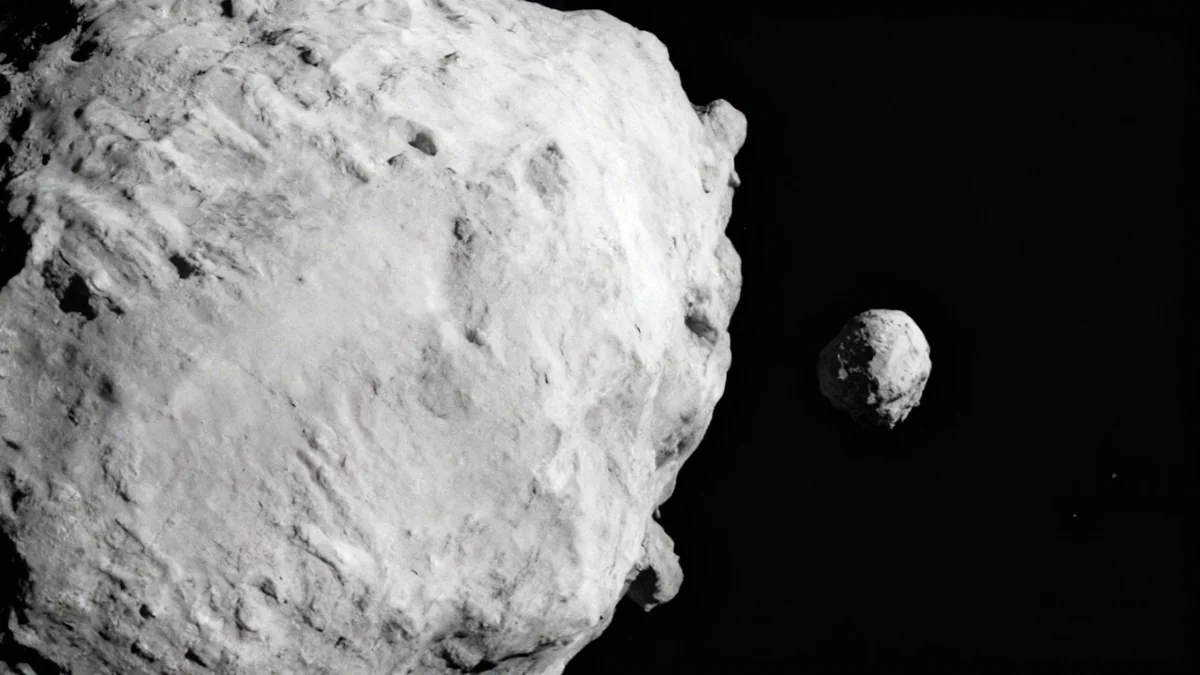
In September 2022, a NASA spacecraft deliberately collided with Dimorphos, a small asteroid orbiting a larger one named Didymos. The primary goal was to test if a 'kinetic impactor' could nudge a potentially hazardous object off a collision course with Earth. While the Didymos system poses no threat to our planet, it served as an ideal target for this crucial experiment.
Initial findings quickly showed success on a local scale. The impact dramatically shortened Dimorphos's 12-hour orbit around Didymos by an impressive 33 minutes. However, scientists have now confirmed a more profound and far-reaching consequence: the collision also altered the trajectory of the entire binary system as it travels through space.
A Tiny Shift with Big Implications
The change to the system's solar orbit is incredibly small. The time it takes for Didymos and Dimorphos to circle the sun, about 770 days, was reduced by just 0.15 seconds. This translates to an orbital speed change of only 11.7 microns per second, or about 1.7 inches per hour.
While seemingly insignificant, this level of precision demonstrates the effectiveness of the technique. "Over time, such a small change in an asteroid’s motion can make the difference between a hazardous object hitting or missing our planet," stated Dr. Rahil Makadia, a planetary defense scientist who worked on the DART team.
The Power of Ejected Debris
The mission's success was amplified by an unexpected factor: the debris blasted from the impact. Dimorphos, believed to be a loosely-held 'rubble pile' asteroid, lost about 0.5% of its mass in the collision. This resulted in a massive cloud of debris weighing an estimated 16 million kilograms (35.3 million pounds).
This ejected material created a powerful recoil effect, much like the thrust from a rocket engine. Scientists determined that the momentum from this spewing rubble provided a greater push to the asteroid system than the initial impact from the 1,200-pound spacecraft. This debris-driven momentum boost was the primary driver behind the change in the system's solar orbit.
What is a Binary Asteroid?
A binary asteroid system consists of two asteroids that orbit each other while they also orbit the sun together. In this case, the smaller Dimorphos (about 170 meters wide) orbits the larger Didymos (about 780 meters wide). Because they are gravitationally bound, a change to one asteroid's motion inevitably affects the other.
Precision Measurement Through Global Collaboration
Confirming such a minuscule change in an object millions of miles away required extraordinary effort and precision. Astronomers relied on a technique known as stellar occultation, which involves carefully timing the moment an asteroid passes in front of a distant star, causing it to briefly 'blink' out from our perspective on Earth.
Observing these fleeting events is incredibly challenging and highly dependent on weather and location. The new findings are based on 22 separate stellar occultation observations conducted between October 2022 and March 2025 by a global network of volunteer astronomers.
"This work is highly weather dependent and often requires travel to remote regions with no guarantee of success. This result would not have been possible without the dedication of dozens of volunteer occultation observers around the world."
These observations, combined with years of existing ground-based data, allowed researchers to calculate the system's exact position and speed before and after the DART impact, thereby confirming the change.
What's Next for Planetary Defense?
The DART mission's success provides a crucial proof-of-concept for protecting Earth. It validates that a kinetic impactor can not only deflect a single asteroid but can also influence a more complex binary system. This could be vital if a dangerous asteroid is discovered with a smaller companion.
More data is on the way. The European Space Agency’s (ESA) Hera mission, launched in 2024, is currently en route to the Didymos system. It is scheduled to arrive later this year to conduct a detailed post-impact survey.
- Close-Up Inspection: Hera will study the DART impact crater, measure Dimorphos's mass, and analyze its composition.
- New Images: The first new images of the altered asteroid are expected this fall.
- Refined Models: Data from Hera will help scientists refine their models for how rubble pile asteroids respond to impacts.
Meanwhile, NASA continues to develop its capabilities for detecting potentially hazardous objects. The upcoming Near-Earth Object (NEO) Surveyor mission will be a space-based telescope designed to find and track asteroids, including those that are difficult to spot from Earth.
The DART mission has officially moved planetary defense from theory to practice. By successfully nudging a distant asteroid system, humanity has taken a significant step toward securing its future in the cosmic neighborhood.