



Top military commanders have confirmed the U.S. Space Force is playing a critical, yet largely unseen, role in the ongoing Operation Epic Fury. While officials remain guarded about specifics, citing operational security, they credit the service with degrading Iranian military capabilities and protecting American forces through non-kinetic effects in space.
Experts suggest these operations almost certainly involve advanced electronic warfare, including the jamming and spoofing of Iranian satellite communications. This new form of warfare, conducted from the ultimate high ground, marks a significant moment for the nation's youngest military branch, demonstrating its capabilities on the modern battlefield.
Key Takeaways
- U.S. military leaders praised the Space Force for its role in Operation Epic Fury, highlighting its ability to degrade enemy capabilities.
- Operations are described as "non-kinetic," with experts pointing to electronic warfare like satellite jamming and spoofing.
- The Space Force utilizes several ground-based systems, including the Counter Communications System (CCS) and newer Meadowlands and RMT jammers.
- These actions disrupt Iran's ability to communicate, coordinate forces, and use its own space assets for targeting.
A Critical Enabler in the Fight
In recent statements, senior military officials have begun to pull back the curtain, however slightly, on the Space Force's contributions to the conflict with Iran. The praise has been consistent, emphasizing the strategic advantage gained through dominance in the space domain.
Adm. Brad Cooper, commander of U.S. Central Command (CENTCOM), stated that the Space Force's efforts have been a "critical enabler" from the outset. In a video address, he outlined the service's dual mission in the operation.
"Unseen by the world, the Space Force is doing two things. First, they’re degrading Iranian capability and second, they’re helping to protect American forces, and I’ll have to leave it right there," Adm. Cooper said.
His remarks echoed earlier comments from Gen. Dan Caine, Chairman of the Joint Chiefs of Staff, who identified U.S. Space Command (SPACECOM) and Cyber Command as the "first movers" in the conflict. According to Gen. Caine, these commands layered non-kinetic effects to disrupt and blind Iran's ability to see, communicate, and respond.
The Meaning of 'Non-Kinetic' Effects
While official channels have declined to provide further details, former Pentagon officials and space warfare experts have provided clarity on what these statements imply. The consensus points directly to electronic warfare (EW) targeting Iran's satellite infrastructure.
"Establishing 'space superiority' in this case generally means jamming SATCOM systems that the Iranians might be using," one former Pentagon space official explained. This involves interfering with the signals traveling between Iranian satellites and their ground stations, effectively severing communication links.
These actions can have a profound impact on military operations. According to Victoria Samson of the Secure World Foundation, the effects are widespread. "Electronic warfare means that Iranian military units are having trouble or cannot communicate with each other, which impedes their ability to fight," she noted. This can also involve spoofing, or sending false signals to confuse GPS-reliant systems, and cyber operations to disable ground-based processing systems.
Iran's Satellite Network
The Iranian government and commercial entities own approximately 17 satellites. However, only one, the Khayyam Earth observation satellite launched in 2022, is considered a military asset. The primary targets for U.S. electronic warfare are the communication links that support these and other systems.
The Tools of a New Trade
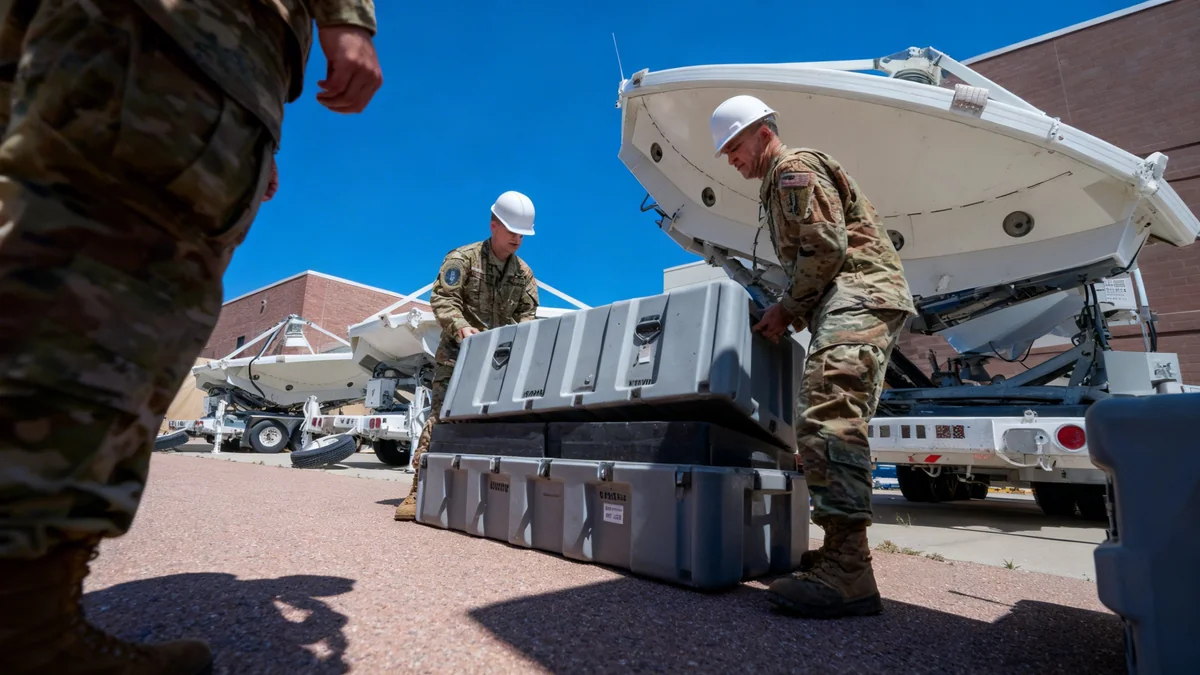
The U.S. Space Force has been publicly developing and deploying the tools for this exact mission for years. Its counterspace capabilities are managed by Mission Delta 3 and are designed to achieve what the military calls "space electromagnetic warfare." These are not space-based weapons, but rather sophisticated, ground-based systems that target adversary satellites from Earth.
The service operates at least three distinct satellite communication jamming systems:
- Counter Communications System (CCS): The original jamming system, first deployed in 2004. The latest version, CCS 10.2, was completed in 2020 by L3Harris. There are 16 operational units deployed globally, including within the CENTCOM area of responsibility.
- Meadowlands: A follow-on to the CCS, also developed by L3Harris. This system is lighter, more mobile, and can be operated remotely, reducing the risk to personnel. It is capable of jamming multiple frequency bands and has been in operational testing since 2025.
- Remote Modular Terminal (RMT): A miniature jamming system developed by the Space Rapid Capabilities Office. RMTs are designed to be highly portable and can block adversary "kill chains" and targeting links. As of late 2024, dozens of units had been delivered to the Space Force for operational use.
These systems work by targeting the uplink signals from ground stations to satellites. A former Pentagon official described the process as either "brute force," overpowering the satellite's receiver, or a more "exquisite" approach that targets specific channels or users.
Lt. Gen. Dennis Bythewood, a senior Space Force commander, recently emphasized that such capabilities are often the first to be used in any conflict. "When we look at electronic warfare, being able to preclude any adversary from using their space systems the same way we would want to use ours," he said, highlighting the goal of denying the enemy the advantages of space.
Space Force vs. SPACECOM
It's important to distinguish between the U.S. Space Force and U.S. Space Command (SPACECOM). The Space Force is a military service responsible for organizing, training, and equipping personnel, known as Guardians. The SPACECOM is a combatant command responsible for conducting military operations in space. In this conflict, the Space Force provides the trained Guardians and the EW systems, while SPACECOM directs their operational use to support joint forces.
A Decisive, Invisible Advantage
The impact of these unseen operations appears to be significant. Defense Secretary Pete Hegseth noted that space provides the "ultimate high ground," allowing the U.S. to deliver supporting effects to cover ground forces. His recent assessment of the situation on the ground suggests the strategy is working.
"They can barely communicate, let alone coordinate. They are confused; we know it," Hegseth stated in a morning briefing, alluding to the success of the non-kinetic campaign.
The component responsible for executing these missions within the theater is Space Forces-Central (SPAFORCENT), which is assigned to CENTCOM. Activated in 2022 and headed by Brig. Gen. Todd Benson, this unit embeds Space Force Guardians directly with the regional command, ensuring seamless integration of space effects into the broader military plan.
While the exact number of personnel and systems deployed for Operation Epic Fury remains classified, the public statements from top leadership signal a new era of warfare. The conflict is providing the first major test case for the Space Force's counterspace doctrine, proving that battles can be shaped and won through the control of the electromagnetic spectrum, miles above the Earth's surface.