



U.S. Secretary of the Air Force Troy Meink has issued a stark warning against underestimating China's technological prowess, stating that its rapid advancements in space and missile technology are the result of significant independent innovation, not just imitation of American systems. Speaking at the Spacepower conference in Orlando, Florida, Meink emphasized that Beijing is closing the technology gap at an alarming rate, challenging the long-held U.S. dominance in the space domain.
Meink's comments reflect a growing consensus among defense and intelligence officials that China represents the primary “pacing challenge” for the United States. He stressed that while China does learn from U.S. designs, it is a mistake to dismiss their progress as mere copying, pointing to their impressive launch cadence and manufacturing scale as evidence of a sophisticated and self-sufficient industrial base.
Key Takeaways
- U.S. Air Force Secretary Troy Meink stated China's space and missile progress is driven by genuine innovation, not just copying U.S. technology.
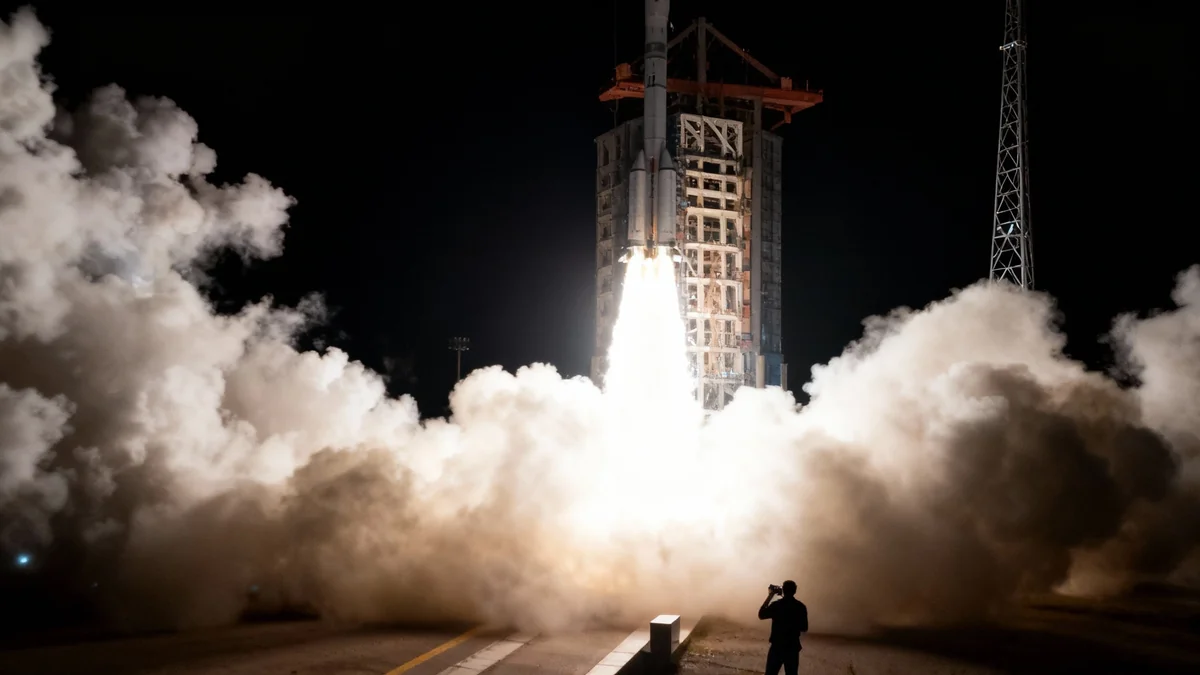
- China's launch infrastructure and manufacturing capabilities are rapidly advancing, with some facilities resembling those on the U.S. Space Coast.
- Beijing's ability to produce military systems at a massive scale presents a significant challenge to the U.S. defense industrial base.
- The assessment labels China as the United States' primary "pacing challenge," requiring the U.S. to accelerate its own development and acquisition cycles.
A Shift in Perception
For decades, a common assumption within defense circles was that China's technological growth relied heavily on reverse-engineering or stealing American designs. Secretary Meink directly challenged this outdated view, arguing that it fosters a dangerous sense of complacency.
During his address, he recalled a time when China developed systems at roughly half the speed of the United States. This slower pace led some observers to dismiss the threat, believing Beijing would always remain a generation behind. "However, that is just not true at all," Meink asserted, noting that the gap has been closed "not just in space, but across the board."
"They are copying us in many ways. But don’t let that confuse you. They are very, very innovative as well. It’s not just copying us. They are super innovative in how they’re operating, which puts even more pressure on us to innovate faster."
Meink described a recent tour of U.S. Space Force launch facilities at Cape Canaveral, noting the striking similarities with China's newest launch complexes. "You actually look at some of the videos that just came out, it actually looks like some of our factories down the road," he said, highlighting the parallel development in infrastructure and industrial capability.
The Missile and Launch Challenge
Beyond space infrastructure, Meink highlighted China's significant strides in missile development. He pointed to the country's expanding and diverse arsenal as a clear indicator of its independent research and development capabilities.
China's Growing Arsenal
According to U.S. defense assessments, China's missile inventory includes a wide range of systems designed to counter American military power in the Indo-Pacific. This includes advanced conventional ballistic missiles, hypersonic glide vehicles that can evade traditional defenses, and anti-satellite weapons capable of disrupting critical U.S. space assets.
"It’s just amazing how quickly the Chinese and other adversaries are advancing in missiles," Meink remarked. He explained that missile technology requires extensive and reliable testing for validation, a process that cannot be accomplished solely through espionage. "They didn’t steal all from us. They’re doing a lot themselves. So we have to, again, move faster."
This rapid progress is also visible in China's space launch activities. "How they’re trying to catch up with launch is super impressive," Meink said. He acknowledged the long history of U.S. leadership in global launch but noted that China is making "massive improvements" in an effort to close that gap and potentially surpass the U.S. launch cadence.
The Advantage of Scale
One of the most significant challenges identified by Secretary Meink is China's immense manufacturing capacity. He expressed concern over the sheer volume of systems Beijing can produce and deploy, a scale that the U.S. industrial base is currently not structured to match.
A Tale of Two Industries
The U.S. defense production model often relies on small-batch manufacturing, facing constraints from complex supply chains and lengthy acquisition cycles. In contrast, China's state-directed economy allows for rapid, large-scale production, enabling it to field new technologies in vast numbers.
"Nobody’s ever really seen, to be quite honest, the numbers of those systems, it’s just phenomenal how quickly they’re moving," Meink stated. This ability to scale production gives China a distinct advantage, allowing it to potentially overwhelm adversaries with quantity, even as it improves the quality of its technology.
Pentagon officials have recognized this disparity and are actively seeking to reform the U.S. procurement process. The goal is to shift towards more responsive and agile manufacturing models, but overcoming long-standing industrial bottlenecks remains a difficult and slow-moving effort.
The Pacing Threat
Secretary Meink's remarks align with the Pentagon's official designation of China as the nation's foremost "pacing challenge." This term signifies that China's military modernization is the primary driver shaping U.S. defense strategy, planning, and investment for the foreseeable future.
"The Chinese are a concerning adversary," Meink said. "But the bottom line is that if you deal with that threat, you can deal with most all threats. They’re not the only threat that we have to worry about, but they are obviously the driver. If you can’t deal with that, you’re gonna have a bad day."
This perspective underscores the urgency within the U.S. Department of Defense to accelerate its own technological development. The warning from a top Air Force official serves as a call to action for both the government and the defense industry to recognize the reality of China's capabilities and respond with increased speed, innovation, and a reformed approach to manufacturing and acquisition.