
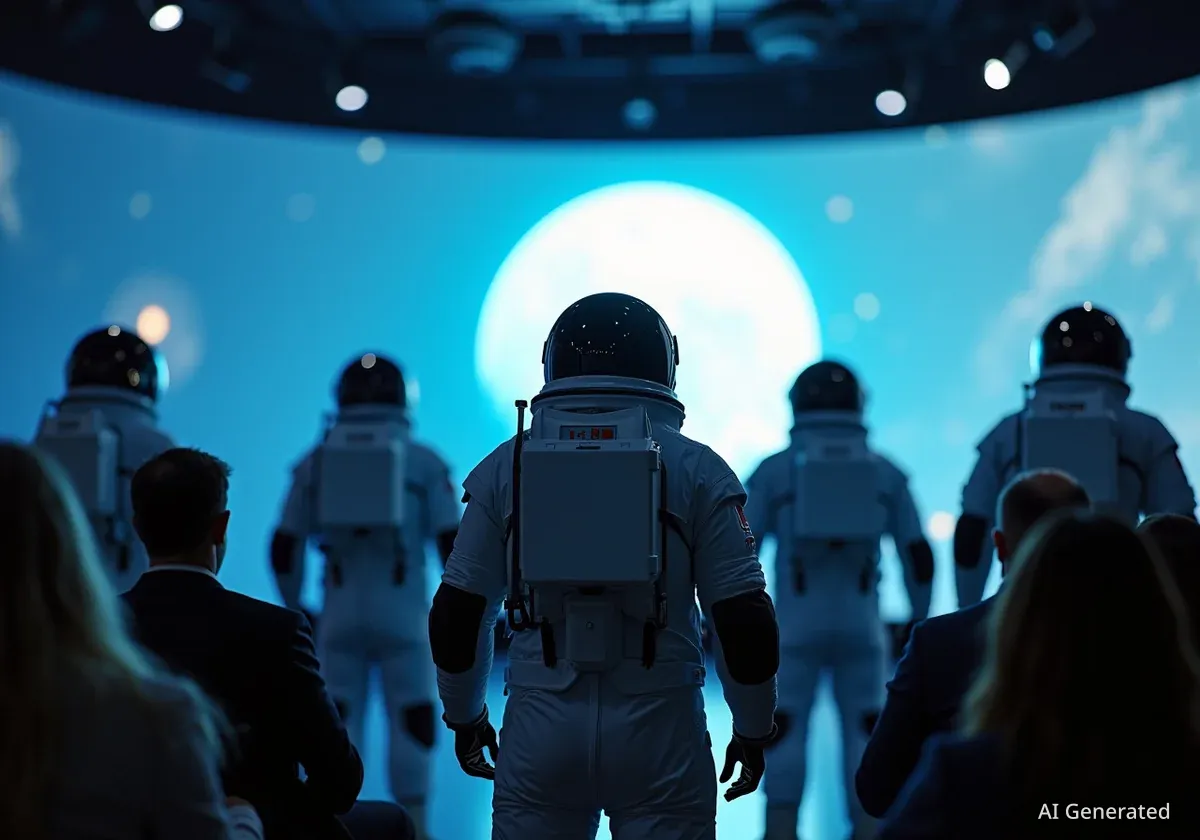
NASA introduced its new class of astronaut candidates on September 22, 2025, a significant development in human spaceflight that occurred during a period of intense activity across the space sector. The announcement was complemented by a rapid series of rocket launches by SpaceX, major scientific discoveries including a new exoplanet milestone, and key international policy updates.
Key Takeaways
- NASA announced its 2025 astronaut candidate class, the first new group since 2021, selected from over 8,000 applicants.
- SpaceX completed two successful Falcon 9 launches within 24 hours, deploying both Starlink internet satellites and a classified payload for the U.S. National Reconnaissance Office.
- Scientists confirmed the discovery of the 6,000th exoplanet, a major milestone in the search for worlds beyond our solar system.
- NASA and ESA finalized an agreement for the 2028 launch of the ExoMars rover, with NASA providing key hardware components.
- A potential U.S. government shutdown on October 1 threatens to disrupt operations at NASA and other space agencies.
Intense Launch Activity Marks a Busy Weekend
The space industry demonstrated a high operational tempo over the weekend, with multiple companies executing significant missions. SpaceX, in particular, maintained its aggressive launch schedule with back-to-back flights from different coasts of the United States.
SpaceX Conducts Two Launches in 24 Hours
On September 21, SpaceX launched its 119th Falcon 9 mission of the year from Cape Canaveral, Florida. The rocket carried 28 Starlink internet satellites into low Earth orbit. The first-stage booster, completing its 11th flight, landed successfully on a droneship in the Atlantic Ocean.
Just a day later, on September 22, another Falcon 9 rocket lifted off from Vandenberg Space Force Base in California. This mission, designated NROL-48, carried a classified payload for the U.S. National Reconnaissance Office. The payload is widely understood to be part of the Starshield satellite constellation, a network for national security purposes. The booster for this mission also completed a successful landing at a ground-based site in California.
Record-Breaking Pace
SpaceX's 119 Falcon 9 launches by late September 2025 highlight the company's ability to maintain a launch frequency that far exceeds any other provider globally, playing a critical role in deploying large satellite constellations and serving government clients.
Blue Origin and NASA Prepare for Future Missions
Blue Origin also marked a return to flight on September 18 with its New Shepard suborbital vehicle. The uncrewed NS-35 mission successfully carried over 40 research and educational payloads above the Kármán line before both the capsule and booster returned safely to the ground in West Texas. This flight occurred after a month-long delay due to a technical issue.
Looking toward orbital missions, Blue Origin is preparing for the second launch of its heavy-lift New Glenn rocket, scheduled for September 29. This mission is notable as it will carry NASA's twin ESCAPADE Mars probes, marking Blue Origin's first interplanetary mission for the space agency.
Meanwhile, NASA and NOAA are finalizing preparations for the September 23 launch of the Interstellar Mapping and Acceleration Probe (IMAP). The mission, launching on a SpaceX Falcon 9, will travel to the L1 Lagrange point to study the boundary of our solar system. It will be accompanied by two secondary payloads: NOAA's SWFO-L1 for space weather monitoring and NASA's Carruthers Geocorona Observatory.
Developments in Human Spaceflight
The focus on human exploration saw significant progress, with NASA introducing its next generation of explorers and preparing for its upcoming crewed mission to the Moon.
NASA Introduces 2025 Astronaut Class
At a ceremony at the Johnson Space Center on September 22, NASA officially introduced its newest class of astronaut candidates. Selected from a pool of more than 8,000 applicants, this is the first new group of trainees since the 2021 class.
The candidates, who come from diverse backgrounds in science, engineering, medicine, and piloting, will now begin approximately two years of rigorous training. Their instruction will cover spacecraft systems, robotics, spacewalking, and the Russian language. Upon graduation, they will be eligible for assignments to the International Space Station, future Artemis missions to the Moon, and potentially the first human missions to Mars.
Artemis II Mission Preview
NASA also scheduled briefings on September 23 and 24 to provide details about the upcoming Artemis II mission. Planned for spring 2026, Artemis II will be the first crewed flight of the Orion capsule, sending four astronauts on a 10-day journey around the Moon. It will be the first time humans have traveled beyond low Earth orbit in over 50 years.
Mission managers are expected to discuss the flight plan, which involves a lunar flyby, and key objectives like testing Orion's life support systems. The mission will also deploy several small satellites and carry microgravity experiments to study the effects of deep space radiation.
Major Scientific Breakthroughs Announced
The period was also marked by two significant scientific announcements that expand our understanding of the cosmos, from distant planets to the extreme environment around a supermassive black hole.
Exoplanet Catalog Reaches 6,000 Confirmed Worlds
On September 21, NASA confirmed that the number of known exoplanets has officially surpassed 6,000. This milestone was reached three decades after the first exoplanets were discovered. The count crossed the threshold after a new batch of verified planets was added to the official NASA Exoplanet Archive.
"This milestone represents decades of exploration… a foundation to answering ‘Are we alone?’," said Shawn Domagal-Goldman, NASA’s acting astrophysics chief, highlighting the importance of this achievement.
The discoveries, made by telescopes like Kepler and TESS, have revealed an incredible diversity of worlds, from rocky planets similar to Earth to gas giants and other exotic types of planets not found in our solar system.
New Insights into M87 Black Hole
The Event Horizon Telescope (EHT) collaboration revealed new findings about the supermassive black hole at the center of the M87 galaxy. Observations show that the magnetic fields just outside the black hole's event horizon are highly turbulent and dynamic. Scientists noted a dramatic change in the polarization of light around the black hole between 2017 and 2021.
This discovery challenges previous models that treated the area as relatively stable. The findings suggest that complex and previously unknown physical processes are at work, offering a new view of how black holes consume matter and launch powerful jets of energy.
International Cooperation and Space Policy
Global partnerships and national strategic interests continue to shape the future of space exploration and security, with several key developments taking place.
The Geopolitical Landscape of Space
As more nations and private companies become active in space, issues of cooperation, security, and regulation are becoming increasingly important. International agreements like the Artemis Accords coexist with growing national security concerns and the development of defensive space capabilities.
NASA and ESA Solidify ExoMars Partnership
NASA and the European Space Agency (ESA) signed a formal agreement to move forward with the ExoMars Rosalind Franklin rover mission, now targeting a 2028 launch. Following the termination of cooperation with Russia, NASA will provide the launch vehicle, braking engines for landing, and radioisotope heater units for the rover. This partnership ensures the long-delayed mission to search for signs of past life on Mars can proceed.
Space Security and Government Funding
In response to a recent near-miss in orbit, India announced plans to develop "bodyguard" satellites to protect its valuable space assets from potential threats. This move reflects a growing trend among spacefaring nations to develop defensive capabilities in an increasingly congested orbital environment.
In the United States, a potential government shutdown looms as the October 1 deadline approaches without a budget agreement in Congress. A shutdown could furlough most NASA employees, halt planning for future missions, and delay contract payments, disrupting the momentum of both scientific and exploration programs.