
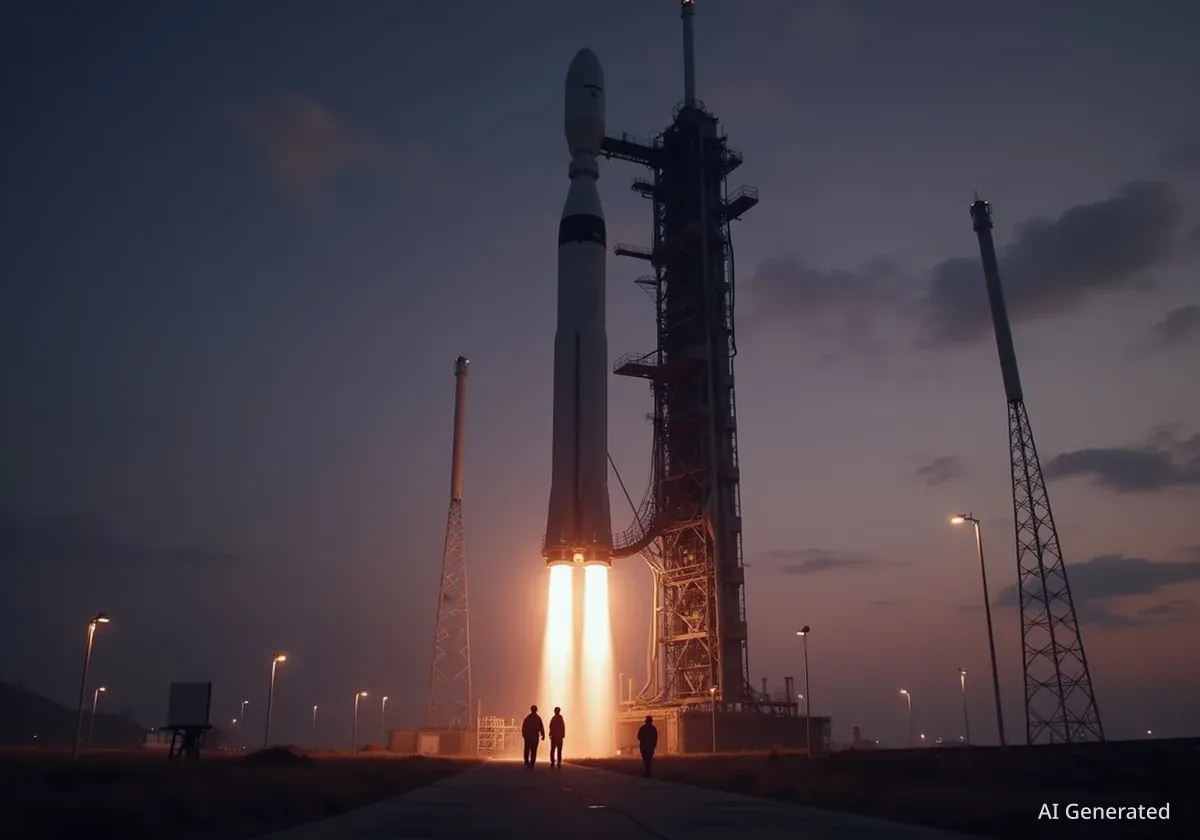
NASA welcomed its newest class of astronaut candidates on September 22, 2025, at the Johnson Space Center in Houston. These 10 highly qualified individuals have now begun a rigorous, nearly two-year training program. This extensive preparation aims to make them flight-eligible for missions spanning low Earth orbit, the Moon, and eventually, Mars.
Key Takeaways
- NASA's new class of 10 astronaut candidates started training on September 22, 2025.
- The training program lasts nearly two years and covers a wide range of skills.
- Candidates will prepare for missions to low Earth orbit, the Moon, and Mars.
- Training includes space health, flight skills, spacewalk simulations, and robotics.
- The program emphasizes teamwork and problem-solving for future space missions.
Comprehensive Training for Future Missions
The training schedule for these astronaut candidates is both comprehensive and demanding. It covers various aspects essential for space travel and living. The curriculum begins with a deep dive into NASA's history and its future vision. Candidates learn how astronauts contribute to the agency's overarching mission of exploration and scientific discovery.
A significant portion of the training focuses on space health. This includes understanding the effects of radiation exposure and microgravity on the human body. Candidates also study space food and nutrition. They learn how to use specialized exercise equipment found on the International Space Station (ISS). Additionally, first aid and emergency medical care for crewmates are critical components of their health training.
Fact: International Space Station
The International Space Station is nearing 25 years of continuous human presence in space. This orbiting laboratory serves as a vital platform for scientific research and technology development, preparing humanity for longer journeys.
Developing Core Flight and Operational Skills
Each astronaut candidate will receive extensive flight training. This involves learning to pilot or enhancing existing piloting skills using the T-38 supersonic jet and other advanced aviation platforms. Proficiency in flight operations is a fundamental requirement for all NASA astronauts, regardless of their specific mission roles.
NASA's future exploration plans mean this class of astronauts could have diverse opportunities. Some may conduct research on the space station. Others might participate in lunar missions as a stepping stone for future human travel to Mars.
"Training was such an intense period that we got to know each other really well. Now when we come together, there are these moments — like we might be handing off a capcom shift, or we might be flying a jet together — and in those moments, I feel like I know them so well that we know how to navigate all sorts of challenges together and just be our best selves as a team."
— NASA astronaut Anil Menon, Group 23 (2021 class)
Preparing for Deep Space and Earth Sciences
To ensure readiness for any space destination, this class will undergo both space station-specific training and advanced preparation for deep space missions. These exercises are designed to help candidates solve complex problems and build strong relationships with their classmates. This teamwork is crucial for successful spaceflights.
Earth and planetary sciences also form a key part of their preparation. Astronauts study geology in classrooms and during field training. For example, NASA astronaut Marcos Berríos was observed studying rock samples during Earth and planetary sciences field training in northern Arizona. This knowledge is vital for understanding other planetary bodies.
Context: Astronaut Group 23
NASA's Astronaut Group 23, announced in 2021, included individuals like Anil Menon, Christina Birch, Andre Douglas, Christopher Williams, and Deniz Burnham. Their experiences provide valuable insights into the rigorous training process and the strong bonds formed among astronaut candidates.
Simulating Spacewalks and Robotics
Astronaut candidate training also includes foundational skills applicable across various space environments. The group will complete several dives in the Neutral Buoyancy Laboratory (NBL). This facility uses a large underwater pool with a full-scale mockup of the International Space Station to simulate spacewalks and maintenance tasks in microgravity.
Candidates also train inside mockups of other space vehicles. Here, they learn emergency procedures, spacecraft maintenance, and repair. This training also prepares them to contribute to future developmental programs for new spacecraft and systems.
- Robotics Training: Candidates learn to operate the Canadarm2 robotic arm, used for cargo operations and station maintenance on the ISS.
- Survival Training: Land and water survival training takes candidates through wilderness environments, building resilience and essential outdoor skills.
- Geology Studies: Classroom and field geology training prepares astronauts to identify and collect samples on other celestial bodies.
Advanced Simulations and Mission Control Experience
The training program incorporates a variety of simulations. These leverage Johnson Space Center's world-class facilities, virtual reality, and other immersive technologies. Such simulations allow candidates to practice complex tasks and react to unexpected scenarios in a controlled environment.
Additionally, the class will work shifts in the Mission Control Center in Houston. This experience provides them with a firsthand understanding of the ground support operations. It shows them the crucial role played by the teams who monitor astronauts and space vehicles during missions.
Statistic: Training Duration
The astronaut candidate training program typically lasts for approximately two years before individuals become eligible for flight assignments. This period is dedicated to acquiring a diverse set of skills and knowledge.
Graduation and Continued Learning
Upon successful completion of the training program, astronaut candidates participate in a graduation ceremony. After this, they officially become flight-eligible members of NASA's astronaut corps. They then receive office and ground support roles at Johnson Space Center while awaiting their future flight assignments.
Many active NASA astronauts emphasize that learning continues even after candidate training ends. According to astronaut Deniz Burnham, the hardest days can often be the most educational. "You get to learn, you get to improve, and then you’re still getting the opportunity. It’s such a positively unique experience and environment, and you can’t help but be grateful."
As NASA astronaut Frank Rubio, who serves as a class mentor, told the new group: "You’ll become part of a legacy of those who trained before you, continuing the adventure they started, and looking ahead to future human exploration." The journey to space is one of continuous growth and dedication.