
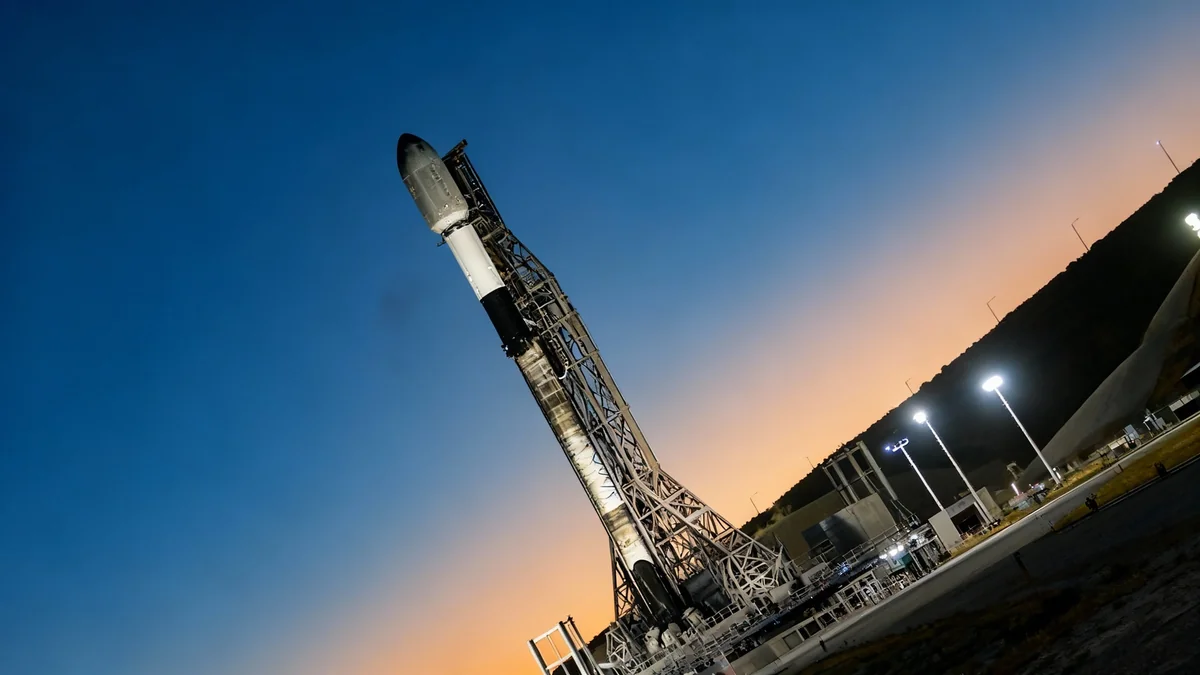


SpaceX successfully launched 25 Starlink satellites into orbit from California on Tuesday night, marking its first West Coast mission of 2026. The Falcon 9 rocket lifted off from Vandenberg Space Force Base, continuing the rapid expansion of the company's global internet constellation.
The mission, designated Starlink 17-30, also featured the successful landing of the rocket's first stage on a drone ship in the Pacific Ocean, highlighting the company's commitment to reusability.
Key Takeaways
- SpaceX launched 25 Starlink V2 Mini satellites from Vandenberg Space Force Base in California.
- This was the first Starlink mission from the West Coast in 2026 and the sixth Starlink launch for the company this year.
- The Falcon 9 first stage booster, B1093, completed its 10th successful flight and landing.
- The booster landed on the drone ship 'Of Course I Still Love You' in the Pacific Ocean.
Mission Details from Vandenberg
The Falcon 9 rocket ignited its engines and ascended from Space Launch Complex 4 East at 9:47 p.m. Pacific Standard Time on January 21, 2026. The rocket headed on a southerly trajectory, a path required to place the satellites into a polar low Earth orbit.
This type of orbit allows the Starlink constellation to provide internet coverage to regions at higher latitudes, including polar areas, ensuring more complete global service. The payload consisted of 25 Starlink V2 Mini Optimized satellites, the latest generation designed for increased bandwidth and capacity.
Why Launch from California?
While many SpaceX launches occur from Florida, Vandenberg Space Force Base is strategically important for missions requiring polar orbits. Its coastal location allows rockets to fly south over the open Pacific Ocean without passing over populated areas, a critical safety measure for this type of trajectory.
This launch represents the sixth dedicated Starlink mission for SpaceX in just the first three weeks of 2026, demonstrating an aggressive launch cadence aimed at building out the satellite megaconstellation.
A Veteran Booster's 10th Flight
A key element of the mission was the reuse of the Falcon 9 first stage booster, tail number B1093. This flight marked the 10th successful mission for this specific piece of hardware, a testament to the reliability and cost-effectiveness of SpaceX's reusable rocket system.
Before this mission, B1093 had a distinguished flight history. It previously launched seven other batches of Starlink satellites and completed two critical missions for the U.S. Space Development Agency, deploying national security assets.
"Reusability is fundamental to making life multi-planetary. The ability to rapidly and reliably reuse the most expensive parts of the rocket drives down the cost of access to space."
Just over eight minutes after liftoff, the booster performed a series of engine burns to guide itself back through the atmosphere, touching down precisely on the deck of the drone ship 'Of Course I Still Love You,' which was positioned in the Pacific Ocean.
Landing by the Numbers
- 10th Flight: The number of missions completed by booster B1093.
- 172nd Landing: The total number of successful landings on the drone ship 'Of Course I Still Love You'.
- 562nd Landing: The overall number of successful orbital booster landings for SpaceX across its fleet.
Expanding a Global Network
Each Starlink launch adds more capacity and coverage to SpaceX's satellite internet service, which aims to provide high-speed, low-latency broadband to underserved and remote areas around the world. The company has been building its constellation since 2019 and now has thousands of active satellites in orbit.
The development of private launch infrastructure, such as the company's Starbase facility in South Texas which broke ground in 2014, has been central to SpaceX's ability to maintain a high launch frequency. This vertical integration allows the company to control nearly every aspect of its satellite deployment, from manufacturing to launch.
The Pace of Deployment
SpaceX's ability to launch missions almost weekly is unprecedented in the history of spaceflight. This rapid deployment is made possible by a streamlined process and, most importantly, the reusability of its Falcon 9 boosters.
By recovering and reflying its first stages, SpaceX significantly reduces the cost per launch. This economic advantage has not only enabled the Starlink project but has also reshaped the entire commercial launch industry, making access to space more affordable for commercial and government customers alike.
As the Starlink constellation grows, the focus continues to be on improving service, reducing latency, and expanding coverage to connect the globe. Tuesday's successful mission from California is another steady step toward achieving that goal.