
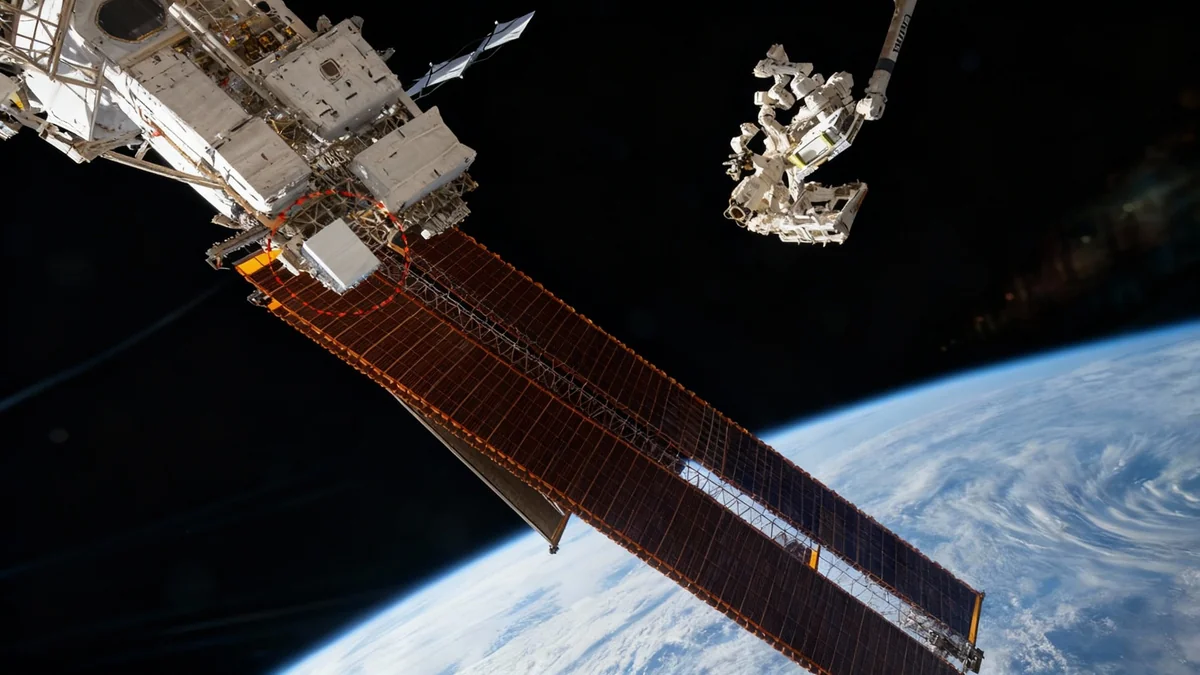


A NASA instrument originally designed to study dust in Earth's atmosphere has found a new purpose: detecting plastic pollution on land from its vantage point on the International Space Station. This breakthrough, achieved in late 2025, has inspired scientists to explore if the same technology can be adapted to track the vast amounts of plastic debris littering our oceans.
The sensor, known as the Earth Surface Mineral Dust Source Investigation (EMIT), can identify materials on the planet's surface by analyzing the unique patterns of light they reflect. While it successfully pinpointed plastic concentrations in terrestrial environments, researchers are now tackling the more complex challenge of spotting debris in water, a crucial step toward addressing a global environmental crisis.
Key Takeaways
- NASA's EMIT sensor, located on the ISS, has successfully detected plastic pollution on land for the first time.
- Researchers are developing a new spectral library to help sensors identify different types of marine debris, including 19 kinds of plastic.
- The ultimate goal is to use space-based technology to track the 8 million tons of plastic entering the ocean each year.
- Detecting plastic in the ocean is more difficult than on land because water absorbs infrared light, masking the material's signature.
A New Mission for an Earth-Watching Sensor
The EMIT instrument was launched to the International Space Station in 2022 with a clear objective: to map the mineral composition of Earth's desert regions. By understanding how dust absorbs and reflects sunlight, scientists aimed to improve climate models. However, the instrument's capabilities have proven far more versatile than initially planned.
Powered by a technology called imaging spectroscopy, pioneered at NASA's Jet Propulsion Laboratory (JPL), EMIT can identify hundreds of different compounds by their unique spectral fingerprints. This same technology has a long history of discovery, from finding water on the Moon in 2009 to helping identify future sampling sites for astronauts.
The recent study, co-authored by JPL's David Thompson, confirmed that EMIT could identify plastic compounds in large-scale structures like landfills and greenhouses. This success on land has opened a new frontier for environmental monitoring, providing a potential tool to map pollution hotspots near coastlines before plastic washes out to sea.
From Dust to Debris
While EMIT's primary mission is to analyze atmospheric dust, its advanced imaging spectrometer has also been used to identify greenhouse gas emissions, map agricultural conditions, and now, detect plastic waste. This versatility highlights the power of remote sensing technology.
Building a Library for Litter
Before any sensor can effectively track plastic in the ocean, it needs to know what it's looking for. The challenge is immense, as debris comes in countless forms, materials, and states of decay. A weathered plastic bottle has a different spectral signature than a new fishing net or a discarded tire.
To solve this, NASA intern Ashley Ohall led a project to build a comprehensive reference library of marine debris. Working with a team of collaborators, she compiled nearly 25,000 molecular "fingerprints" from a wide range of common ocean pollutants. This open-source database includes everything from buoys and bottle caps to bubble wrap and rope.
A Catalog of Contaminants
The library is a crucial step in training algorithms to recognize pollution. It standardizes years of data collected by researchers using handheld instruments in labs. Key components of the library include:
- 19 different types of polymers to account for the prevalence of plastic.
- Spectra from materials in various conditions, including weathered and new.
- Data on non-plastic items like metal and tires that also pollute waterways.
By making this repository searchable and standardized, scientists can now develop more sophisticated detection tools. "My biggest hope is that people see remote sensing as an important and useful tool for marine debris monitoring," Ohall stated. "Just because it hasn’t been done yet doesn’t mean it can’t be done."
The Challenge of Water
Detecting plastic on land is one thing, but finding it in the ocean presents a significant hurdle. Seawater absorbs infrared light, which effectively masks many of the key spectral features that make plastic identifiable from space. Overcoming this will require new analytical techniques and possibly next-generation sensors specifically tuned for the marine environment.
A Planet-Scale Problem Needs a New Perspective
An estimated 8 million metric tons of plastic enter the world's oceans annually, much of it originating from land-based sources. This debris can travel thousands of miles on ocean currents, impacting marine ecosystems, coastal tourism, and public health.
Traditional methods for tracking this pollution, such as dragging nets through garbage patches, can only sample a tiny fraction of the total volume. They provide snapshots but cannot deliver the comprehensive, real-time data needed to manage the crisis effectively.
"Humans have a visceral connection to the ocean and its health. Detecting marine debris is the kind of incredible challenge that NASA can help solve."
Kelsey Bisson, NASA Program Manager
Space-based monitoring offers a potential solution to this planet-scale challenge. By leveraging existing sensors and developing new artificial intelligence tools to analyze satellite imagery, researchers hope to gain a better understanding of where debris accumulates and how it moves.
The work being done by scientists like Ashley Ohall is laying the essential groundwork. By creating the tools needed to identify pollution, they are bringing the world one step closer to using the powerful technology flying in orbit today to protect the oceans below. As program manager Kelsey Bisson noted, it's a monumental endeavor, but one that NASA is uniquely equipped to help tackle.