
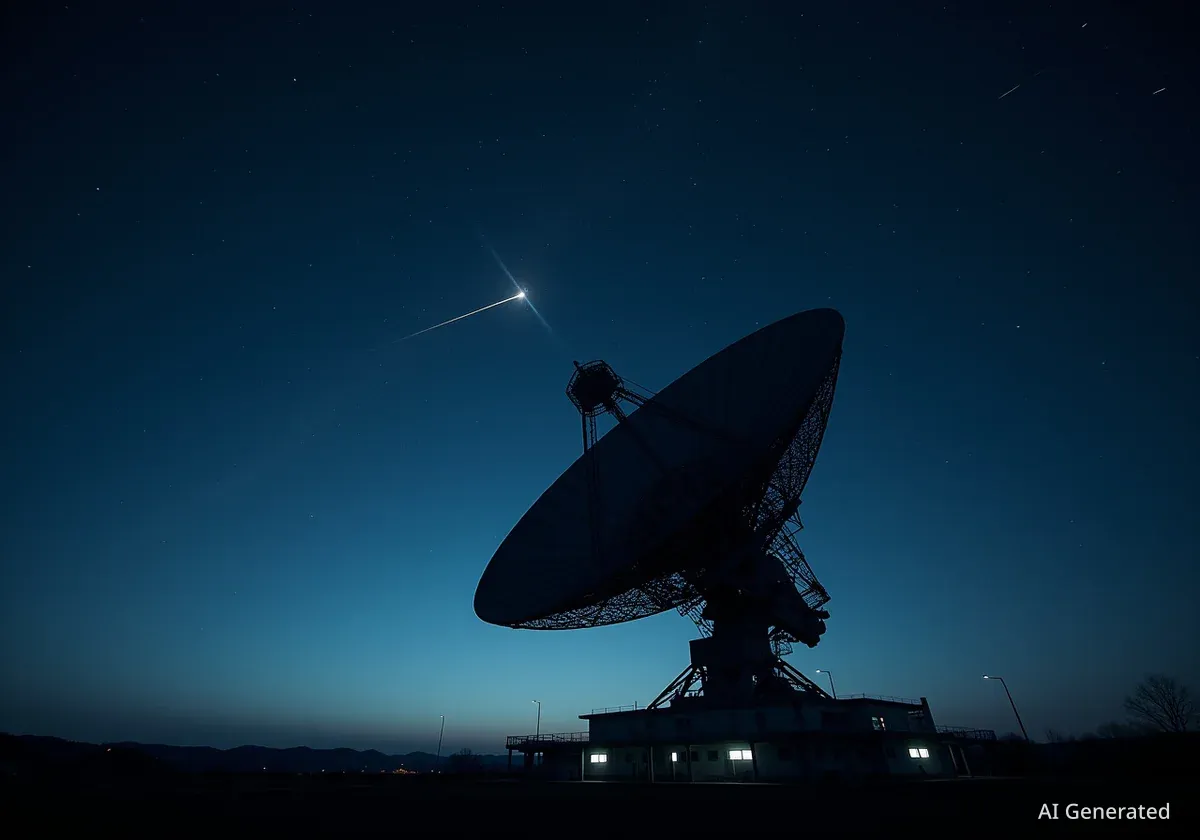


NASA's Deep Space Optical Communications (DSOC) experiment has successfully completed its primary mission, demonstrating the ability to transmit high-bandwidth data from millions of miles away using lasers. The system, which traveled aboard the Psyche spacecraft, made its final scheduled transmission on September 2, setting new benchmarks for deep space data rates.
The technology demonstration proved that laser communications can provide significantly higher data rates than the radio frequency systems currently used for interplanetary missions. This success paves the way for future robotic and human exploration missions to send and receive more complex scientific data and high-definition video from deep space.
Key Takeaways
- NASA's DSOC laser communication experiment has finished its scheduled operations aboard the Psyche spacecraft.
- The system successfully transmitted data from a distance of nearly 350 million kilometers (218 million miles).
- DSOC achieved data rates up to 267 Mbps, far exceeding the capabilities of current deep space radio systems.
- The technology is a critical step toward enabling higher-resolution scientific data and video from future missions to Mars and beyond.
Final Transmission From Deep Space
The DSOC system conducted its final communications test on September 2. At the time, the Psyche spacecraft was approximately 2.34 Astronomical Units (AU) from Earth, which translates to just under 350 million kilometers (218 million miles).
During this final pass, the system achieved a data rate of 12.4 megabits per second (Mbps). According to project technologist Abi Biswas, this speed was accomplished despite partially cloudy skies at the ground station. In a previous test under clear skies at a distance of 2.28 AU, the system reached an even higher rate of 20.8 Mbps.
What is an Astronomical Unit?
An Astronomical Unit (AU) is a unit of length used by astronomers. One AU is equal to the average distance between the Earth and the Sun, which is about 150 million kilometers or 93 million miles. The use of AU helps scientists manage the vast distances involved in space exploration.
A Leap Beyond Radio Frequencies
The primary objective of the DSOC project was to prove that laser communications could offer significantly more bandwidth than the traditional radio waves used by spacecraft for decades. While lasers have been successfully tested in Earth orbit and for lunar missions, DSOC was designed to operate over much greater interplanetary distances.
The experiment exceeded its goals throughout the mission. One of its most impressive achievements was transmitting data at a rate of 267 Mbps when it was 30 million kilometers (19 million miles) from Earth. This is comparable to high-speed terrestrial internet connections.
DSOC vs. Traditional Radio Systems
To understand the scale of this achievement, consider NASA's Mars Reconnaissance Orbiter (MRO). At its maximum distance from Earth (about 400 million km), MRO's radio system can transmit data at approximately 0.5 Mbps. DSOC achieved a sustained rate of 6.25 Mbps and a peak of 8.3 Mbps from a similar distance of 386 million kilometers, demonstrating a performance improvement of more than 10 times.
This increased bandwidth capacity is crucial for the future of space exploration. It will allow missions to transmit large volumes of high-resolution images, complex scientific instrument data, and even live video streams from distant planets like Mars.
The Mechanics of Interplanetary Lasers
The DSOC system relies on a sophisticated set of hardware on both the spacecraft and on Earth. The Psyche spacecraft is equipped with an advanced laser transceiver capable of sending and receiving optical signals.
Pointing with Extreme Precision
To establish a connection over such vast distances, precision is essential. The process begins on the ground at the Jet Propulsion Laboratory's Table Mountain facility. An uplink laser sends a beacon to the Psyche spacecraft, which the DSOC transceiver uses to lock onto Earth's position.
Once locked, the transceiver aims its own downlink laser back toward a specific point on Earth. The primary ground station for receiving this data is the 200-inch (5.1-meter) Hale Telescope at Caltech's Palomar Observatory in San Diego County, California.
"There were numerous good surprises related to pointing performance resulting in exceedance of predicted performance. There were no bad surprises, as such," said Abi Biswas, the project's technologist, highlighting the success of the system's complex targeting mechanism.
Future of the DSOC Experiment
While DSOC was a technology demonstration and not the primary communication system for the Psyche mission, it was interfaced to stream or store data from the spacecraft. According to Biswas, this capability was designed as a backup but was highly unlikely to be needed due to the redundancy in Psyche's main communication systems.
With its primary objectives met, the DSOC hardware has been powered down. However, there is a possibility it could be reactivated in the future. "There is no currently approved plan for reactivation though conversations with the sponsor on the subject continue," Biswas stated.
If funding is approved, the earliest opportunity for more demonstrations would be in late 2026. This would occur after the Psyche spacecraft completes its Mars flyby in May 2026 and continues its journey toward the main asteroid belt.
Discussions are also ongoing about integrating this proven laser communication technology into future NASA missions. The success of DSOC provides scientists and engineers with a powerful new tool to gather unprecedented amounts of data from the farthest reaches of our solar system.