
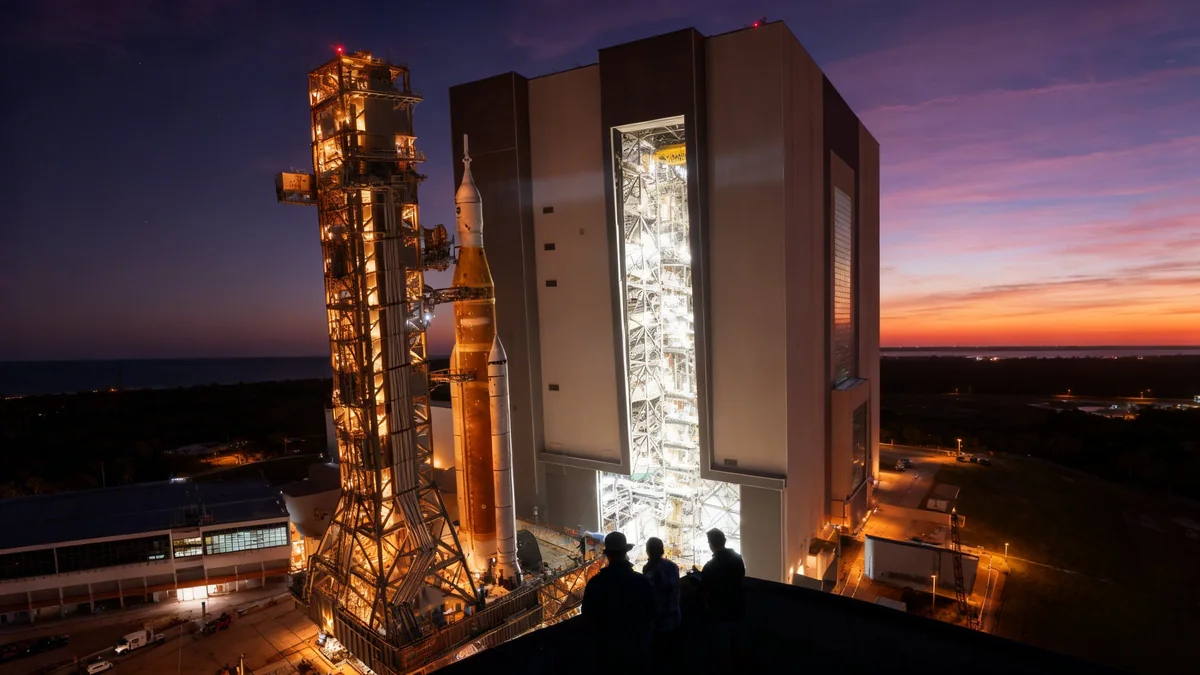


NASA engineers have successfully completed crucial repairs on the Artemis 2 rocket, keeping the mission on schedule for a potential April launch. The work addressed a helium flow issue in the Space Launch System (SLS) rocket's upper stage, a problem discovered following a major pre-flight test in late February.
The mission, set to be the first crewed flight to the vicinity of the moon in over 50 years, remains a top priority for the agency. With the repairs finished, teams are now preparing the massive rocket for its return to the launch pad at Kennedy Space Center in Florida.
Key Takeaways
- Engineers fixed a helium flow problem in the SLS rocket's upper stage that was discovered after a wet dress rehearsal.
- The repair keeps a potential April 2026 launch window open for the crewed lunar flyby mission.
- The rocket was rolled back to the Vehicle Assembly Building (VAB) for the repairs, as the affected area was inaccessible at the launch pad.
- While in the VAB, teams are also performing other maintenance, including replacing and charging various flight system batteries.
A Delicate Repair Inside the Assembly Building
The issue surfaced after the Artemis 2 stack completed its wet dress rehearsal, a comprehensive two-day simulation of launch procedures. Mission controllers noticed an interruption in the flow of helium to the rocket's upper stage. This was a significant concern, as helium is essential for pressurizing the propellant tanks during flight.
Because the hardware was inaccessible at Launch Pad 39B, NASA made the decision on February 25 to roll the entire SLS rocket and Orion capsule back to the cavernous Vehicle Assembly Building (VAB).
The Role of Helium in Rocketry
Helium is an inert gas used in rocketry to create pressure inside fuel and oxidizer tanks. As propellant is consumed during flight, the empty space, or ullage, must be filled. Pressurized helium pushes the remaining propellant into the engines, ensuring a consistent and controlled flow for a stable burn.
Inside the VAB, engineers focused on a component known as a "quick disconnect," an interface that allows helium to flow from ground equipment into the rocket. An investigation revealed that a seal within this interface had become dislodged, obstructing the flow.
"The team removed the quick disconnect, reassembled the system, and began validating the repairs to the upper stage by running a reduced flow rate of helium through the mechanism to ensure the issue was resolved," NASA officials stated in an update this week.
Engineers are now analyzing the cause of the dislodged seal to implement measures that will prevent the issue from happening again.
Paving the Way for a Historic Launch
With the primary repair complete, the path is now clear to continue preparations for launch. The rollback and repair work effectively removed any possibility of a March launch, but the swift resolution has kept the April windows in play.
NASA is currently targeting several launch opportunities next month:
- April 1
- April 3-6
- April 30
The agency anticipates rolling the fully assembled rocket and spacecraft back to the launch pad later this month. This will be a critical step before final preparations for the mission, which will send four astronauts on an approximately 10-day journey around the moon and back.
A Return to the Moon
The Artemis 2 mission marks a monumental step in human spaceflight. It will be the first time astronauts have traveled to the lunar neighborhood since the Apollo 17 mission in December 1972, more than 50 years ago.
More Than Just One Fix
The time spent inside the VAB is being used for more than just the helium system repair. Technicians are taking advantage of the access to the vehicle to conduct other essential maintenance and pre-flight checks.
This includes replacing flight batteries on the SLS core stage, the upper stage, and the solid rocket boosters. Additionally, the emergency-abort batteries for the Orion crew capsule are being charged.
Another critical task involves activating a new set of batteries for the flight termination system. This system is a safety feature designed to destroy the rocket if it veers off course during launch, and it will undergo a full end-to-end retest before the vehicle leaves the VAB.
The Broader Artemis Program Shift
This repair update comes shortly after NASA announced a significant restructuring of its long-term Artemis program goals. Originally, the Artemis 3 mission was slated to be the first to land astronauts on the lunar surface.
Under the new plan, Artemis 3 will now remain in Earth orbit. It will perform a rendezvous with one of the private moon landers being developed for NASA. The first crewed lunar landing is now targeted for the Artemis 4 mission, scheduled for 2028.
This strategic shift underscores the complexity of returning humans to the moon and the reliance on commercial partners to develop key landing technologies. For now, all eyes are on the successful repair of Artemis 2, the critical next step in this ambitious new era of space exploration.