
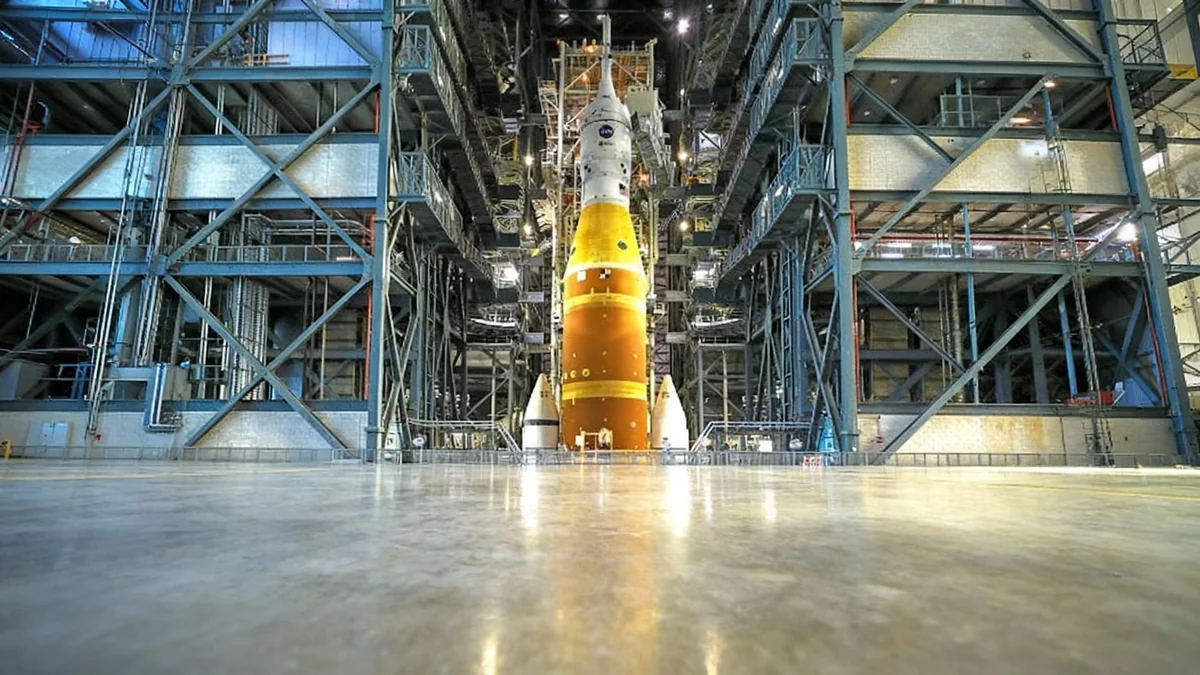


NASA has begun the slow and meticulous process of moving its 322-foot-tall Space Launch System (SLS) rocket to the launchpad at Kennedy Space Center in Florida. This move, known as the "rollout," is a critical step in the preparations for the Artemis II mission, which will send four astronauts on a journey around the Moon for the first time in over 50 years.
The massive rocket, with the Orion spacecraft secured at its top, started its 4-mile journey from the Vehicle Assembly Building on Saturday morning. The event marks the beginning of the final series of tests before NASA commits to a firm launch date, potentially as early as February 2026.
Key Takeaways
- NASA's 322-foot Artemis II rocket is being moved to Launch Pad 39B at Kennedy Space Center.
- The mission will carry four astronauts—three from NASA and one from Canada—on a 10-day trip around the Moon.
- This rollout is a precursor to a critical "wet dress rehearsal," a full launch day simulation.
- A successful Artemis II mission is essential for the subsequent Artemis III flight, which aims to land astronauts on the Moon in 2027.
A Monumental Journey to the Pad
The process of moving the 11-million-pound rocket stack is a significant engineering feat in itself. Perched atop a massive crawler-transporter, the vehicle inches along at a deliberate pace of about one mile per hour. The entire journey from the Vehicle Assembly Building to Launch Pad 39B is expected to take up to 12 hours.
This historic launchpad has served as the starting point for some of humanity's greatest space adventures, including the Apollo and space shuttle missions. Its use for the Artemis program connects a new generation of lunar exploration with its pioneering past.
Mission managers view the rollout as a vital opportunity to assess the integrated system's health and stability before proceeding with more complex tests. "These are the kind of days we live for," John Honeycutt, the Artemis II mission management team chair, stated during a briefing on Friday.
The Final Dress Rehearsal
Once the rocket is securely positioned at the launchpad, teams will begin preparations for the most comprehensive test yet: the wet dress rehearsal. This procedure is a full-scale simulation of launch day, designed to uncover any potential issues before the crew is onboard.
During the rehearsal, engineers will load the SLS rocket with its cryogenic propellants—liquid hydrogen and liquid oxygen—and conduct a complete countdown. The countdown will proceed through all standard procedures, stopping just 29 seconds before the simulated liftoff.
"Launch day will be pretty similar to wet dress," explained Artemis launch director Charlie Blackwell-Thompson. "There’ll be two big differences: One is that we’re going to send the crew to the pad, and the other one is we’re not going to stop at 29 seconds."
Artemis II by the Numbers
- Height: 322 feet (98 meters)
- Weight: 11 million pounds (5 million kilograms) with crawler
- Journey Distance: 4 miles (6.4 kilometers)
- Travel Speed: Approximately 1 mile per hour
- Mission Duration: 10 days
- Crew: 4 astronauts
This critical test allows engineers to monitor the rocket's systems in a real-world environment, checking for fuel leaks or other technical problems. If any significant issues are discovered, the rocket will be rolled back to the Vehicle Assembly Building for repairs. However, a successful rehearsal will clear the path for NASA to officially set a target launch date.
The Crew and the Mission
The Artemis II mission is the first time the SLS rocket and Orion spacecraft will fly with astronauts. The four-person crew represents a new era of international cooperation in lunar exploration.
Meet the Artemis II Crew
The crew for this historic lunar flyby includes three NASA astronauts and one Canadian Space Agency astronaut, marking the first time a non-American will travel beyond low-Earth orbit.
- Reid Wiseman (NASA): Mission Commander
- Victor Glover (NASA): Pilot
- Christina Koch (NASA): Mission Specialist
- Jeremy Hansen (CSA): Mission Specialist
Their 10-day mission will be a rigorous test of the Orion spacecraft's capabilities. After launching into Earth's orbit, the crew will perform a series of checks on the capsule's life-support and docking systems. From there, they will begin their multi-day journey to the Moon, entering its orbit before returning to Earth.
The data and experience gathered during this flight are indispensable. A successful Artemis II will provide the confidence and validation needed to proceed with Artemis III, which is currently scheduled for 2027. That mission aims to achieve the monumental goal of landing the first woman and the first person of color on the lunar surface, specifically near the Moon's south pole.
A New Era of Lunar Exploration
The Artemis program represents more than just a return to the Moon; it signifies a renewed commitment to human space exploration and scientific discovery. The program is also taking place within a shifting geopolitical landscape, as a new space race appears to be forming.
Officials in China have publicly stated their goal of landing astronauts on the Moon by 2030, creating a sense of competition that echoes the Cold War-era space race. This international dynamic has added a layer of urgency to NASA's lunar ambitions.
As the Artemis II rocket stands on Launch Pad 39B, it serves as a powerful symbol of progress. The upcoming tests will determine the timeline for the next chapter in human spaceflight, paving the way for a sustained presence on the Moon and eventual missions to Mars.