
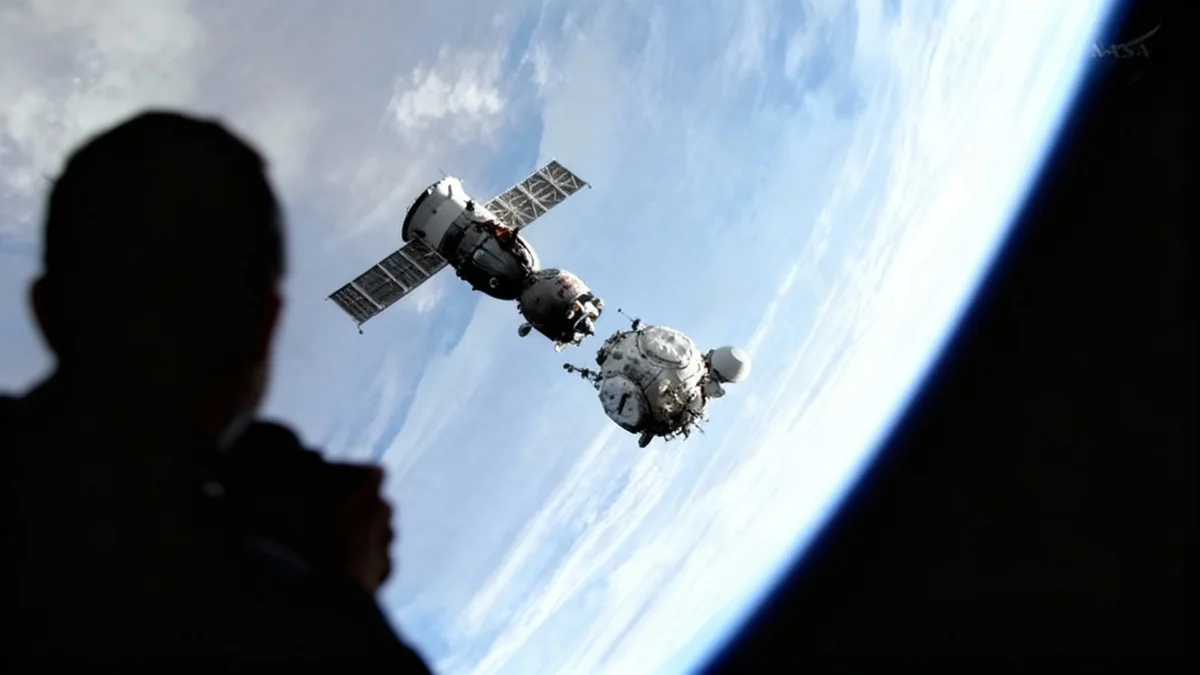



A three-person international crew has begun its journey back to Earth after completing an eight-month mission aboard the International Space Station. The Soyuz MS-27 spacecraft, carrying NASA astronaut Jonny Kim and Russian cosmonauts Sergey Ryzhikov and Alexey Zubritsky, successfully undocked from the orbiting laboratory on Monday evening.
The crew is scheduled for a nighttime landing on the frigid steppe of Kazakhstan, concluding a mission that spanned thousands of orbits and millions of miles traveled in space.
Key Takeaways
- A crew of one NASA astronaut and two Russian cosmonauts is returning to Earth.
- The mission lasted eight months, covering approximately 104 million miles.
- The Soyuz spacecraft undocked from the ISS on Monday at 8:41 p.m. ET.
- Landing is scheduled for just after midnight ET in Kazakhstan, where recovery teams are on standby.
The Final Leg of the Journey
The departure of the Soyuz MS-27 spacecraft marks the beginning of the final, critical phase of the crew's long-duration mission. After separating from the space station at 8:41 p.m. ET while flying 262 miles over eastern Mongolia, the capsule began a series of maneuvers to position itself for the return trip.
The journey from orbit to the ground is a precisely calculated sequence. The spacecraft will orbit Earth a few more times before initiating a crucial deorbit burn. This braking maneuver, scheduled for 11:09 p.m. ET, will slow the vehicle by approximately 286 mph, a slight but significant change from its orbital velocity of 17,100 mph. This reduction in speed is just enough to allow Earth's gravity to pull the capsule into the upper atmosphere.
A Fiery Reentry
The descent through the atmosphere is one of the most demanding parts of the flight. The Soyuz descent module is designed to withstand extreme conditions, with its heat shield facing temperatures approaching 3,000 degrees Fahrenheit due to friction with air molecules.
After the intense heat of reentry, a sequence of parachutes will deploy to slow the capsule's final descent. The landing, expected at 12:04 a.m. ET (10:04 a.m. local time), is known to be a jarring impact. Russian recovery teams, along with NASA support personnel, are staged near the landing zone to assist the crew as they emerge from the capsule and begin readjusting to gravity.
An Eight-Month Tour of Duty
During their extended stay in orbit, the crew of Ryzhikov, Zubritsky, and Kim logged an impressive record of scientific and maintenance work. Their mission statistics highlight the scale of their journey.
- Total Orbits: 3,920
- Distance Traveled: 104 million miles
- Spacewalks: Two conducted by cosmonauts Ryzhikov and Zubritsky
Kim was responsible for numerous research experiments and maintenance tasks within the U.S. segment of the station. His Russian colleagues focused on the Russian segment, which included conducting two spacewalks to upgrade and maintain external hardware.
In a change-of-command ceremony held Sunday, Kim reflected on his time in space, emphasizing the human element of the mission.
"I firmly believe that the greatest quality of an astronaut, and a human, is not technical competence, or loyalty, or any of the myriad other things we like to ascribe to astronauts. It's love," Kim stated. "We always gave each other grace and had so much love for each other and everyone who supports us. I think that is what makes space exploration possible."
A Remarkable Path to Orbit
For NASA's Jonny Kim, the journey to the International Space Station followed a unique and distinguished career path. The son of South Korean immigrants and a father of three, Kim's background includes service as a U.S. Navy SEAL with combat experience.
From Battlefield to Space Station
After his military service, Kim pursued a different kind of service, earning a medical degree from Harvard Medical School. He has spoken about how his experiences in combat, which left him feeling "burnt out," motivated him to find a new way to contribute through medicine. His desire to be judged on his merits as a physician led him to keep his past as a SEAL private from his medical colleagues and patients.
His selection as a NASA astronaut combined his diverse skills in operational execution, medical knowledge, and mental resilience, making him well-suited for the rigors of long-duration spaceflight.
Changing of the Guard on the ISS
With the departure of the Soyuz MS-27 crew, the International Space Station remains home to a crew of six. Command of the station has been handed over to the remaining astronauts and cosmonauts.
The current residents of the ISS include:
- NASA Crew 11: Zena Cardman and Mike Fincke
- JAXA: Kimiya Yui
- Roscosmos: Oleg Platonov
They are joined by the crew of Soyuz MS-28, who arrived on November 27: commander Sergey Kud-Sverchkov, flight engineer Sergei Mikaev, and NASA astronaut Christopher Williams. This seamless transition ensures that scientific research and station operations continue without interruption.
Once on the ground, the returning crew will undergo initial medical checks. Kim will then board a NASA jet for a long flight back to the Johnson Space Center in Houston, Texas. Ryzhikov and Zubritsky will return to Star City, near Moscow, for their own debriefings and reunions with family.