
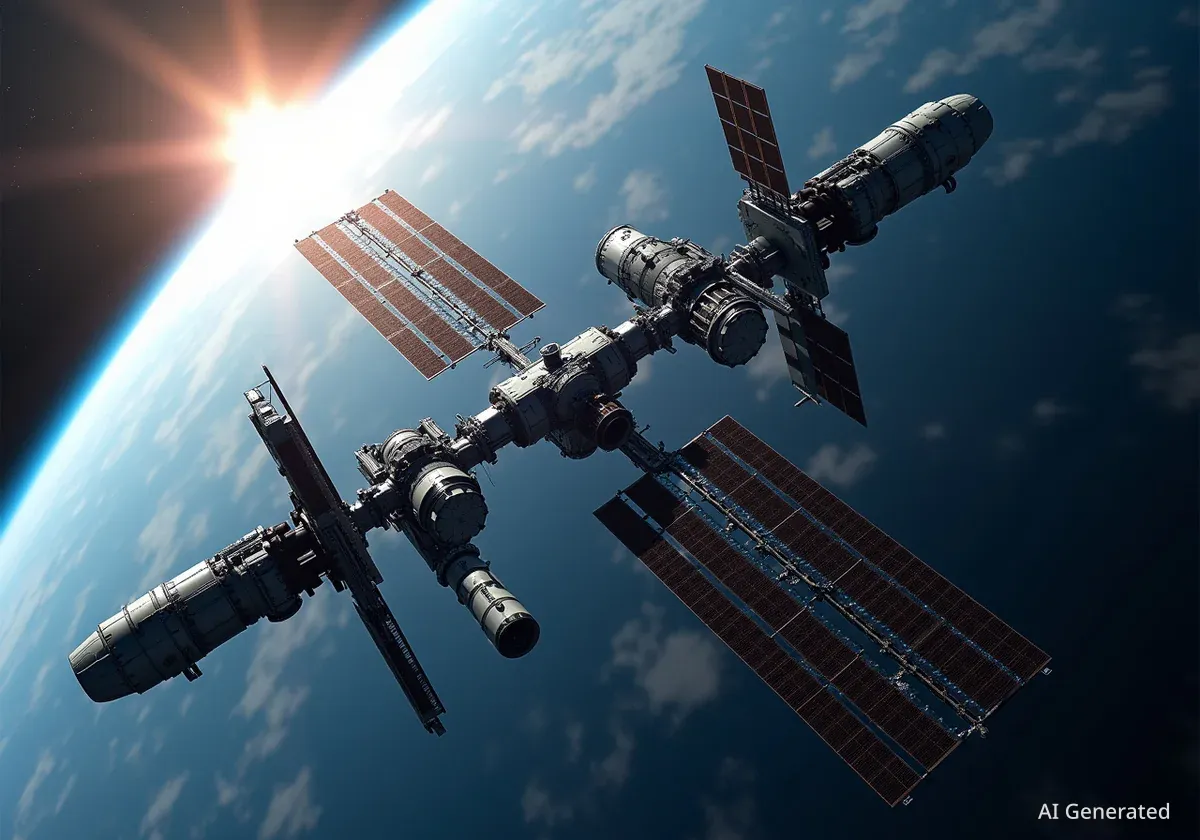

The International Space Station (ISS), a cornerstone of global space cooperation for over two decades, is scheduled for a controlled deorbit in 2030. In preparation for its retirement, NASA is actively funding the development of privately owned and operated space stations to ensure a continuous human presence and research platform in low-Earth orbit.
Key Takeaways
- The International Space Station will be intentionally deorbited into a remote area of the Pacific Ocean in 2030.
- Since November 2000, the ISS has maintained an uninterrupted human presence in low-Earth orbit.
- NASA has invested over $400 million to stimulate the creation of commercial space stations by private companies.
- The transition aims to shift NASA from an owner-operator model to a customer model, purchasing services from commercial providers.
A Legacy of Scientific Achievement
Launched in 1998, the International Space Station represents a significant achievement in international partnership, bringing together the United States, Europe, Canada, Japan, and Russia. For nearly 25 years, it has served as a unique microgravity laboratory orbiting approximately 250 miles (402 kilometers) above Earth.
The station has been instrumental in advancing scientific knowledge across numerous fields. Researchers have utilized its distinct environment—characterized by very low gravity, vacuum conditions, and exposure to space radiation—to conduct groundbreaking studies.
By the Numbers: ISS Research
To date, more than 4,000 experiments have been conducted aboard the ISS. This extensive research has resulted in the publication of over 4,400 scientific papers, contributing to advancements that benefit life on Earth and pave the way for future space exploration.
Breakthroughs in Microgravity
The research conducted on the ISS has yielded tangible benefits and expanded scientific understanding. Key projects have led to significant progress in various domains.
- Biotechnology: Experiments have improved the crystallization processes for important cancer-treating drugs and demonstrated the potential to grow artificial retinas in space.
- Materials Science: Researchers have explored the creation of ultrapure optical fibers, which have applications in telecommunications and advanced sensors.
- Earth and Atmospheric Science: Observations from the station have provided new insights into the behavior of thunderstorms and other weather phenomena.
- Human Biology: The ability to sequence DNA in orbit was proven on the ISS, a critical capability for future long-duration missions and astronaut health monitoring.
These accomplishments underscore the value of a dedicated research outpost in low-Earth orbit for studying physical, chemical, and biological processes that are difficult or impossible to replicate on the ground.
Transitioning to a Commercial Future
As the ISS approaches its operational end, NASA is not planning to abandon low-Earth orbit. Instead, the agency is fostering a new commercial space economy. This strategy mirrors the success of its Commercial Crew and Cargo programs, where companies like SpaceX and Boeing transport astronauts and supplies to the station.
By becoming a customer rather than an owner, NASA aims to reduce operational costs while continuing to support critical research and technology development. In December 2021, the agency announced significant financial awards to stimulate this new market.
NASA invested more than US$400 million in initial awards to help private companies begin the development of commercial space stations. This funding is intended to ensure these new platforms are operational before the ISS is decommissioned.
The Next Phase of Development
In September 2025, NASA outlined the next steps with a draft announcement for Phase 2 partnership proposals. The goal is to select companies that can move toward critical design reviews and ultimately demonstrate a fully functional station capable of hosting four people for at least 30 days.
Before any NASA personnel can use these facilities, the commercial stations must undergo a rigorous design acceptance and certification process. This ensures they meet the agency's strict safety and operational requirements, protecting the well-being of all crew members.
China's Tiangong Space Station
While the U.S. transitions to commercial platforms, China operates its own orbital outpost. The Tiangong space station is a permanently crewed facility for three astronauts and has been continuously inhabited for approximately four years. If there is a gap between the ISS decommissioning and the launch of new U.S. commercial stations, Tiangong will hold the title for the longest continually inhabited station in operation.
The Final Years of the International Space Station
With several years remaining until its planned retirement in 2030, the ISS continues to be a hub of scientific activity and a powerful symbol of international collaboration. It remains one of the brightest objects in the night sky, visible to the naked eye as it travels at around 17,500 miles per hour (28,000 kilometers per hour).
On clear nights, observers can watch it trace a silent, brilliant path across the sky. This visible reminder of human ingenuity in space serves as a testament to what has been achieved and a preview of the commercial era that will follow.
The controlled deorbiting process will be a complex engineering feat, designed to guide the massive structure to a safe entry over the South Pacific Ocean Uninhabited Area, also known as the spacecraft cemetery. This will mark a poignant end to one of humanity's greatest engineering projects, clearing the way for its successors.