
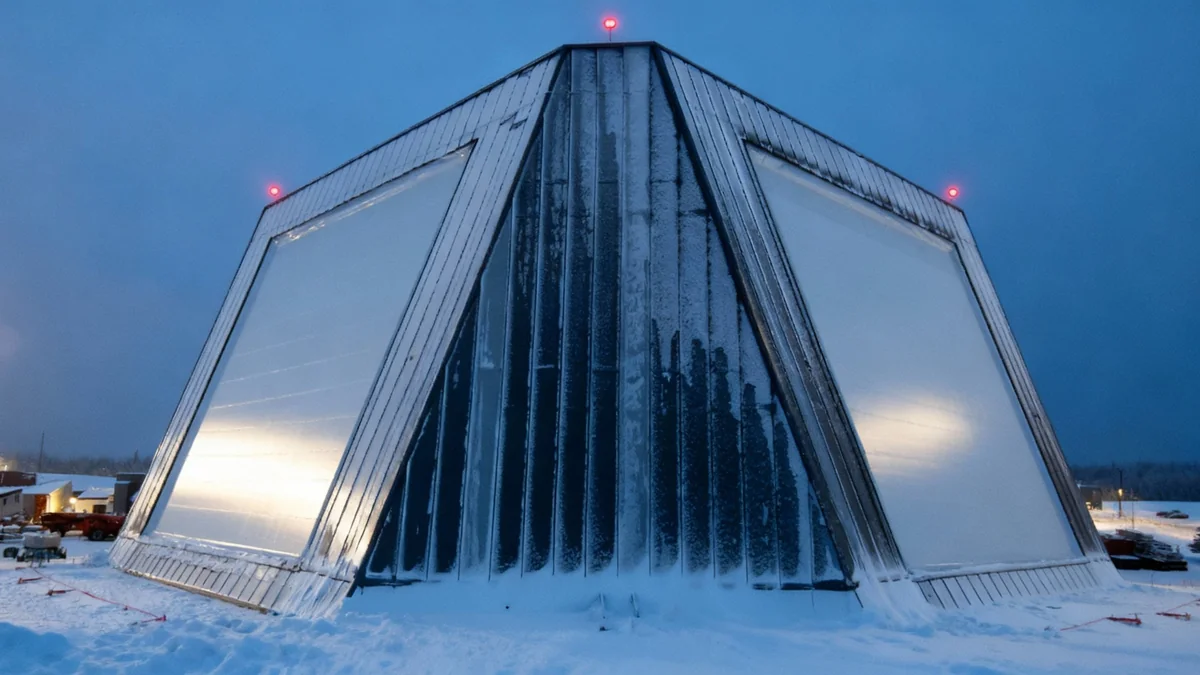



The United States Space Force has officially taken control of a powerful new radar system in Alaska, marking a significant step in the nation's missile defense capabilities. The Long Range Discrimination Radar, or LRDR, completed its extensive testing phase in early December and is now fully operational, providing continuous surveillance of the skies.
Located at Clear Space Force Station, the advanced ground-based system is designed to detect and track long-range ballistic missile threats with unprecedented accuracy. Its activation transitions the technology from a developmental project into a core component of the U.S. strategic defense network, tasked with providing early warning and detailed data to protect against potential attacks.
Key Takeaways
- The U.S. Space Force now operates the Long Range Discrimination Radar (LRDR) in Alaska.
- The system moved from testing to full operational status in early December after years of development.
- LRDR's primary function is to detect, track, and identify long-range ballistic missile threats.
- Its advanced technology improves the ability to distinguish real threats from non-threatening objects like space debris.
A New Sentinel in the Arctic
After years of development and rigorous testing, the LRDR system has been formally handed over from the Missile Defense Agency to the Space Force's Combat Forces Command. This transfer signifies that the radar has met all performance requirements and is ready for its 24/7 mission of monitoring the northern approaches to the United States.
The system's location in central Alaska provides a strategic vantage point for observing potential missile trajectories over the Arctic. This placement is critical for the layered defense strategy of the U.S., offering precious extra minutes of warning time in the event of a launch from potential adversaries in the Indo-Pacific region.
Development of the LRDR began years ago, with the Missile Defense Agency initiating the first major tests at the Alaskan site in late 2021. The subsequent period involved integrating the system with the broader U.S. missile defense architecture, a complex network of sensors, command centers, and interceptors located on land, at sea, and in space.
What is Clear Space Force Station?
Clear Space Force Station is a United States Space Force installation located in Denali Borough, Alaska. For decades, it has played a vital role in missile warning and space surveillance. The addition of the LRDR solidifies its position as a cornerstone of North American defense.
The Power of 'Discrimination'
The key capability of the new radar is embedded in its name: discrimination. In the context of missile defense, this means the system can intelligently distinguish between a genuine threat, such as an intercontinental ballistic missile (ICBM), and other objects that may be traveling alongside it.
When a missile is launched, it often releases decoys or sheds components like booster stages. These non-threatening items create clutter that can confuse older radar systems. The LRDR, a solid-state Gallium Nitride (GaN) based system, is engineered to analyze a cluster of objects and precisely identify the warhead that poses a danger.
This high-fidelity tracking information is crucial for the next stage of defense. By providing clear and reliable data, the LRDR allows ground-based interceptors to engage the correct target, increasing the probability of a successful intercept and preventing wasted resources on harmless debris.
Faster and More Precise
The enhanced precision of the LRDR shortens the time required to confirm a threat and launch a countermeasure. This improved reaction time is a critical advantage in a scenario where every second counts.
Integrating into a Larger Network
The LRDR does not operate in isolation. It is now a critical node in the Ground-Based Midcourse Defense (GMD) system, which is the primary U.S. defense against long-range ballistic missile attacks. Data from the Alaskan radar will be fed into the GMD's command and control network, giving decision-makers a clearer picture of an unfolding threat.
The information gathered by LRDR will help guide interceptors launched from Fort Greely, Alaska, and Vandenberg Space Force Base, California. Its ability to provide precise tracking data improves the efficiency and effectiveness of these interceptors, ensuring they are directed to the right point in space to neutralize an incoming missile.
The Space Force's Expanding Role
The operational acceptance of the LRDR highlights the growing responsibilities of the U.S. Space Force. While often associated with satellites and launch operations, the service is also tasked with terrestrial-based systems that monitor and protect the space domain and provide missile warning for the nation.
By controlling assets like the LRDR, the Space Force solidifies its role as the branch of the military responsible for providing a comprehensive view of threats originating from or passing through space. This constant surveillance is a fundamental part of modern strategic deterrence.
As the system begins its continuous watch, it serves as a silent guardian in the far north, a technological sentinel built to identify dangers long before they reach American soil. Its activation represents a quiet but significant enhancement to the security of the nation.