
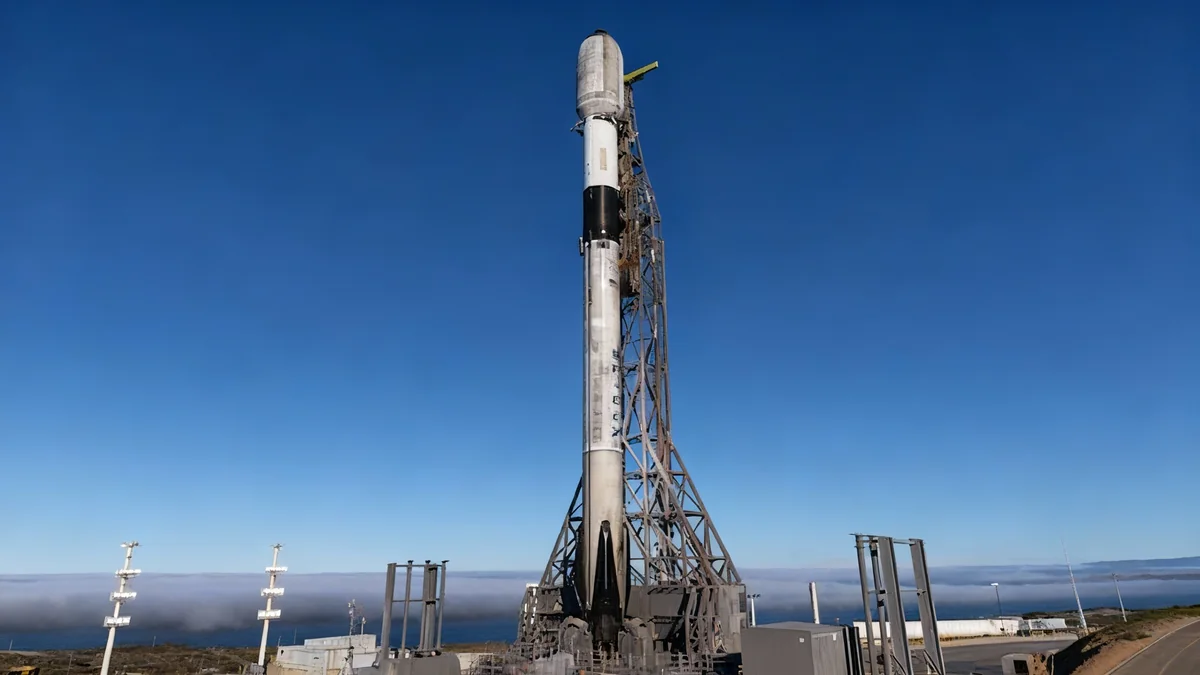



SpaceX successfully launched a Falcon 9 rocket from Vandenberg Space Force Base late Friday night, carrying a classified payload for the U.S. National Reconnaissance Office. The mission, designated NROL-105, is part of an ongoing effort to build a massive new satellite constellation for intelligence gathering.
The rocket lifted off from Space Launch Complex 4 East at 8:39 p.m. Pacific Time on January 16, 2026, piercing the night sky over the California coast. Following the launch, the Falcon 9's first stage booster completed a successful landing back at the base, marking another milestone for SpaceX's reusable rocket technology.
Key Takeaways
- SpaceX launched the NROL-105 mission for the National Reconnaissance Office on January 16, 2026.
- The payload consists of an undisclosed number of intelligence-gathering satellites for a new government constellation.
- The Falcon 9 first stage booster, B1100, successfully landed back at Vandenberg Space Force Base.
- This mission is part of the NRO's plan to deploy hundreds of satellites for enhanced global surveillance and data delivery.
A Strategic Expansion in Orbit
The NROL-105 mission adds to a growing network of satellites designed to significantly enhance U.S. intelligence capabilities. The National Reconnaissance Office (NRO) has been actively deploying this new system since May 2024, with the stated goal of creating “the largest government constellation in history.”
This ambitious project involves launching hundreds of satellites into low Earth orbit over the next several years, with deployments planned through 2029. The satellites are widely believed to be a government-specific variant of SpaceX's Starlink satellites, known as Starshield, which are designed for secure communications and Earth observation.
According to a pre-launch statement from the NRO, the new system is designed for resilience and speed. “The NRO’s proliferated system will increase timeliness of access, diversify communications pathways, and enhance resilience,” the agency noted. This architecture aims to eliminate single points of failure that can be present in traditional satellite systems.
What is a Proliferated Constellation?
A proliferated satellite constellation involves deploying a large number of smaller, less expensive satellites instead of a few large, highly complex ones. This approach offers several advantages, including increased resilience (losing one satellite has minimal impact), more frequent revisit times over a specific location, and broader global coverage.
Mission Details and Booster Recovery
The launch vehicle for Friday's mission was a flight-proven Falcon 9 rocket. The first stage booster, identified by its tail number B1100, was on its second mission. Its previous flight was for the Starlink 11-30 mission on November 23, 2025.
Approximately seven and a half minutes after liftoff, the booster performed a controlled descent and landed precisely at Landing Zone 4, located near the launch pad at Vandenberg. This successful recovery marked the 33rd landing at this specific site and the 560th overall booster landing for SpaceX.
By the Numbers: SpaceX Landings
- Total Booster Landings: 560
- Landings at LZ-4: 33
- Booster B1100 Flights: 2
The ability to reuse first-stage boosters is a cornerstone of SpaceX's strategy to reduce launch costs and increase launch frequency. This capability is particularly critical for deploying large constellations like the one being built for the NRO, which requires numerous launches to complete.
The Future of National Security in Space
The NRO's new constellation represents a significant shift in space-based intelligence gathering. By leveraging hundreds of interconnected satellites, the agency aims to deliver critical information to analysts, military personnel, and civil agencies faster than ever before.
“With hundreds of small satellites on orbit, data will be delivered in minutes or even seconds. This will ensure the analysts, warfighters, and civil agencies NRO serves receive actionable information faster than ever before.”
The agency has outlined an aggressive launch schedule for the coming year. NROL-105 is one of roughly half a dozen missions planned for 2026 as the NRO continues to build out its orbital infrastructure. These launches, procured directly from SpaceX, operate outside the standard National Security Space Launch (NSSL) contract framework, highlighting a flexible and rapid acquisition strategy.
This partnership between a government intelligence agency and a commercial launch provider underscores the evolving landscape of the space industry, where private companies play an increasingly vital role in national security missions. The successful deployment of the NROL-105 payload marks another step toward a new era of persistent, global surveillance from low Earth orbit.