


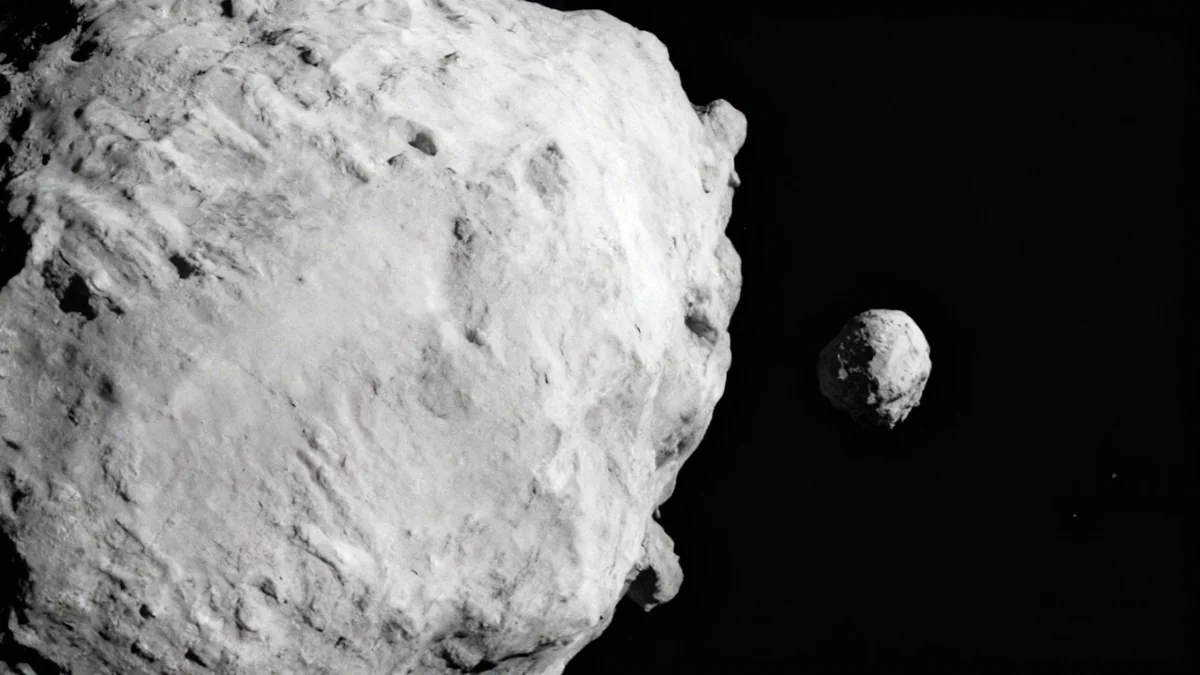

The European Space Agency (ESA) has proposed a new mission, named Ramses, to study the asteroid Apophis during its exceptionally close approach to Earth in 2029. The mission aims to gather crucial data on how the asteroid's structure and trajectory are affected by our planet's gravity, providing valuable insights for future planetary defense strategies.
Key Takeaways
- On April 13, 2029, the 375-meter asteroid Apophis will safely pass Earth at a distance of less than 32,000 kilometers.
- ESA's proposed Rapid Apophis Mission for Space Safety (Ramses) would rendezvous with the asteroid before its Earth flyby.
- The mission would study changes in Apophis's size, shape, and trajectory caused by Earth's gravitational pull.
- Data gathered by Ramses would improve scientific models for deflecting potentially hazardous asteroids in the future.
A Rare Celestial Event in 2029
On April 13, 2029, a significant celestial event will occur. An asteroid named Apophis, with an estimated width of 375 meters, is scheduled to fly past Earth. While it poses no threat of impact, its trajectory will bring it remarkably close to our planet.
Apophis will pass within 32,000 kilometers of Earth's surface. This distance is closer than the orbits of geostationary satellites, which circle the planet at approximately 36,000 kilometers. This proximity will make the asteroid visible to the naked eye for a few hours from locations across Europe and Africa.
Apophis Flyby Details
- Date: Friday, April 13, 2029
- Asteroid Name: 99942 Apophis
- Estimated Diameter: 375 meters
- Closest Approach: Less than 32,000 km
- Significance: An asteroid of this size passes this close only once every several thousand years.
A Unique Scientific Opportunity
The close pass of Apophis presents a rare opportunity for scientific observation. Space agencies have sent missions to asteroids before, but never has a spacecraft been present to observe an asteroid as it interacts with a planet's gravitational field in real time.
This event is being described as a large-scale natural experiment. Scientists will be able to study how Earth's gravity pulls and stretches the asteroid, potentially causing changes to its internal structure, surface, and rotation. The data collected will be invaluable for understanding the physical properties of near-Earth asteroids.
The Proposed Ramses Mission
To capitalize on this unique event, the European Space Agency’s Space Safety Programme has put forward a dedicated mission concept. The mission is called the Rapid Apophis Mission for Space Safety, or Ramses.
If approved, the Ramses spacecraft would be designed, built, and launched on a tight schedule. The current plan involves launching the spacecraft in 2028, a year ahead of the flyby. It would then travel through space to meet Apophis months before the asteroid’s encounter with Earth.
What is Planetary Defense?
Planetary defense involves the detection, tracking, and characterization of near-Earth objects (NEOs) like asteroids and comets. It also includes developing methods to deflect a potentially hazardous object if it were on a collision course with Earth. Missions like Ramses are a key part of this global effort.
Mission Objectives and Instruments
The primary goal of Ramses is to observe Apophis before, during, and after its close approach. The spacecraft would be equipped with a suite of scientific instruments to carry out detailed measurements.
Key scientific objectives for the Ramses mission include:
- Measuring the asteroid's size, shape, and composition.
- Tracking its rotation and exact trajectory with high precision.
- Observing any changes to its surface, such as landslides or shifts in material.
- Analyzing how its orbit is altered by Earth's gravitational influence.
To get an even closer look, the Ramses mission plan also includes deploying two smaller spacecraft, known as CubeSats. These smaller probes would be released near Apophis to conduct detailed, up-close studies of the asteroid's surface and immediate environment.
Implications for Planetary Safety
While Apophis is not a threat in 2029, the knowledge gained from studying it is directly applicable to planetary defense. Understanding how an asteroid responds to gravitational forces is critical for developing effective deflection techniques.
"By seizing this exceptionally rare opportunity to study an asteroid before, during, and after a planetary encounter, Ramses would help us prepare for the day that we may need to deflect a hazardous object on a collision course with Earth," the European Space Agency stated in its mission proposal.
Data from Ramses will help refine computer models that predict how an asteroid might react if a spacecraft were to impact it or use gravity to pull it off course. This information could be crucial if a dangerous asteroid is discovered in the future.
Demonstrating Europe's Capabilities
The Ramses mission would also serve as a cornerstone of the Planetary Defence segment of ESA’s Space Safety Programme. Successfully executing the mission would demonstrate Europe’s ability to rapidly design, launch, and operate a time-sensitive mission to a high-priority celestial object.
As the world looks up in 2029 to witness the rare passage of Apophis, the Ramses mission could be flying alongside it. The mission would not only uncover secrets about the building blocks of our Solar System but also advance humanity's ability to protect our home planet from future threats.