

Florida's Space Coast, centered around Cocoa Beach and Cape Canaveral, offers more than just sandy shores and ocean waves. It's a region where the pioneering history of American spaceflight is a tangible part of daily life, standing alongside the world's most active spaceport as it prepares for humanity's return to the moon.
Here, the legacy of the Mercury 7 astronauts coexists with the towering rockets of the Artemis program, creating a unique travel destination where visitors can walk through the past while witnessing the future unfold in real-time.
Key Takeaways
- Florida's Space Coast remains the world's most active spaceport, with frequent launches visible to the public.
- Historic motels and diners once frequented by the original Mercury 7 astronauts are still in operation and accessible to visitors.
- The Kennedy Space Center Visitor Complex provides an immersive experience with artifacts like the Space Shuttle Atlantis and a Saturn V rocket.
- The upcoming Artemis II mission, poised to return astronauts to the moon, is a visible and central part of the area's current identity.
A Town Steeped in Stardust
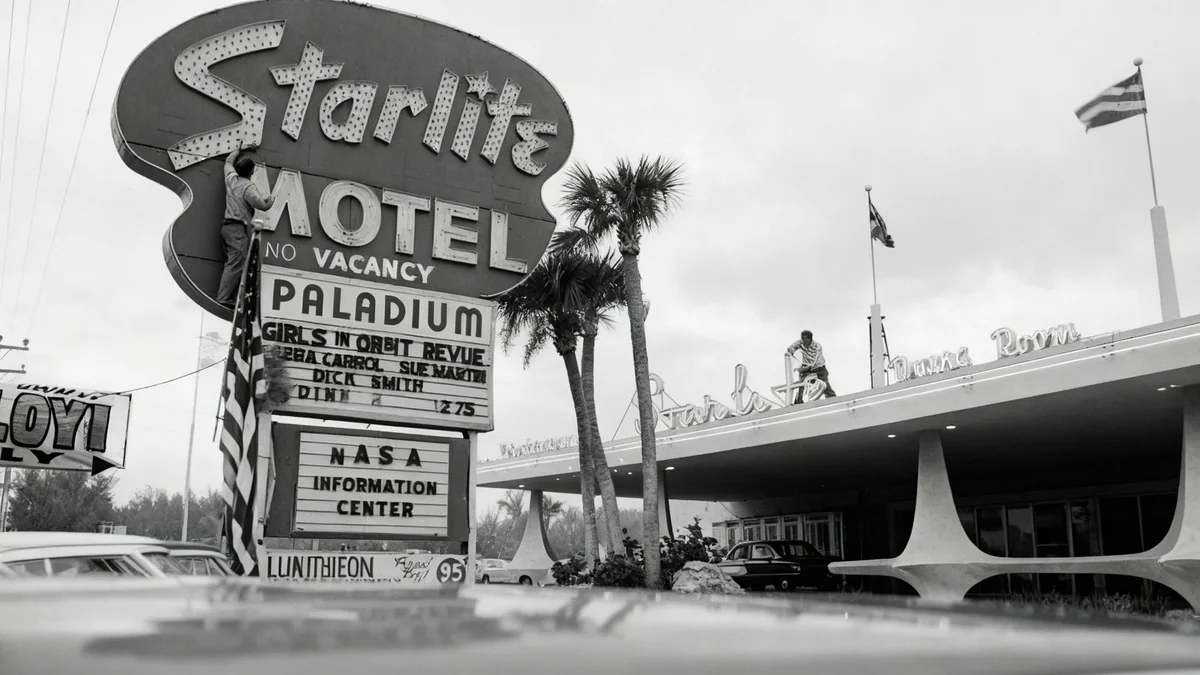
Driving along Route A1A in Cocoa Beach, the influence of the cosmos is unmistakable. It’s woven into the fabric of the community, from murals of astronauts on surfboards to business names like the Lift Off Lounge and Space-Mann Storage. This isn't a manufactured theme; it's an authentic reflection of a town that grew up alongside the U.S. space program.
Sixty years ago, this area was the unassuming home base for the nation's first astronauts. Today, while it has modernized, it retains a modest, unpretentious charm. You won't find sprawling luxury resorts, but rather a collection of classic motels, local diners, and beachfront condos that preserve the atmosphere of a bygone era.
The connection is so profound that even a casual conversation can lead to a space story. A local barista might mention being a "NASA brat," or a hotel lobby might display a detailed schedule of upcoming rocket launches, free for anyone to watch from the beach.
From 'Low Rent' to Launch Pad
In his 1979 book "The Right Stuff," author Tom Wolfe described 1960s Cocoa Beach as the resort for "Low Rent folk." While the area has certainly developed, it has successfully avoided becoming overly commercialized, maintaining an accessible and relaxed environment that feels true to its historic roots.
Tracing Astronaut Footsteps
For those interested in the human side of space history, the Space Coast is a living museum. Many of the places where the original Mercury 7 astronauts lived, worked, and relaxed are still standing. One of the most famous is a hotel on North Atlantic Avenue, once a Holiday Inn and now the La Quinta Inn by Wyndham Cocoa Beach-Port Canaveral.
A vintage sign by the pool proudly states its heritage: "This Hotel was first owned by the original seven Astronauts in the U.S. Mercury space programs'." The lobby contains historical photos and artifacts, offering a direct link to the men who first ventured into the cosmos.
The history continues at local eateries. The Moon Hut in Cape Canaveral, once known for its 97-cent "Moonburgers," still serves hearty meals to locals and tourists. Its walls are covered with NASA mission patches and newspaper clippings, preserving a sense of history alongside its modern-day diner menu.
The Legendary Mousetrap Bar
Another essential stop is the Cocoa Beach Fish Camp Grill. The building was formerly the Polaris Motel, and its bar, The Mousetrap, was a legendary hangout for astronauts and NASA crew. Today, the restaurant serves "swamp food with a flair," but the original bar has been carefully preserved.
The dark wood paneling, back bar mirror, and tin roof are all intact, allowing visitors to sit in the same spot where pioneers of spaceflight once gathered after a long day of training. It's an immersive experience that feels a world away from a typical tourist restaurant.
Did You Know?
John Glenn, the first American to orbit the Earth, used the hard-packed sand of Cocoa Beach as his personal running track to stay in peak physical condition while awaiting his historic mission.
The Heart of American Spaceflight
Just north of the beach towns lies the operational heart of the space program. The Kennedy Space Center Visitor Complex is a sprawling campus dedicated to celebrating past achievements and showcasing future ambitions. It's far more than a collection of artifacts; it's an interactive experience designed to inspire.
One of the most powerful exhibits is the permanent home of the Space Shuttle Atlantis. The reveal is a breathtaking moment, as the orbiter appears as if floating in space, its payload bay doors open. Nearby, somber and respectful memorials are dedicated to the crews of the Apollo 1, Challenger, and Columbia missions, featuring personal items and critical hardware that tell the story of their sacrifice.
"The sheer scale of the Saturn V rocket is impossible to comprehend from pictures. Standing beneath it, you feel the immense power and ambition that drove the Apollo program."
Apollo's Legacy and Artemis's Dawn
A bus tour takes visitors deeper into NASA territory, culminating at the Apollo/Saturn V Center. Here, the centerpiece is one of the three remaining Saturn V rockets, laid on its side and spanning the length of the massive building. The center also houses priceless artifacts, including an actual Lunar Roving Vehicle and a rare opportunity to touch a real moon rock.
From the observation deck behind the hangar, the past and future converge. Across the Banana River, the launch pad hosting the Artemis II rocket is clearly visible. This mission is set to carry astronauts back to the moon for the first time in over 50 years, and its presence is a constant reminder that history is still being made here.
Witnessing a Launch
With a record 109 launches in the last year, the chance of seeing a rocket head to the heavens during a visit is high. The Space Coast Office of Tourism maintains a reliable online launch schedule, and local restaurants with waterfront views, like Grills Seafood Deck & Tiki Bar, become informal viewing parties.
Minutes before a scheduled launch, patrons gather by the water's edge. Then, a brilliant flare appears on the horizon, quickly ascending into the sky. The delayed rumble arrives moments later, a physical vibration that connects spectators on the ground to the immense power propelling the vehicle toward orbit.
It’s a communal experience, with strangers sharing in the awe. As the rocket disappears into the clouds, the moment perfectly captures the essence of the Space Coast: a place where the extraordinary business of reaching for the stars is a regular part of life.