
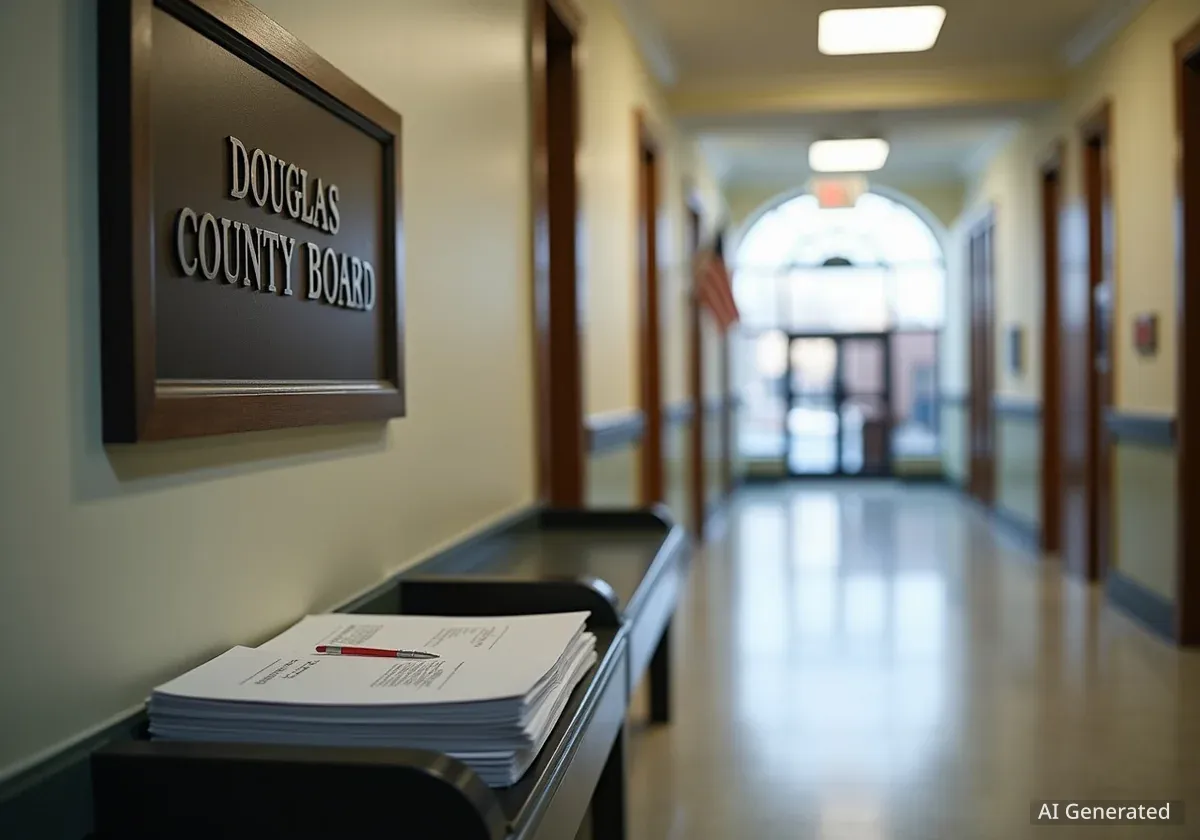



A majority of the Douglas County Board has rejected a proposal from Sheriff Aaron Hanson to rent space in the county jail to U.S. Immigration and Customs Enforcement (ICE) for detaining immigrants. In a joint statement, four of the seven board members cited humanitarian concerns and questioned the financial viability of such a contract.
Key Takeaways
- A four-member majority on the Douglas County Board opposes contracting jail space to ICE.
- Sheriff Aaron Hanson argued the plan would generate revenue and keep detainees closer to their families in Omaha.
- Board members and advocacy groups raise concerns about profiting from detention and the impact on local communities.
- There is a factual dispute over the jail's capacity, with the sheriff claiming low numbers and the corrections director reporting a steady increase.
Board Majority Voices Strong Opposition
The proposal, introduced by Sheriff Aaron Hanson, was met with a firm refusal from a controlling majority of the Douglas County Board, which also serves as the Board of Corrections. Board Chair Roger Garcia, along with Commissioners Chris Rodgers, Jim Cavanaugh, and Brian Fahey, co-signed a statement on Friday making their position clear.
“We will not support any expansion of immigration detention at the Douglas County Jail,” the commissioners stated. They argued that the focus should be on federal-level solutions rather than local contracts that they believe cause harm.
The statement emphasized a preference for comprehensive immigration reform, calling it an approach that “requires coalition-building and advocacy at the federal level, not contracts that perpetuate harm.”
Background on the Proposal
The discussion follows a recent immigration raid in Omaha. On June 10, a raid at Glenn Valley Foods resulted in the detention of nearly 80 undocumented workers. According to Sheriff Hanson, most of these individuals were transported to a facility in North Platte, approximately four hours away, which has an existing contract with ICE.
Economic and Humanitarian Arguments Clash
The debate over the proposal involves conflicting views on its financial and humanitarian implications. Sheriff Hanson presented the plan as a potential source of significant revenue for the county, while opponents argue it is morally and economically unsound.
Sheriff Hanson's Financial and Logistical Case
Sheriff Hanson suggested the contract could provide a new revenue stream to reinvest in his department, offer tax relief, and improve public safety. He also framed the proposal as a humane alternative for detainees from the Omaha area.
He argued that a local facility would allow detainees to remain close to their families and access Omaha's “premier healthcare system, legal and support services.” He urged the County Board to schedule a public hearing on the matter, stating, “This should be on an agenda in which people can come and voice their opinion pro or con.”
The Board's Counterarguments
The opposing board members questioned the financial logic of the proposal. They noted that the daily cost to house an inmate at the Douglas County Jail is $220. This figure is substantially higher than the $175 per diem rate ICE currently pays to nearby counties.
While Hanson believes Douglas County is in an “enviable position” to negotiate a more favorable rate, the commissioners remained unconvinced. Their statement focused on the human cost, describing detainees as “mothers, fathers and workers” who are “essential” to the local economy.
National Detention Statistics
In their statement, the commissioners cited a national statistic, noting that 72% of individuals detained by ICE have no criminal history. They argued that detaining these residents “does not make us safer; it only deepens fear, trauma and economic loss across our communities.”
Dispute Over Jail Capacity
A key point of contention is the current capacity of the Douglas County Jail. In an October 7 memo, Sheriff Hanson claimed the facility was operating at a “historic low capacity,” suggesting ample space was available for federal detainees.
However, this claim was directly contradicted by the Director of Douglas County Corrections, Michael Myers. In a statement released through a county spokesperson, Myers reported that the jail population has been rising steadily since late 2024.
- The incarcerated population stood at 1,101 as of Friday.
- This is an increase from 914 inmates in December 2024.
- Projections show the jail is on pace to process approximately 1,500 more inmates this year compared to the 15,500 individuals booked in the previous year.
This data suggests that the jail may not have the surplus capacity the sheriff's proposal assumes.
Advocacy Groups Denounce the Plan
Local legal and civil rights organizations that have been assisting workers from the Glenn Valley raid have strongly condemned the sheriff’s proposal. They argue that expanding detention capacity would harm immigrant communities, regardless of the facility's location.
“Immigration detention should never be a business model. The Douglas County sheriff’s proposal to profit from detaining immigrants is deeply troubling, especially at a time when fear and uncertainty are already at an all-time high.”
Cortes-Mills dismissed the idea that the plan was about providing better access to services, stating, “It’s about expanding detention in Nebraska and profiting from an administration intent on dehumanizing immigrants.”
The American Civil Liberties Union (ACLU) of Nebraska also voiced its opposition. Mindy Rush Chipman, the organization's executive director, cautioned against what she called the “illusion” that a closer facility would be beneficial.
“We all need to push back against the concept this is happening anyway, so we might as well get paid for it,” Rush Chipman said. She argued that an increased ICE presence and detention capacity would likely lead to more “unlawful detentions and liability to the county itself.”
Despite the widespread opposition, Sheriff Hanson maintains that the proposal deserves public discussion. “The biggest thing I’m trying to promote here is dialogue,” he said, framing the issue as a way to find a local solution for the reality of federal detention.