
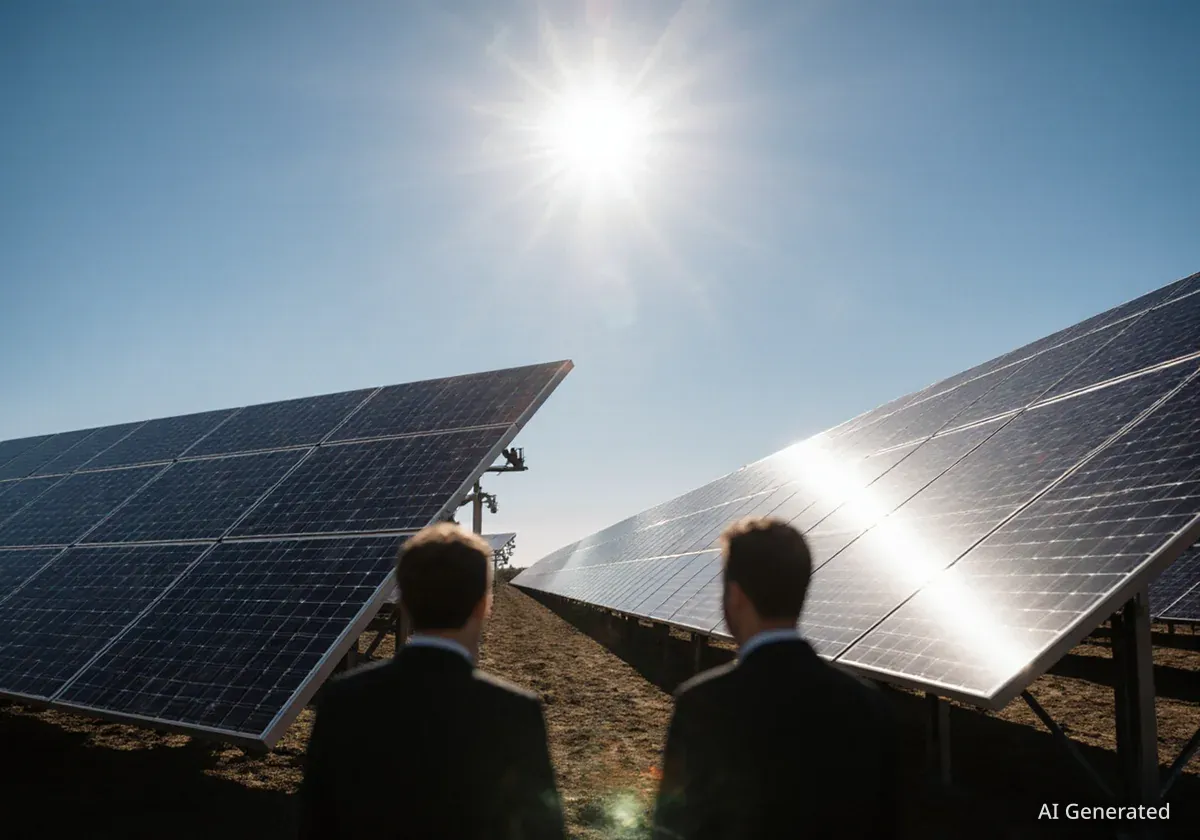




Shares of major Chinese solar panel manufacturers experienced a significant rally on Wednesday, driven by local media reports that a team associated with Elon Musk recently toured several photovoltaic suppliers in the country. The news ignited market speculation about potential high-profile partnerships and increased demand for advanced solar technologies.
Key Takeaways
- Shares of Chinese solar companies, including JinkoSolar and Jolywood, surged up to their 20% daily limit.
- The rally followed reports that a team from Tesla and SpaceX visited Chinese suppliers focusing on next-generation solar technology.
- The visit aligns with Elon Musk's recent announcement of plans to build 100 gigawatts of solar cell capacity in the United States.
- Analysts suggest the market reaction is based on a broader narrative about the energy needs of AI, rather than confirmed business deals.
Market Reacts to High-Profile Interest
The Chinese solar sector saw a dramatic uptick in stock prices Wednesday morning. The surge was led by some of the industry's largest players after reports circulated about a visit from a delegation linked to Elon Musk's companies, Tesla and SpaceX.
JinkoSolar, one of the world's largest solar panel producers, saw its shares jump by as much as 20%, reaching the daily trading limit. Another company, Jolywood Suzhou Sunwatt, which produces photovoltaic auxiliary materials, also experienced a 20% spike in its share price. The positive momentum was felt across the industry.
By the Numbers: Wednesday's Solar Surge
- JinkoSolar: +20% (Daily Limit)
- Jolywood Suzhou Sunwatt: +20% (Daily Limit)
- Trina Solar: +8.9%
- Shenzhen Topraysolar: +10%
- CSI All Share Solar Power Equipment Sub-Industry Index: +6.8%
According to reports from state-backed media outlet Cailianshe, the visiting team represented both Tesla and SpaceX. Another outlet, 21st Century Business Herald, reported that JinkoSolar confirmed it had hosted a team sent by Musk but did not provide further details on the nature of the discussions or any potential business outcomes.
Focus on Next-Generation Solar Technology
The delegation's interest was reportedly not on standard solar panels but on the cutting edge of photovoltaic innovation. The team was said to have met with companies involved in various stages of the supply chain, including equipment manufacturing, silicon wafers, and battery modules.
A key area of focus was on companies developing advanced solar cell technologies. Specifically, the visitors showed significant interest in two emerging approaches:
- Heterojunction (HJT) Technology: This method combines different types of silicon to create a more efficient solar cell that can capture more energy from sunlight.
- Perovskite Technology: Perovskites are a class of materials that have shown immense promise for creating highly efficient and potentially cheaper solar cells, although manufacturing challenges at scale remain.
This focus on next-generation solutions aligns with a broader industry push to move beyond the efficiency limits of traditional solar panels and to lower the overall cost of solar energy production.
The Broader Context: Musk's Solar Ambitions
The timing of the visit is noteworthy. During a Tesla earnings call last week, Elon Musk highlighted the significant potential of solar energy. He announced plans to build 100 gigawatts of solar cell production capacity in the U.S.
"The solar opportunity is underestimated," Musk stated during the call.
This statement, combined with the visit to Chinese suppliers, has fueled speculation that his companies are actively exploring partnerships and supply chains to achieve this ambitious goal.
Analyst Perspective: Narrative Over Fundamentals
While the market's reaction was swift and decisive, some financial analysts are urging caution. They suggest the rally is more about a compelling narrative than it is about a fundamental shift in the companies' order books.
Ke Zong, a portfolio manager at a Shanghai-based quantitative fund, explained that the market is connecting Musk's interest in solar to the massive energy requirements of artificial intelligence. "Musk’s apparent interest in solar has been read as a signal that tech giants are moving upstream into power," Zong said. He characterized the stock movement as being driven by "momentum trading and short-covering" rather than confirmed new business.
This perspective is shared by others who point to the existing challenges within the solar industry. China's dominance in global solar manufacturing has led to a massive supply glut, which has driven down prices and squeezed profit margins for many producers.
Cheng Wang, an equity analyst at Morningstar, noted that following this latest rally, many solar stocks could now be considered "fully valued or overvalued." While maintaining a positive long-term outlook for the sector, Wang expressed skepticism about the immediate impact of any potential deal with Musk's companies.
He argued that even if Chinese suppliers were to secure contracts related to space-based solar for SpaceX, the revenue would likely be minimal. "The scale of space-based solar PV is likely to remain negligible compared with terrestrial installations until the cost of deploying panels into space becomes economically viable," Wang explained.
An Industry at a Crossroads
The intense market reaction highlights a critical moment for the global solar industry. Despite facing headwinds from oversupply and intense price competition, the sector is also on the verge of significant technological advancements with HJT and perovskite cells.
In response to the challenging domestic market and U.S. tariffs, leading Chinese manufacturers like JinkoSolar have been expanding their production capabilities overseas. JinkoSolar operates a factory in Florida and has plans to build over 12 gigawatts of capacity in Southeast Asia by 2030.
The visit from a team linked to one of the world's most prominent technology entrepreneurs has, for now, injected a powerful dose of optimism into the market. Whether this optimism translates into tangible, long-term contracts and a fundamental reshaping of the industry remains to be seen.