
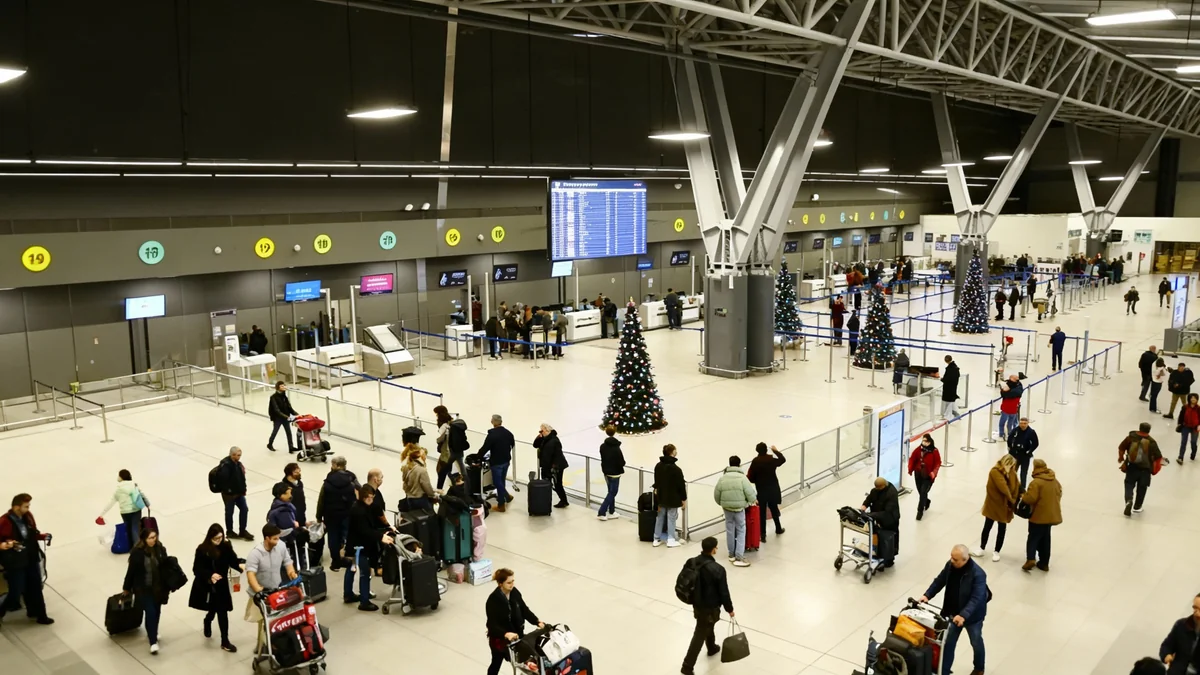




A widespread communications failure over Greece on Sunday led to the temporary closure of the country's airspace, causing significant travel disruption across Europe. Thousands of passengers have been left stranded as flights were cancelled, delayed, or diverted, with authorities working to identify the root cause of the technical breakdown.
The incident, which began Sunday morning, affected major hubs including Athens and led to the complete closure of Thessaloniki's airport. While some departure services have slowly resumed, inbound air traffic remains severely restricted, creating a logistical challenge for airlines and travelers at the end of a busy holiday period.
Key Takeaways
- A technical failure in the air traffic control radio system caused a near-total shutdown of Greek airspace on Sunday.
- Thousands of passengers are stranded across Europe due to widespread flight cancellations, delays, and diversions.
- Athens International Airport is severely impacted, with over 90 flights affected, while Thessaloniki airport was forced to close completely.
- An initial investigation suggests the failure of a critical communications antenna may be the cause of the outage.
Widespread Travel Chaos Unfolds
The system failure created immediate and far-reaching consequences for air travel. At Athens International Airport, one of the region's busiest hubs, more than 90 flights were directly impacted. While officials later managed to restore limited departure capacity, allowing approximately 35 aircraft per hour to take off, the airport remained closed to most inbound flights.
The disruption rippled across the continent. Flights en route to Greece from cities like Dublin, Barcelona, and Paris were instructed to turn back to their airports of origin. Services scheduled from Copenhagen and Malta were cancelled outright, leaving passengers with little information on alternative arrangements. Many inbound flights that were already in the air were diverted to airports in neighboring Turkey.
The situation was also critical at other Greek airports. On the island of Crete, three flights from Heraklion airport experienced significant delays. The timing of the event has amplified its impact, occurring as many travelers were returning from winter holidays.
By the Numbers
- 90+ flights: The number of services affected at Athens International Airport alone.
- 600+ flights: The typical daily number of scheduled flights for Athens during this busy travel season.
- 35 departures per hour: The limited capacity restored at Athens airport following the initial shutdown.
Pinpointing the Cause of the Outage
The core of the problem lies within the critical communication system used by air traffic controllers to safely manage aircraft. Panagiotis Psarros, the chair of the Association of Greek Air Traffic Controllers, described a sudden and complete loss of contact.
"We could not communicate with aircraft in the sky," Psarros stated, explaining that all radio frequencies were "suddenly lost."
This failure effectively blinded controllers, making it impossible to guide planes, which prompted the immediate decision to halt arrivals and departures to ensure safety. The Greek security services have launched an investigation into the incident.
Early reports from the investigation point towards a potential hardware failure. It is believed that an antenna located in the Gerania Mountains, a key component of the air traffic communication network near Athens, may have malfunctioned. Technicians are working to confirm this and restore full functionality to the system. In the interim, neighboring countries including Italy, Turkey, and Cyprus are providing assistance to help manage the airspace around Greece.
Passengers Face Uncertainty and Frustration
Amid the technical chaos, travelers on the ground have expressed growing frustration over the lack of clear communication from airlines and airport authorities. Many were left waiting for hours with no information about when, or if, their flights would depart.
One passenger at Athens International Airport, who was scheduled to fly to London for work, highlighted the personal cost of the disruption. "I'm working on Newport Hospital tomorrow morning. I'm not going to be there on time," she said. "Who is going to pay for the additional cost this travel will cost me? We still don't know if and when we're going to leave."
A Critical Time for Air Travel
The disruption occurred at the end of a peak travel period, with many people returning from winter holidays. Athens International Airport typically handles over 600 flights per day, and the sudden shutdown created a significant backlog that could take days to clear, even after the system is fully restored.
Another traveler, whose flight to Rhodes was forced to return to Athens shortly after takeoff, reported a complete information vacuum. "From that moment until now we have no information whatsoever," the passenger told a news agency. This sentiment was echoed by others who found their flight details had disappeared from departure boards, leaving them in a state of uncertainty.
While domestic travelers may have the option of using Greece's rail network, this alternative is significantly slower and does not help international passengers attempting to return home. As airlines work to reschedule flights and manage the backlog, travelers are advised to check directly with their carriers for the latest updates before heading to the airport.