
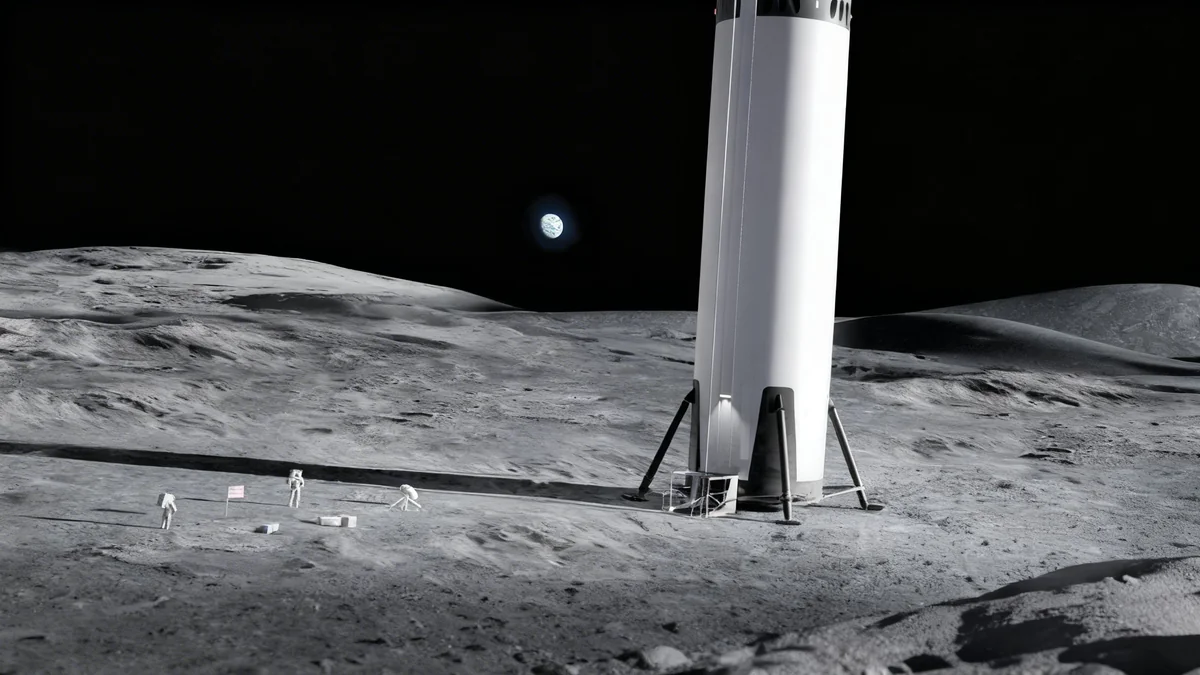
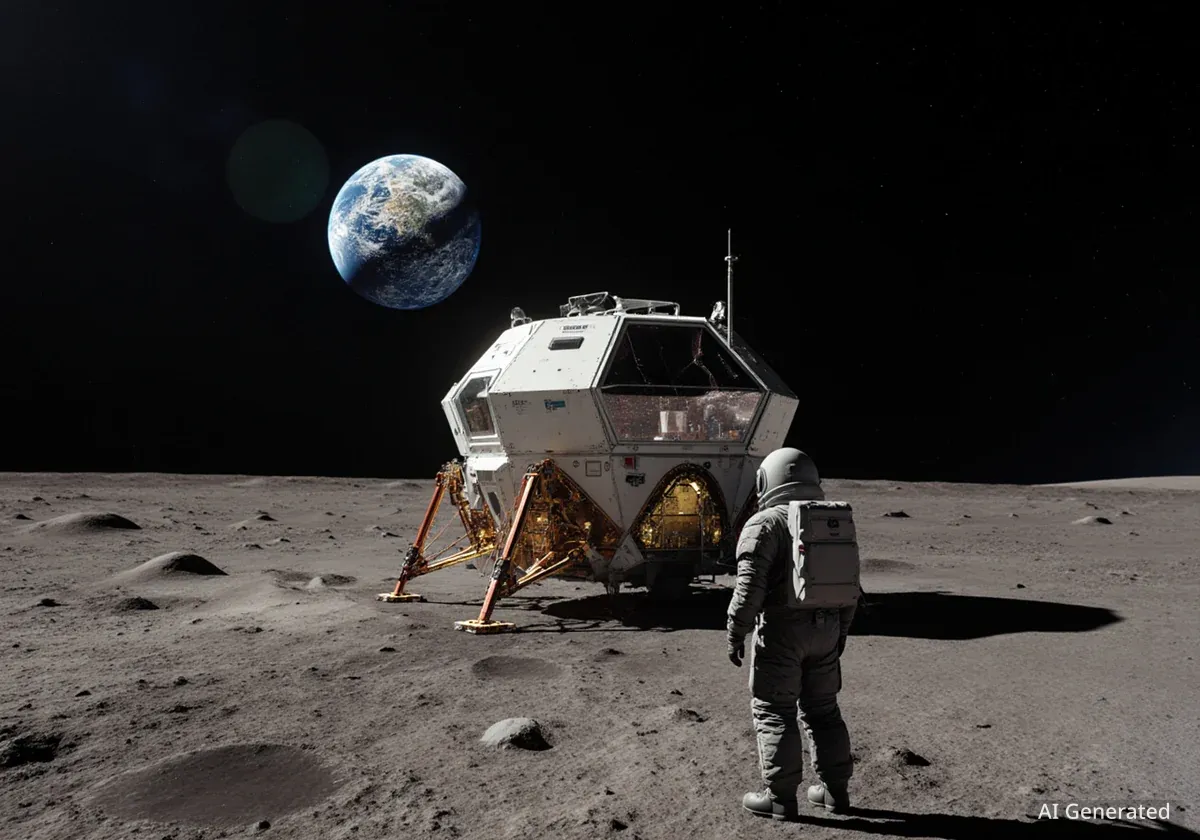


SpaceX is pivoting its immediate colonization efforts from Mars to the Moon, a significant strategy shift for the company long defined by its Red Planet ambitions. CEO Elon Musk announced the change, stating that a self-sustaining lunar city could be established in under a decade, a far quicker timeline than the 20-plus years projected for a similar settlement on Mars.
The decision is driven by logistical advantages and concerns over the long-term viability of a distant Martian colony. This new focus aligns SpaceX's commercial goals more closely with its ongoing partnership with NASA's Artemis program, which aims to return humans to the lunar surface.
Key Takeaways
- SpaceX is now prioritizing the establishment of a self-growing city on the Moon over Mars in the short term.
- Elon Musk cites a faster development timeline, estimating a Moon base is achievable in less than 10 years, compared to over 20 for Mars.
- The Moon's proximity allows for more frequent launches (every 10 days) and shorter travel times (2 days), enabling faster problem-solving.
- Concerns about a potential catastrophe on Earth severing supply lines to a distant Mars colony influenced the decision.
- Mars remains a long-term goal, with efforts expected to run in parallel starting in approximately five to six years.
A New Lunar Focus
For years, Elon Musk has been clear that the primary mission of SpaceX, founded in 2002, was to make humanity a multi-planetary species by settling Mars. However, recent statements from the CEO have revealed a major adjustment to this roadmap. The Moon, once described as a potential distraction, is now the primary target.
In a series of posts on the social media platform X, Musk outlined the new direction. "For those unaware, SpaceX has already shifted focus to building a self-growing city on the moon, as we can potentially achieve that in less than 10 years, whereas Mars would take 20+ years," he explained.
This change represents a pragmatic approach to interplanetary settlement, prioritizing a closer, more accessible celestial body to develop the necessary technologies and infrastructure for off-world living.
The Logic of Logistics and Risk
The reasoning behind the pivot is rooted in simple logistics and risk management. Travel to Mars is constrained by planetary alignment, allowing for a launch window only once every 26 months. The journey itself takes approximately six months.
In contrast, the Moon is a mere two-day trip, with launch opportunities arising roughly every 10 days. This frequency is critical for development. "This means we can iterate much faster to complete a moon city than a Mars city," Musk noted.
Planetary Launch Windows
The 26-month interval between Mars launch opportunities is due to the orbits of Earth and Mars around the Sun. Spacecraft must be launched on a trajectory that allows them to efficiently intercept Mars at its closest point. The Moon's orbit around Earth makes it a consistently available destination, dramatically reducing wait times for missions.
Beyond speed, Musk expressed a deeper concern driving the strategic shift: the fragility of a fledgling off-world colony dependent on Earth.
"The priority shift is because I'm worried that a natural or manmade catastrophe stops the resupply ships coming from Earth, causing the colony to die out," he wrote. "We can make the moon city self-growing in less than 10 years, but Mars will take 20+ years due to the 26-month iteration cycle. That is what matters most."
Starship and the Artemis Connection
Central to both the lunar and Martian plans is SpaceX's Starship, the massive, fully reusable rocket designed to carry unprecedented amounts of cargo and crew into deep space. The company is already under contract with NASA to develop a version of Starship as the human landing system for the Artemis program.
Starship is slated to land astronauts on the Moon for the first time since the Apollo era during the Artemis 3 mission, currently targeted for 2028. This existing partnership provides a foundational framework for SpaceX's expanded lunar ambitions.
Starship's Development Path
To date, the Starship system has undergone 11 suborbital test flights from its facility in South Texas. Key milestones still ahead include achieving a successful orbital flight and demonstrating in-space propellant transfer. This refueling capability is essential for lunar missions, as it will require multiple tanker flights to fill Starship's tanks in Earth orbit before it can journey to the Moon.
Musk envisions lunar factories that could use local resources to manufacture satellites, potentially deploying them into deep space using an electromagnetic mass driver. This long-term vision aims to harness a significant portion of the sun's energy, advancing humanity on the Kardashev scale, a method of measuring a civilization's technological advancement based on energy consumption.
Mars is Delayed, Not Canceled
Despite the new emphasis on the Moon, SpaceX has not abandoned its ultimate goal of reaching the Red Planet. Musk clarified that the timeline has simply been adjusted, with the Moon serving as a crucial stepping stone.
"Mars will start in 5 or 6 years, so will be done in parallel with the moon, but the moon will be the initial focus," he stated. In another post, he suggested a crewed flight to Mars could still be possible as early as 2031.
This parallel approach suggests that lessons learned and technologies proven on the Moon will directly inform and de-risk the more challenging and ambitious Mars settlement program. By first establishing a permanent and self-sufficient presence nearby, SpaceX aims to build a more resilient foundation for humanity's future in the cosmos.