
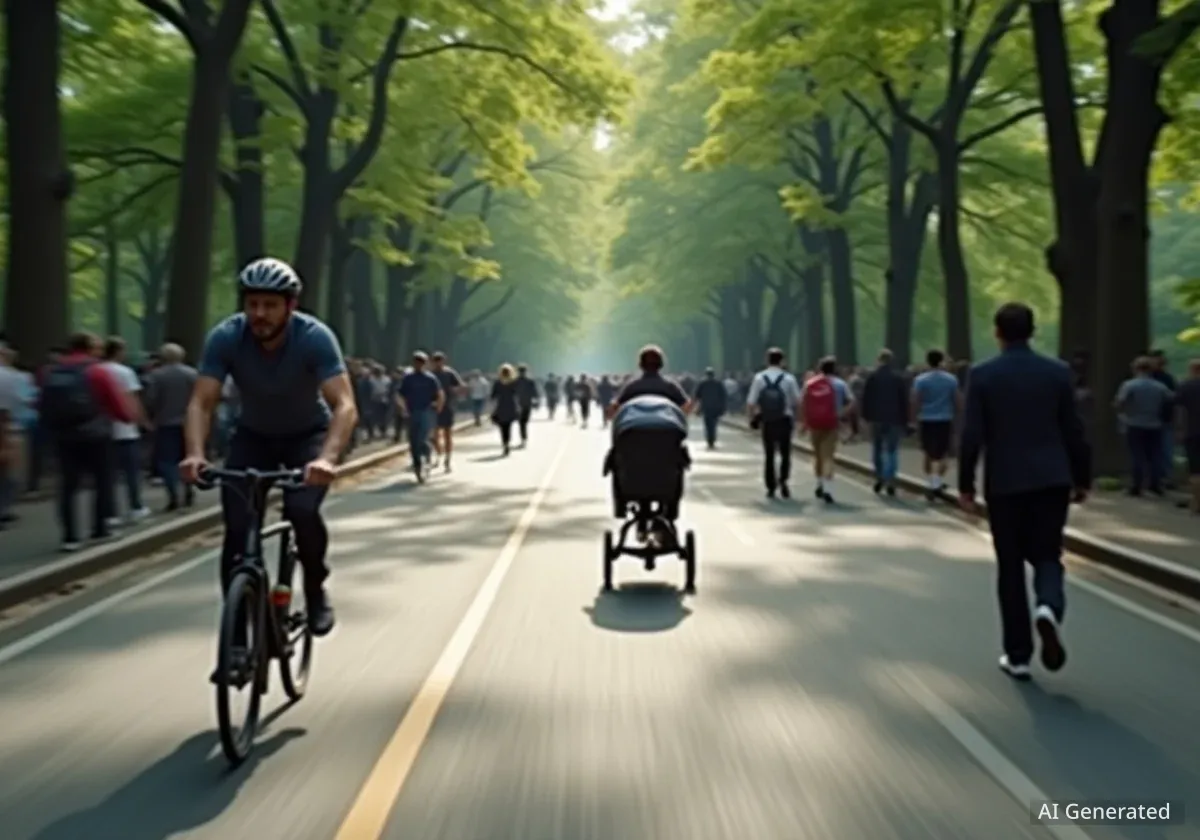

Central Park's iconic drives, once a haven for leisurely strolls and traditional cycling, are now at the center of a growing conflict over public space. The proliferation of high-speed electric bikes, particularly those used by commercial delivery workers, has created a chaotic and hazardous environment, leading to increased accidents and raising urgent safety questions for millions of park visitors.
The issue was highlighted by a serious incident in the spring of 2023, when cyclist Carrie Michaels was struck by a delivery worker on an e-bike. The collision resulted in a six-hour hospital stay and a months-long recovery, forcing her to reconsider using the park's main loop. Her experience is one of many that advocates and park users are citing as evidence that the current rules are insufficient to manage the new reality of mixed-speed traffic.
Key Takeaways
- Reports of accidents and near-misses involving e-bikes, pedestrians, and traditional cyclists in Central Park are increasing.
- The park's drives serve as a crucial, and often safer, transit route for commercial delivery workers on e-bikes, creating a conflict between recreational and commercial use.
- City officials and park management acknowledge the problem and are exploring solutions, including better enforcement, designated lanes, and speed limits.
- The conflict reflects a broader urban challenge of integrating new micro-mobility options into public spaces designed in a different era.
A New Era of Conflict on Historic Paths
The pathways of Central Park were originally designed by Frederick Law Olmsted and Calvert Vaux as a retreat from the city's commercial bustle. Today, that bustle has found its way onto the park's main drives, fundamentally altering the user experience. The primary source of this change is the rise of electric-powered micro-mobility, from e-bikes to electric scooters.
Traditional cyclists and runners, who typically travel at speeds between 8 and 15 miles per hour, now share the pavement with e-bikes that can easily reach and exceed 25 miles per hour. This speed differential is a significant factor in the rising number of conflicts. Pedestrians, horse-drawn carriages, and tourists often find themselves navigating a high-speed environment they did not anticipate.
The Cyclist's Experience
For many long-time park users, the change is jarring. Carrie Michaels was on her carbon-fiber road bike when her life changed in an instant. "One moment I was enjoying the ride, and the next I was on the pavement bleeding," she recalled. "It happened so fast. Someone was telling me not to move."
Her recovery was long and difficult, and the psychological impact remains. "I'm hesitant to ride the loop now," Michaels stated. "You have to be constantly on high alert. It's not the relaxing escape it used to be." Her story is not unique, as cycling groups and online forums are filled with similar accounts of close calls and collisions.
A Design from a Different Time
Central Park's loop was designed in the 19th century for horse-drawn carriages and pedestrians. While it has adapted over the decades to accommodate automobiles and then bicycles, it was never engineered for the mix of high-speed and low-speed traffic that exists today. This historical context is central to the current safety challenges.
The Perspective of E-Bike Riders
While many view e-bikes as a problem, for thousands of New Yorkers, they are an essential tool for their livelihood. Delivery workers, in particular, rely on e-bikes to navigate the city quickly and efficiently. For them, Central Park's drives are not just recreational paths but critical transportation corridors.
Using the park allows riders to bypass congested city streets, traffic lights, and dangerous intersections. For a worker paid per delivery, time is money, and the park offers the fastest route between the Upper West Side and Upper East Side. Many riders argue they are being unfairly targeted for using the most logical and often safest route available to them.
"We are just trying to make a living," said one delivery worker who asked not to be named. "The streets are dangerous with cars. In the park, it is more open. We try to be careful, but we have to be fast to get orders delivered on time."
This highlights a fundamental tension: the park as a place of leisure versus the park as a place of commerce and transit. The Parks Department has acknowledged this dual role, stating that parks often provide the "most comfortable and scenic routes" for cyclists and that it is committed to finding ways to safely accommodate all users.
E-Bike Growth in NYC
According to city data, the use of e-bikes for food delivery has surged dramatically in recent years. It is estimated that there are over 65,000 delivery workers in New York City, the vast majority of whom use e-bikes to perform their jobs. Their work became even more critical during the COVID-19 pandemic, cementing their role in the city's economy.
Searching for a Sustainable Solution
Finding a solution that respects the needs of all park users is a complex challenge for city officials and the Central Park Conservancy. Several proposals are being debated, each with its own set of benefits and drawbacks.
State Senator Brad Hoylman-Sigal, whose district includes parts of the park, has been a vocal advocate for improved safety measures. He has suggested clearer rules and better enforcement to manage the flow of traffic. "Central Park is the jewel of our park system, but it's become a Wild West on wheels," he commented. "We need a multi-faceted approach to restore a sense of safety."
Potential Safety Measures
Experts and advocacy groups have put forward several potential interventions. These include:
- Dedicated Lanes: Creating separate, clearly marked lanes for high-speed traffic (e-bikes) and lower-speed users (pedestrians, joggers). This is considered effective but may be difficult to implement given the limited width of the drives.
- Speed Limits and Enforcement: Establishing and strictly enforcing a speed limit for all wheeled vehicles. This would require a significant presence of Parks Enforcement Patrol officers or NYPD with speed detection equipment.
- Commercial Use Restrictions: Limiting or prohibiting commercial delivery traffic during peak recreational hours. However, this could negatively impact delivery workers' incomes and push them onto more dangerous city streets.
- Public Awareness Campaigns: Launching educational initiatives to promote shared responsibility and safe practices among all park users.
The Central Park Conservancy, the nonprofit that manages the park, is actively studying traffic patterns to inform its strategy. Their goal is to balance accessibility and safety, ensuring the park remains a welcoming space for everyone, from the tourist taking a carriage ride to the delivery worker completing a route.
A Microcosm of a Larger Urban Debate
The conflict in Central Park is not an isolated issue. Cities across the globe are grappling with how to integrate new forms of micro-mobility into urban infrastructure that was not designed for them. Electric bikes and scooters offer sustainable and efficient transportation alternatives, but their introduction has created new safety challenges on sidewalks, bike lanes, and public parks.
As New York City continues to encourage alternatives to cars, the need for a comprehensive plan for shared public spaces becomes more urgent. The situation in Central Park serves as a critical test case. The solutions developed here could provide a blueprint for how to manage the evolving landscape of urban mobility, ensuring that progress in transportation does not come at the cost of public safety and enjoyment.
For now, users like Carrie Michaels remain cautious. The outcome of these discussions will determine whether Central Park can reclaim its identity as an urban sanctuary or if its paths will remain a contested frontier in the city's ongoing transportation evolution.