
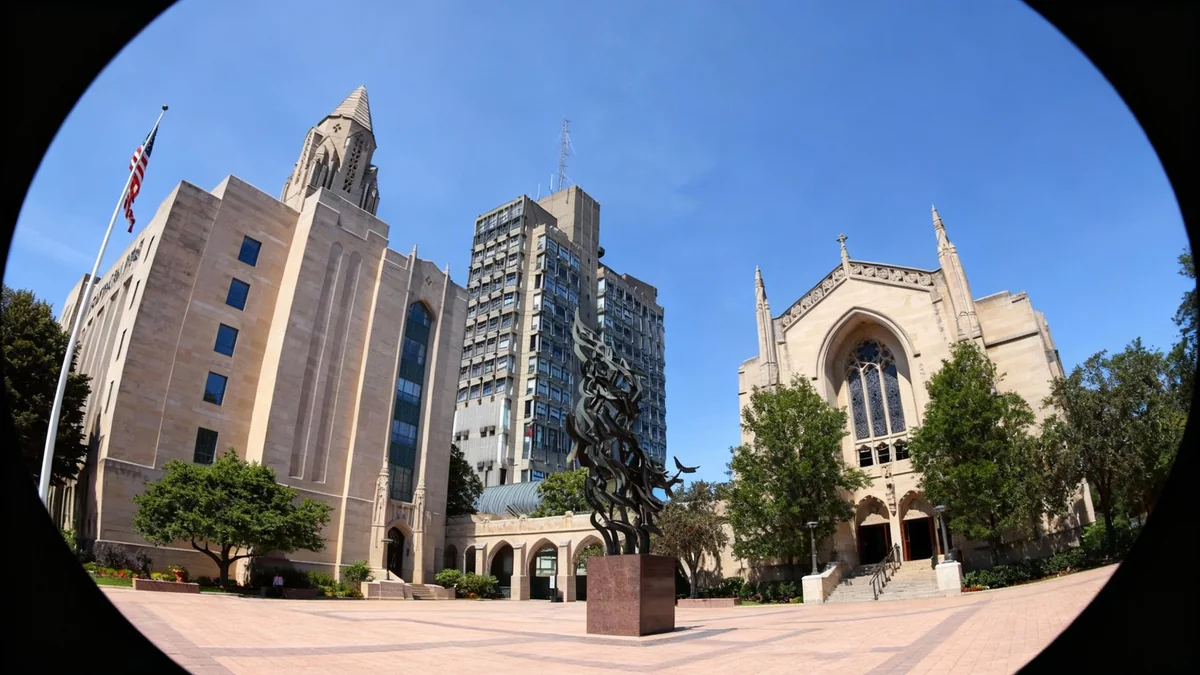
On college campuses across the country, the discourse surrounding the Israeli-Palestinian conflict has become increasingly polarized, leaving students who advocate for a two-state solution feeling politically isolated. At institutions like Boston University, students who support both Israeli and Palestinian statehood find themselves caught between two seemingly irreconcilable political camps, struggling to find space for a middle-ground perspective.
This growing divide highlights a significant challenge in academic environments, where nuanced conversations are being replaced by zero-sum arguments from both the political left and right. The result is a campus climate where dialogue breaks down over fundamental disagreements on facts and historical narratives, leading to social alienation for those who refuse to pick a side.
Key Takeaways
- Students supporting a two-state solution report feeling isolated on college campuses amid rising polarization.
- Discussions are often stalled by fundamental disagreements over historical facts and the viability of peace initiatives.
- Both pro-Israel hardliners and anti-Zionist activists frequently view the conflict as a zero-sum game, rejecting compromise.
- This ideological rift contributes to social isolation and makes constructive dialogue about peace in the Middle East increasingly difficult.
A Shrinking Middle Ground
For students who identify as Zionist while also supporting Palestinian rights, navigating campus life has become a complex balancing act. Oliver Zinn, a recent history graduate from Boston University, describes his experience as that of a "political outcast." He has found it difficult to engage with peers on either side of the political spectrum who share his belief in a two-state solution as the most viable path to peace.
This challenge is not unique to one university but reflects a broader national trend. Since the events of October 7, 2023, campus divisions have deepened, making it harder for moderate viewpoints to gain traction. The core of the problem often lies in an inability to agree on a shared set of facts, which serves as the foundation for any meaningful discussion.
The Two-State Solution Framework
The two-state solution is a proposed framework to resolve the Israeli-Palestinian conflict by establishing an independent State of Palestine alongside the State of Israel. It is based on the United Nations Partition Plan of 1947 and is generally understood to mean Israel within its pre-1967 borders, with the Palestinian state comprising the West Bank and Gaza Strip.
Dialogue with the Political Right
Attempts to discuss the conflict with right-leaning student groups have revealed deep-seated views that often preclude compromise. During a Boston University College Republicans meeting, Zinn encountered perspectives that he found alarming. One student reportedly expressed a desire for the forcible relocation of Palestinians from Gaza, coupling the statement with jokes that suggested Arabs were less deserving of moral consideration.
Another student, while expressing hope for an eventual Palestinian state, argued that Israel's occupation must continue indefinitely due to what she described as Arab rejectionism. When presented with evidence to the contrary, such as the Palestinian Authority's decades-long support for a two-state solution and the 2002 Arab Peace Initiative, the information was dismissed.
"The 2002 Arab peace initiative sets the enactment of that solution — along with some compromise on issues surrounding Palestinian refugees — as the Arab world’s only prerequisite for recognizing the Jewish state."
This interaction highlights a critical barrier to dialogue: the rejection of sources and facts that challenge a pre-existing narrative. When basic historical events and political proposals cannot be agreed upon, conversation becomes impossible.
Engagement with the Political Left
Conversations with peers on the political left have presented a different, yet equally challenging, set of obstacles. While these discussions have often been more frequent and less confrontational, they too are marked by a rejection of the two-state framework.
Many anti-Zionist students and activists view the conflict through a lens of decolonization. They advocate for a single, unified state where Israel's distinct Jewish identity would be dissolved. One student argued that just as European colonizers left Africa, Jewish "settler-colonialists" in Israel should do the same. When challenged on the violent history of decolonization, the student suggested that many Jews would leave voluntarily rather than live as a minority in an Arab-majority nation.
Public Opinion on a Two-State Solution
While support has fluctuated, public opinion polls have historically shown significant backing for a two-state solution. A 2012 poll indicated that a slight majority of Palestinians in the occupied territories supported the Arab Peace Initiative. Though support has waned amid ongoing conflict and political stagnation, a notable minority of Palestinians still favor this outcome.
This perspective frames the conflict as a zero-sum game, where Palestinian statehood can only be achieved at the expense of Israel's existence as a Jewish state. This fundamentally aligns with the hardline right-wing view, though with the opposite preferred victor. For supporters of a two-state solution, this leaves no room for a compromise that would grant both peoples national self-determination.
The Social Cost of a Moderate Stance
The inability to find common ground has tangible consequences for students like Zinn. The most painful outcome, he notes, is a persistent feeling of social isolation. Being alienated by both the left and the right for holding a nuanced position is a lonely experience, and one that research suggests has become more common on campuses since October 7.
This environment discourages open dialogue and pushes individuals toward ideological silos. The pressure to conform to an all-or-nothing viewpoint can stifle the very kind of critical thinking and debate that universities are meant to foster.
Despite the challenges, the search for a middle ground continues. For those who believe in a future where Israelis and Palestinians can coexist peacefully in separate, secure states, the effort to foster sane conversations between people with divergent views remains critical. The belief in peaceful coexistence, though tested, is seen by these students as more important than ever.