
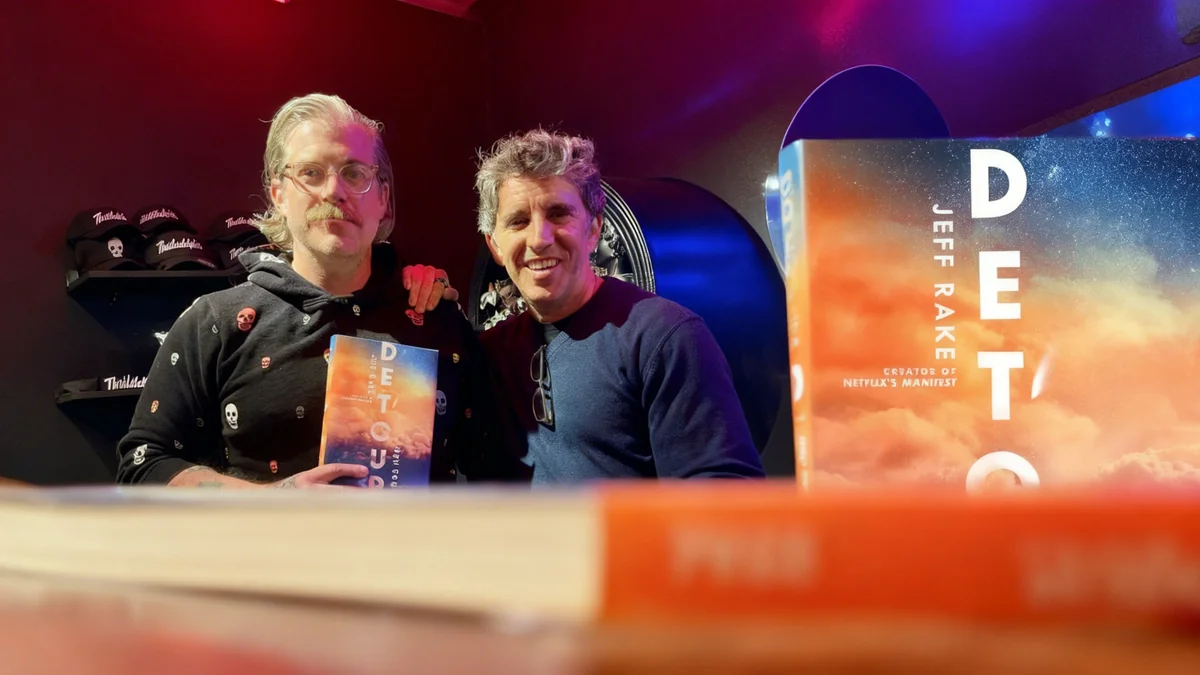




A new science fiction novel, "Detour," explores the unsettling premise of astronauts returning from a mission to Saturn's moon, Titan, only to find an Earth they no longer recognize. The book is a collaboration between Jeff Rake, creator of the hit show "Manifest," and bestselling author Rob Hart, who combined their talents to ground a high-concept thriller in human emotion and family drama.
The story, which blends elements of mystery and suspense, follows a flight crew as they navigate a world that has subtly but profoundly changed during their time in space. The project began as an idea for a television series before evolving into a novel, a process that required a unique partnership between two distinct creative fields.
Key Takeaways
- "Detour" is a new sci-fi novel by TV writer Jeff Rake ("Manifest") and author Rob Hart ("The Warehouse").
- The plot centers on astronauts returning from Titan to a mysteriously altered Earth.
- The project originated as a TV show concept but was developed as a novel first.
- The authors prioritized character-driven drama and believability over strict scientific accuracy.
- Saturn's moon Titan was chosen as the destination to offer a fresh alternative to Mars in science fiction.
From Television Pitch to Novel
The concept for "Detour" began with Jeff Rake, who was looking for his next major project after the conclusion of his successful series "Manifest." He aimed to develop another idea that combined a grand science fiction mystery with a grounded, emotional story about family.
"I've been writing TV for about 25 years and was brainstorming high-concept ideas that could be a potential sci-fi show,” Rake explained. He landed on the broad strokes of "Detour" and pitched it to his agents.
During the pitching process, an agent suggested the idea felt "novelistic" and proposed developing it as a book first, with a potential television adaptation later. This presented a challenge for Rake, who had no experience writing novels. "That was incredibly intimidating to me. I didn't know how to write a book," he admitted. The solution was to find a writing partner.
The Power of Collaboration
Creative partnerships between television writers and novelists are becoming more common as intellectual property is developed across multiple media formats. This approach allows a story's core concepts to be fully explored in prose before being adapted for the screen, often leading to richer world-building and character development.
Forging a Creative Partnership
The search for a collaborator led Rake to the work of Rob Hart, author of the acclaimed novel "The Warehouse." After reading Hart's book, Rake knew he had found the right person for the project. For his part, Hart was already a fan of Rake's work on "Manifest" and was immediately drawn to the pitch for "Detour."
"The thing that Jeff is so good at, and the thing I love so much, is when you take a really big-swing, crazy sci-fi idea and then humanize it with really strong characters," Hart said. Despite the potential for creative friction, the two found they were on the same wavelength from their first meeting.
"We hopped on a Zoom and just hit it off... I started riffing and hitting him with ideas for things we could do with the story, and he said, 'This sounds awesome, let's do it.' From there, it was pretty much off to the races."
Hart noted that Rake's background in television, a highly collaborative medium, made the process smoother. They quickly established a productive working relationship, blending their respective skills to build out the world and characters of their story.
The Science of Storytelling
To create a believable near-future setting, the authors had to consider the scientific and technological aspects of deep-space travel. The story is set around the year 2030 and involves a mission to Titan, Saturn's largest moon. Hart, a self-described research nerd, took the lead on designing the technology, including the spaceship itself.
"The thing that I was most excited about is I got to design a ship for deeper travel in our solar system," Hart explained. He envisioned a vessel with rotating wheels to generate artificial gravity, a crucial element for maintaining astronaut health on long journeys. An artist was even commissioned to create a rendering of the ship, which is included as a diagram in the book.
Believability Over Accuracy
While research was important, the authors made a conscious decision to prioritize narrative needs over scientific purity. Hart stated, "I always live by this adage that things don't need to be 100% correct, but they do have to be believable within the confines of the story." He humorously added, "If Neil deGrasse Tyson read this book, he would not be thrilled."
The novel's advanced propulsion system, a new type of ion engine, is loosely based on emerging technologies. This fictional leap allows the crew to complete a round trip to Titan in a dramatically shortened timeframe, making the narrative feasible.
Why Titan Instead of Mars?
A key decision in the story's development was choosing Titan as the destination. For decades, Mars has been the default target for stories about humanity's expansion into the solar system. Rake and Hart wanted to explore a different path.
"I've always been a geek about the fact that Mars kind of sucks in terms of colonizing for a bevy of reasons," Rake said. "Whereas Titan is more reasonable for establishing a colony. It was fun to play in that space of like, 'Everybody always does Mars, let's do something different.'"
The book itself includes an excerpt from a fictional paper titled "The Case for Titan," which outlines the scientific arguments for prioritizing the moon over the Red Planet. Key points include:
- Thick Atmosphere: Titan has a nitrogen-rich atmosphere that is 50% thicker than Earth's, providing natural protection from cosmic radiation.
- Abundant Resources: Its surface features plastic-like sand dunes for construction and lakes of ethane and methane that could be used for fuel.
- Reduced Equipment Needs: Colonists would not require heavily shielded, pressurized suits, only temperature-controlled ones to combat the cold.
- Lower Gravity: The weaker gravity would make launching rockets from Titan's surface far more fuel-efficient.
By focusing on Titan, the authors not only distinguish their story from other sci-fi tales but also ground their narrative in a compelling, and scientifically plausible, alternative for future space exploration. This thoughtful world-building provides a rich backdrop for the central mystery and human drama that unfolds when the crew finally returns home.